Forging vs Casting Cost Comparison: Which Is More Economical?
Forging is more economical for high-volume production (10,000+ units) due to lower per-unit costs and durability, while casting is more economical for low-volume, complex shapes due to lower upfront tooling costs. In the hand tools industry, the economic decision typically depends on production volume, alloy grade, mechanical performance requirements, and Total Cost of Ownership (TCO).
For B2B buyers evaluating forging vs casting cost, focusing only on initial piece price often leads to higher lifecycle and warranty expenses.
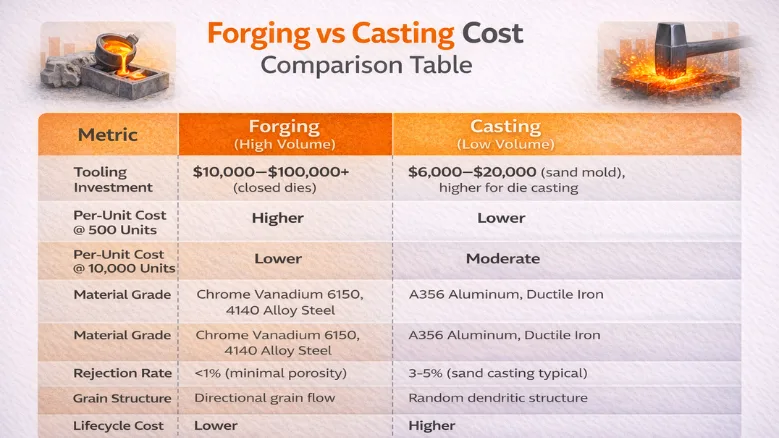
Forging vs Casting Cost Comparison Table
| Metric | Forging (High Volume) | Casting (Low Volume) |
| Tooling Investment | $10,000–$100,000+ (closed dies) | $6,000–$20,000 (sand mold), higher for die casting |
| Per-Unit Cost @ 500 Units | Higher | Lower |
| Per-Unit Cost @ 10,000 Units | Lower | Moderate |
| Material Grade | Chrome Vanadium 6150, 4140 Alloy Steel | A356 Aluminum, Ductile Iron |
| Rejection Rate | <1% (minimal porosity) | 3–5% (sand casting typical) |
| Grain Structure | Directional grain flow | Random dendritic structure |
| Lifecycle Cost | Lower | Higher |
What Are the Primary Cost Drivers in Metal Forging?
Forging reshapes heated metal billets under compressive force using closed dies, making tooling investment, alloy selection, and mechanical performance the primary cost drivers.
1. Tooling & Die Cost
Closed-die forging requires hardened steel dies ranging from $10,000 to over $100,000, depending on geometry complexity. Although capital-intensive, these costs are amortized efficiently in medium- to high-volume production.
2. Material Grades in Forged Tools
Forged hand tools typically use Chrome Vanadium (Cr-V 6150) or 4140 alloy steel, materials selected for high tensile strength, wear resistance, and fatigue durability under torque and impact loading.
3. Grain Flow & Mechanical Strength
During forging, compressive force aligns the metal’s grain structure to follow the tool’s contour. This directional grain flow enhances impact resistance and reduces crack propagation compared to casting’s random dendritic structure.
4. Quality & Rejection Rates
Forging significantly reduces subsurface porosity, resulting in rejection rates typically below 1%, compared to 3–5% commonly observed in sand casting operations.
What Are the Primary Cost Drivers in Metal Casting?
Casting involves pouring molten metal into a mold cavity, where tooling flexibility, material choice, secondary machining, and structural integrity determine overall cost efficiency.
1. Mold & Tooling Cost
Sand casting tooling typically ranges from $6,000 to $20,000, permanent molds from $10,000 to $90,000, and die casting molds exceed $60,000, offering economic flexibility for short production runs.
2. Material Grades in Cast Tools
Common casting alloys include A356 aluminum for lightweight applications and ductile iron for structural components, delivering cost efficiency but generally lower fatigue resistance than forged Cr-V steels.
3. Machining & Finishing
Cast parts often require surface cleanup, dimensional machining, and occasional heat treatment to meet tolerance and strength requirements, increasing secondary processing costs.
4. Porosity & Structural Risk
Casting can introduce air pockets, shrinkage cavities, and internal porosity, increasing rejection rates and reducing fatigue life under repeated impact stress.
Real Per-Unit Cost Example (B2B Scenario)
For a 12-inch adjustable wrench manufactured in Chrome Vanadium steel:
- At 1,000 units, forging averages $8.90 per unit, while casting averages $7.20 per unit.
- At 12,000 units, forging drops to $5.75 per unit, while casting averages $6.50 per unit.
The break-even point typically occurs between 3,000 and 5,000 units, where die amortization offsets higher initial tooling investment.
How Does Production Volume Impact Cost?
Production scale is the most decisive factor in any forging vs casting price comparison because tooling amortization and rejection rates directly influence per-unit economics.
1. Low Volume (Under 1,000 Units)
Casting is generally more economical due to lower upfront tooling investment, reduced capital exposure, and faster setup for specialty or prototype tools.
2. Medium Volume (1,000–10,000 Units)
Forging begins closing the cost gap as die costs are distributed across larger batches, reducing per-unit cost while improving mechanical reliability.
3. High Volume (10,000+ Units)
Forging typically becomes more economical, delivering lower per-unit cost, reduced rejection rates, and minimized warranty exposure in professional tool manufacturing.
Which Process Is More Economical?
The economic choice depends on application risk, production scale, and durability requirements.
Forging is typically more economical for high-volume professional tools due to lower long-term failure rates and superior fatigue resistance. Casting offers advantages for limited production runs or tools requiring complex geometry and rapid design iteration.
Pro Tip for Procurement Managers: If your tool includes a striking face (e.g., hammer or chisel), always choose forging regardless of volume. Forged grain alignment significantly reduces fragmentation risk and liability exposure.
Forging vs Casting: Long-Term Cost Considerations
A proper manufacturing cost comparison must include life cycle economics, as durability and failure rates directly influence long-term procurement costs.
Forged Chrome Vanadium tools maintain structural integrity under repeated stress and resist crack propagation, whereas cast tools are more prone to fatigue fractures in high-impact environments. Lower failure rates reduce warranty claims, field replacements, and distributor friction.
When evaluating Total Cost of Ownership (TCO), procurement teams must consider downtime cost, replacement cycle frequency, and brand-reputation risk. Forged tools frequently justify higher upfront investment through lower lifecycle expenditure.
Industry Standards & Compliance
Professional-grade hand tools must comply with globally recognized manufacturing and performance standards, including:
- ASTM A29 (Alloy Steel Bars)
- ASME B107 / ANSI Hand Tool Standards
Additional applicable standards include ISO 2725 and DIN 3113 for dimensional and torque performance compliance.
Forged tools more consistently meet DIN and ANSI requirements due to superior material density and aligned grain structure, improving torque performance and fatigue life.
Conclusion
In the hand tools industry, the outcome of a forging vs casting cost comparison ultimately depends on production volume and application requirements. Casting is more economical for low-volume, complex designs, while forging becomes more cost-effective beyond approximately 3,000–5,000 units due to die amortization and lower per-unit cost. Beyond pricing alone, forged tools provide superior mechanical strength, reduced defect rates, and stronger lifecycle ROI. For B2B buyers prioritizing durability, compliance, and long-term brand reliability, forging consistently delivers the stronger economic advantage.
FAQ
Forging has higher upfront tooling costs but becomes more economical at volumes above 10,000 units due to lower per-unit cost and reduced rejection rates.
Casting requires lower initial tooling investment and is better suited for small batches and complex shapes.
Yes. Forging aligns grain flow, improving fatigue resistance and impact strength, reducing lifecycle cost.
Forging is typically more cost-effective at high volumes due to die amortization and lower defect rates.
Yes. Forged tools have aligned grain structure and significantly lower porosity, improving durability under impact use.
Related Post
Casting Defects vs Forging Defects: Key Differences, Causes & Prevention
The primary difference between casting defects and forging defects lies in their origin: casting defects, [...]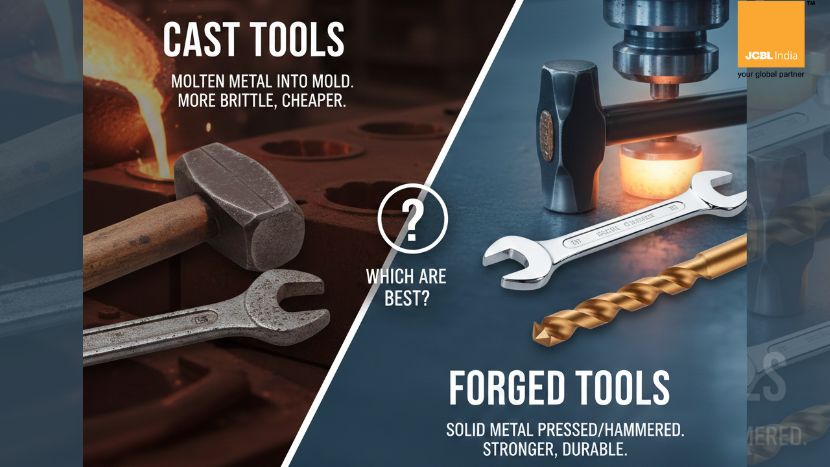
Difference Between Cast and Forged Tools
Forged tools are stronger, more durable, and better suited for high-impact and heavy-duty applications, while [...]