Bearing Pullers: Types, Benefits & Maintenance Guide
- What Is a Bearing Puller?
- Types of Bearing Pullers
- How Does a Bearing Puller Work?
- Quick Comparison: Types of Bearing Pullers
- Detailed Breakdown of Bearing Removal Tools
- Internal vs. External Bearing Pullers: Understanding the Difference
- How to Choose the Right Bearing Puller
- Benefits of Using Professional Bearing Pullers
- Maintenance and Storage Tips for Longevity
- Final Verdict
- FAQs
Removing a stuck bearing without the right tool can damage shafts, housings, gears, or nearby machine components. Many mechanics still rely on hammers, heat, or cutting methods, but these approaches increase the risk of misalignment and costly repairs.
A bearing puller is designed to remove bearings safely, accurately, and with controlled force. Whether you work in automotive repair, industrial maintenance, manufacturing, or DIY mechanical projects, using the correct bearing removal tool helps reduce downtime and protects equipment.
What Is a Bearing Puller?
A bearing puller is a specialized mechanical or hydraulic tool used to safely remove press-fitted components—such as bearings, gears, couplings, and pulleys—from a shaft or inside a housing without damaging the machine parts.
Bearings naturally wear out over time due to friction, heat, heavy load pressure, contamination, and lack of lubrication. When bearings seize, manual forced extraction can warp the shaft. A proper bearing remover applies even, axial pulling force, making extraction safer and more precise.
- Automotive Use: Wheel bearing pullers are essential for hub, axle, and transmission repairs.
- Industrial Use: Heavy-duty pullers maintain pumps, electric motors, conveyors, and rotating machinery.
Types of Bearing Pullers
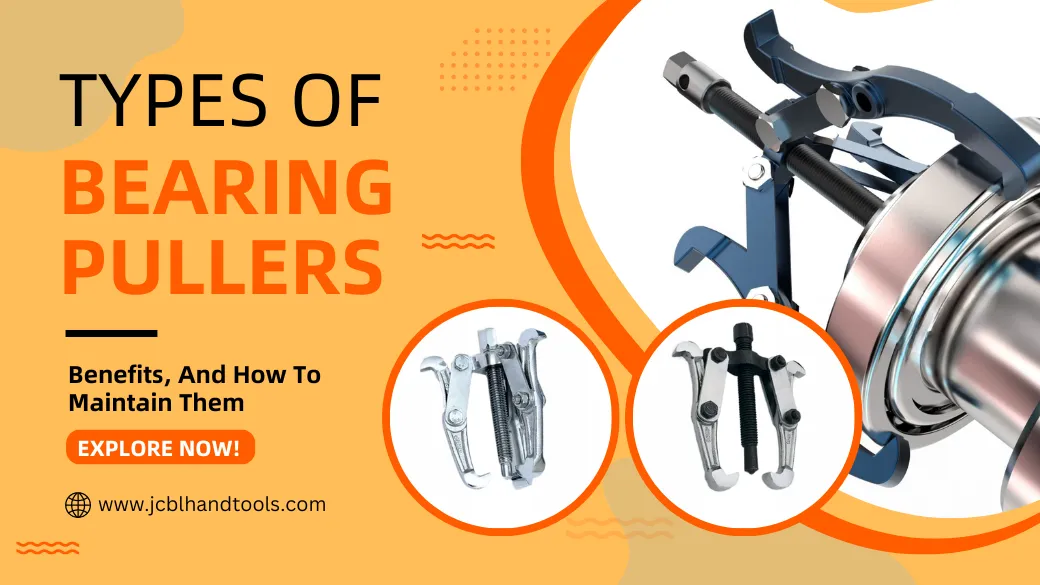
The main types of bearing pullers include two-jaw pullers, three-jaw pullers, hydraulic pullers, blind pullers, internal pullers, and external pullers. Each type is designed for different bearing sizes, spaces, and removal applications.
- Two-Jaw Bearing Puller – Ideal for small bearings and tight spaces with limited access.
- Three-Jaw Bearing Puller – Offers better grip and balanced force for standard bearing removal tasks.
- Hydraulic Bearing Puller – Uses hydraulic pressure to remove large, heavy, or seized bearings safely.
- Blind Bearing Puller – Designed for extracting bearings installed inside recessed or blind holes.
- Internal Bearing Puller – Expands inside the bearing bore to remove bearings from enclosed housings.
- External Bearing Puller – Grips the outer side of the bearing for shaft-mounted bearing removal.
How Does a Bearing Puller Work?
A bearing puller works on the principle of mechanical advantage. It grips the bearing component securely while applying a controlled, counter-active pulling pressure through a threaded central spindle or hydraulic ram.
Step-by-Step Bearing Removal Process
- Select the correct puller size based on the bearing’s diameter and accessibility.
- Position the jaws, arms, or attachments securely around or behind the bearing race.
- Align the central spindle precisely with the center of the shaft.
- Tighten the spindle gradually (using a wrench or hydraulic lever) to apply steady force until the bearing slides off the shaft.
Quick Comparison: Types of Bearing Pullers
| Puller Type | Best Used For | Key Advantage | Force Delivery |
| Two-Jaw Puller | Small bearings, tight spaces | Fast setup, fits compact areas | Manual / Threaded |
| Three-Jaw Puller | Standard & large bearings | Maximum stability, no slipping | Manual / Threaded |
| Hydraulic Puller | Heavy industrial, seized bearings | High tonnage, minimal effort | Hydraulic Ram |
| Blind / Internal Puller | Recessed housings, blind holes | Expands inside the inner race | Slide Hammer / Collet |
Detailed Breakdown of Bearing Removal Tools
1. Two-Jaw Bearing Pullers
A two-jaw bearing puller features two opposing gripping arms mounted on an adjustable cross-beam. It is specifically engineered for extraction tasks where lateral workspace is restricted, making it impossible to fit a third jaw.
- How it works: The two jaws latch onto the outer race or shoulder of the bearing, and the central pressure screw is turned against the shaft to pull the component free.
- Best Used For: Alternator bearings, steering wheels, small electric motors, and compact automotive engine bays.
Advantages
- High Accessibility: Requires clearance on only two sides of the component, making it highly effective in narrow spaces.
- Adjustable Width: The jaws can easily slide along the cross-arm to accommodate different bearing diameters.
Limitation
- Slippage Risk: Because force is applied on only two points, it requires precise manual balancing. If the spindle is slightly off-center, the tool can tilt, causing the jaws to slip or damage the shaft threads.
2. Three-Jaw Bearing Pullers
The three-jaw bearing puller is the most widely utilized manual extraction tool in mechanical workshops. Its design features three articulating arms spaced symmetrically at 120-degree intervals around a central spindle.
- How it works: The triangular configuration automatically centers the pulling force directly along the shaft’s axis as the pressure screw is tightened.
- Best Used For: Heavy-duty automotive hubs, large pulleys, industrial gearboxes, and high-torque mechanical assemblies.
Advantages
- Perfect Load Distribution: Spreading the extraction force across three points minimizes component distortion and prevents the bearing from cocking (tilting) during removal.
- Self-Centering Design: As torque is applied, the geometry naturally pulls the jaws tighter inward, significantly reducing the risk of catastrophic tool slippage.
Limitation
- Clearance Requirement: Requires uniform open space around the entire circumference of the bearing to position all three jaws properly.
3. Blind Bearing Pullers
A blind bearing puller (often called an internal expander or slide hammer puller) is a specialized tool designed to extract bearings nested inside a dead-end hole, pocket, or recessed housing where the outer diameter is completely inaccessible.
- How it works: The tool utilizes a split-collet (expanding sleeve) that is inserted into the inner bore of the bearing. Turning the expander pin forces the collet segments to flare outward, locking securely behind the inner race. The bearing is then extracted using a slide hammer weight or a bridge-puller attachment.
- Best Used For: Motorcycle wheel hubs, pilot bearings in flywheels, transmission main-shaft pockets, and blind pump housings.
Advantages
- Zero Housing Damage: It applies force entirely from the inside out, ensuring the surrounding machined walls or engine casings remain completely untouched.
- High Precision: Securely grips even thin-walled needle roller bearings without crushing them.
Limitation
- Collet Matching: Requires a highly specific collet size that precisely matches the internal diameter (ID) of the bearing bore.
4. Hydraulic Bearing Pullers
For heavy industrial maintenance, standard manual threads fall short. Hydraulic bearing pullers integrate a high-pressure hydraulic cylinder or ram into the pulling mechanism, replacing muscle power with fluid dynamics.
- How it works: Instead of manually rotating a threaded spindle with a wrench, the technician operates an integrated or external hydraulic pump. This advances a hydraulic piston against the shaft end, generating massive linear tonnage.
- Best Used For: Steel mills, agricultural machinery, heavy marine propulsion shafts, and large industrial conveyor systems.
Advantages
- Immense Force Generation: Easily delivers anywhere from 5 to over 50 tons of precise axial force, making quick work of heavily corroded or press-fitted components.
- Technician Safety: Eliminates the physical fatigue and dangerous spring-back risks associated with over-torquing manual wrenches.
- Smooth Extraction: The continuous, non-jerky hydraulic pressure ensures a smooth slide without damaging critical shaft tolerances.
Limitation
- Cost & Weight: Considerably more expensive, heavier, and bulkier than manual equivalents, requiring careful storage to prevent hydraulic fluid leaks.
Internal vs. External Bearing Pullers: Understanding the Difference
Choosing between an internal and external puller depends entirely on the accessibility of the bearing’s footprint. Using the wrong approach can ruin both the tool and the machine casting.
External Bearing Pullers
- Grip Point: The jaws hook onto the Outer Diameter (OD) or behind the outer race of the bearing.
- Force Vector: Pulls the component outwardly along an exposed shaft.
- When to Use: When the bearing is pressed onto a visible axle, shaft, or spindle where you can easily slide a jaw behind its rear face.
Internal Bearing Pullers
- Grip Point: The expanding jaws or collets expand inside the Inner Diameter (ID) or bore of the bearing.
- Force Vector: Anchors inside the center and pulls the bearing out of a surrounding pocket or housing.
- When to Use: When the bearing is pressed into a blind hole, gearbox casing, or housing wall where the outer perimeter is completely blocked from view and reach.
Pro-Tip for Mechanics: If an external bearing is pressed flush against a housing shoulder leaving no gap for standard jaws, a bearing separator (splitter) must be clamped behind it first, which then links to an external puller.
How to Choose the Right Bearing Puller
Selecting the wrong tool can lead to catastrophic component failure or jaw slippage. Ensure you evaluate these parameters:
- Reach and Spread: The Spread must match or exceed the outer diameter of the bearing. The Reach must be long enough to reach the back of the component from the shaft end.
- Force Capacity (Tonnage): Industrial bearings require higher tonnage, which manual pullers cannot safely provide; opt for hydraulic variants.
- Space Constraints: Measure clearance behind the bearing. If clearance is less than a few millimeters, a bearing separator attachment should be used in tandem with the puller.
Benefits of Using Professional Bearing Pullers
- Component Integrity: Prevents scoring, scratching, or bending of expensive motor shafts and housings.
- Enhanced Workplace Safety: Eliminates the dangerous practice of using open flames (heat) or flying chisels to break a seized bearing.
- Time Efficiency: Reduces equipment downtime during critical plant shutdowns or busy garage hours.
Maintenance and Storage Tips for Longevity
To ensure your tool handles high-stress applications without failing, implement this maintenance checklist:
- Thread Lubrication: Always apply a high-pressure grease or anti-seize lubricant to the central force screw (spindle) before operation to prevent thread galling.
- Stress Inspection: Regularly check jaws and bolts for hairline cracks, deformation, or structural fatigue.
- Rust Prevention: Clean off grease, grit, and metal shavings after use. Wipe down with a light coat of machine oil and store in a dry, molded protective case.
Final Verdict
Investing in high-quality bearing pullers engineered to international standards—like the professional range from JCBL Hand Tools – is a non-negotiable step for any workshop. Whether it’s a compact manual tool for a garage or a high-tonnage hydraulic system for industrial overhauls, the right puller protects your machinery, optimizes labor time, and ensures operational safety.
FAQs
While similar, a bearing puller often features flat, low-profile jaws or relies on internal expansion to grip precision bearing rings without slipping. A gear puller typically has thicker, hooked jaws designed to latch onto the heavy teeth of a gear or pulley wheel.
Yes, specific wheel bearing pullers and press kits are engineered to extract front and rear wheel hub bearings directly on the vehicle without removing the steering knuckle.
Puller slippage occurs due to misalignment, worn jaw hooks, or overloading. To prevent this, ensure the central spindle is perfectly centered on the shaft and use a three-jaw puller for superior grip balance.