How to Choose the Best Nose Pliers for Different Applications

Nose pliers are essential hand tools used in electrical work, automotive repairs, electronics, jewelry making, and industrial maintenance. However, not every nose plier is suitable for every task. Choosing the wrong type can reduce precision, damage expensive components, and make your work unnecessarily difficult.
Understanding how different jaw designs, materials, and ergonomics affect your workflow is the secret to selecting the perfect tool for better performance, safety, and efficiency.
Why Choosing the Right Nose Pliers Matters
Using the correct tool isn’t just about making the job easier—it directly impacts the quality of your output. The right pair of nose pliers helps you:
- Improve Accuracy: Delivers precise torque to tiny components.
- Access Restricted Areas: Reaches deep into complex assemblies effortlessly.
- Reduce Hand Fatigue: Ergonomic handles prevent blisters during long shifts.
- Prevent Component Damage: Avoids scratching soft wires or stripping small fasteners.
Quick Summary: The best nose pliers depend entirely on your specific trade—whether that is high-voltage electrical routing, micro-electronics soldering, or heavy-duty automotive mechanical work.
Match the Tool to Your Trade: Application Guide
Before buying, evaluate the exact nature of your daily tasks. Different industries require specialized tool configurations:
1. Electrical Applications
Electricians regularly navigate crowded switchboards, junction boxes, and conduit systems where live wires are present.
- Recommended: Long Nose Pliers / Insulated Nose Pliers
- Must-Have Features: Heavy-duty gripping power, integrated wire cutters, and certified insulation.
2. Electronics & Micro-Repair
Circuit board (PCB) assembly and smartphone or laptop repairs involve fragile components and microscopic clearances.
- Recommended: Needle Nose Pliers / Tweezer Nose Pliers
- Must-Have Features: Ultra-slim jaw profiles, spring-loaded return handles, and smooth (non-serrated) inner jaws to prevent component scratching.
3. Automotive & Mechanical Repairs
Mechanics deal with deeply recessed engine bays, stubborn hose clips, cotter pins, and wiring harnesses behind dashboards.
- Recommended: Bent Nose Pliers / Pistol Grip Pliers
- Must-Have Features: Angled access (45° or 90°), maximum leverage handles, and high mechanical strength.
4. Jewelry Making & Artisan Crafts
Wire wrapping, beadwork, and custom jewelry require metal wire to be shaped flawlessly without being nicked or gouged.
- Recommended: Round Nose Pliers / Chain Nose Pliers
- Must-Have Features: Perfectly smooth, conical jaws for seamless looping and uniform curve shaping.
4 Critical Factors to Evaluate Before Buying
To get the best return on investment (ROI) for your tool budget, look closely at these technical specifications before making a purchase:
1. Jaw Design vs. Material Shape
The profile of the jaw dictates what material shapes the tool can securely lock onto:
| Application / Material Shape | Best Jaw Profile | Expected Outcome |
| General Wire & Fasteners | Straight Elongated Jaw | Maximum reach and balanced grip |
| Obstacles & Blind Angles | Bent / Angled Jaw | Clears obstructions; keeps line of sight clear |
| Wire Loops & Links | Round Conical Jaw | Creates perfect, scratch-free circular loops |
| Sheet Metal & Flat Ribbons | Flat / Duckbill Jaw | Distributes clamping pressure evenly |
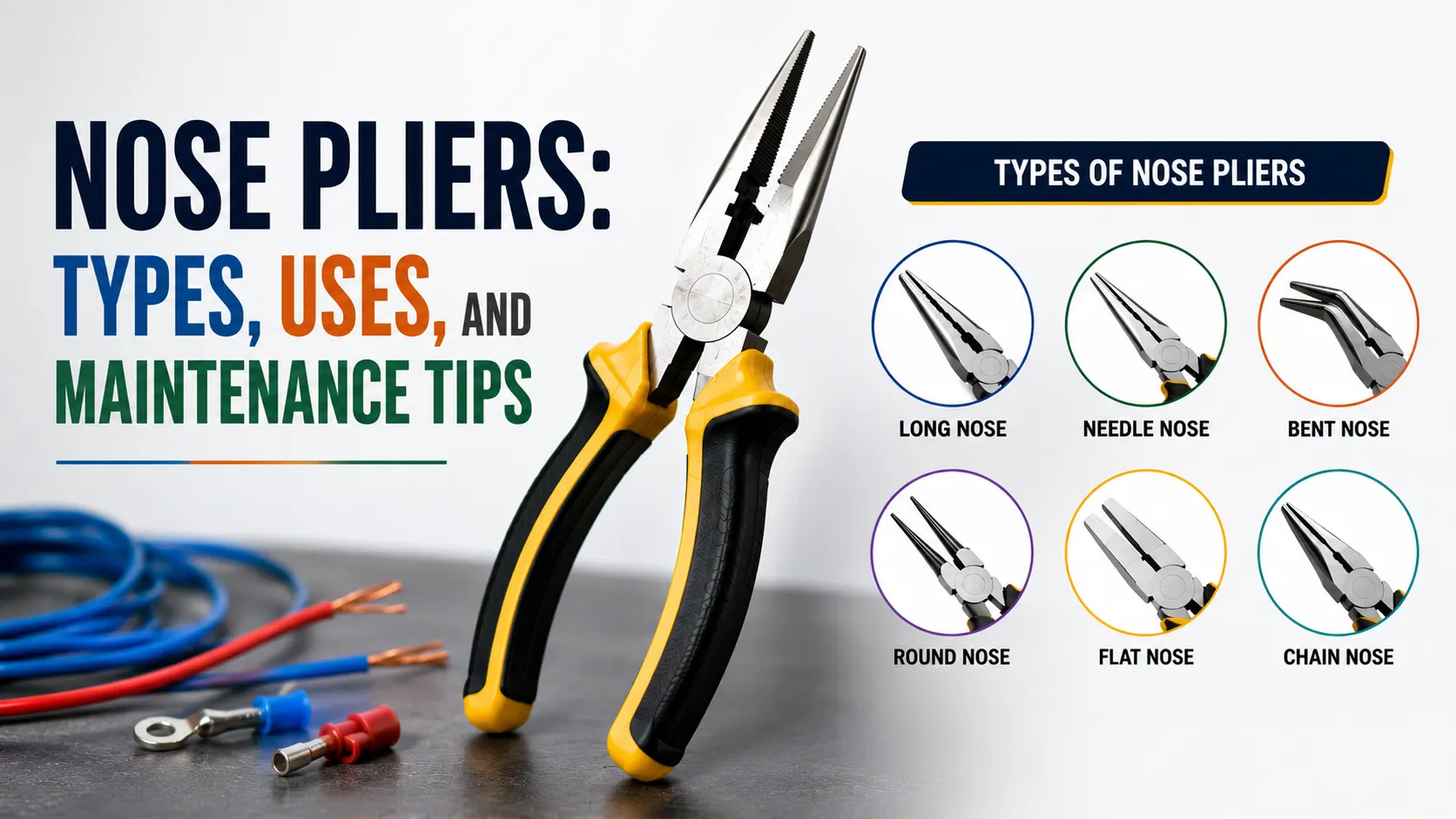
Choosing the right tool depends heavily on this jaw shape. While some tasks require a standard elongated grip, others need specialized geometry. Fully understanding these distinct nose pliers types, uses, and maintenance tips will help you identify exactly which profile matches your regular workload before making a purchase.
2. Metallurgy & Material Quality
Industrial environments demand tools that don’t bend under load or rust in high-humidity workshops. Look for:
- Chrome Vanadium (Cr-V) Steel: The industry standard for high tensile strength and impact resistance.
- Hardened/Tempered Carbon Steel: Ensures the cutting edges stay sharp over thousands of cycles.
- Anti-Corrosion Coatings: Black phosphate or satin nickel finishes that actively repel rust.
3. Handle Ergonomics and Safety Insulation
- For General Mechanics: Look for multi-component, bi-material ergonomic grips that provide a non-slip hold even when your hands are oily.
- For Electricians: Look for VDE Certification and 1000V Ratings. Standard plastic sleeves are not a substitute for true electrical insulation and can lead to severe shock hazards.
4. Tool Size and Scale
- 4-inch to 5-inch Pliers: Ideal for benchwork, electronics, and intricate artisan crafts.
- 6-inch to 8-inch Pliers: The sweet spot for industrial maintenance, construction setups, and automotive garages.
Professional vs. Standard Grade Nose Pliers
Investing in professional-grade tools from trusted manufacturers like JCBL Hand Tools yields significantly better long-term value compared to cheap counter options:
| Feature | Professional Grade | Standard Grade |
| Material | Premium Chrome Vanadium Steel | Basic High-Carbon or Drop-Forged Steel |
| Alignment | Zero jaw play; high-precision pivot | Jaws can misalign under heavy torque |
| Durability | Built for continuous industrial cycles | Suitable for occasional light DIY use |
| Grip Comfort | Specialized ergonomic, non-slip handles | Basic dipped plastic or rubber sleeves |
Maintenance for Long-Term Performance
Keep your premium selection performing like new with these basic shop habits:
- Post-Work Clean: Wipe down jaws with a clean rag to remove grease, sweat, and corrosive debris.
- Pivot Lubrication: Apply a single drop of light machine oil or lubricating spray to the joint weekly.
- Correct Tool Allocation: Never use nose pliers as a makeshift hammer or wedge; this warps the precise alignment of the nose tips.
Conclusion
Choosing the best nose pliers is all about mapping your specific workplace challenges to the right tool design. By analyzing your required jaw shape, material metallurgy, and handling safety features, you ensure high productivity, excellent precision, and safety on every project.
For engineering setups and workshops demanding industrial-grade reliability, investing in premium solutions from trusted brands like JCBL Hand Tools ensures superior gripping strength, tight tolerances, and an extended service life that stands up to heavy daily use.
FAQs
Bent nose and pistol-grip nose pliers are the best choices for obstructed environments. Their angled jaws allow you to reach around blocks, wires, or bracket components easily without blocking your direct line of sight.
No. Needle nose pliers have thin, highly tapered jaws engineered for precision work, not high torque. Attempting to twist heavy, rusted bolts can permanently bend, misalign, or snap the delicate tips. For stuck fasteners, you should use a spanner, socket, or a dedicated locking plier.
They are not mandatory for mechanical, crafting, or automotive jobs, but they are strictly mandatory if you are performing any electrical repairs near live or potentially energized circuits. Always look for an official VDE 1000V safety rating on the handles for electrical safety.
Serrated (toothed) jaws provide a powerful, non-slip grip on heavy wires and industrial fasteners but can scratch or dent the metal. Smooth jaws provide slightly less friction but are essential for delicate tasks like jewelry making or electronics repair, where components must remain scratch-free.
The ideal size depends on the scale of your work. Compact pliers measuring 4 to 5 inches are perfect for benchwork, micro-electronics, and intricate artisan crafts. For industrial maintenance, automotive garages, and standard electrical wiring, larger 6 to 8-inch pliers are highly recommended for better leverage.
Related Readings: