Nose Pliers: Types, Uses, and Maintenance Tips
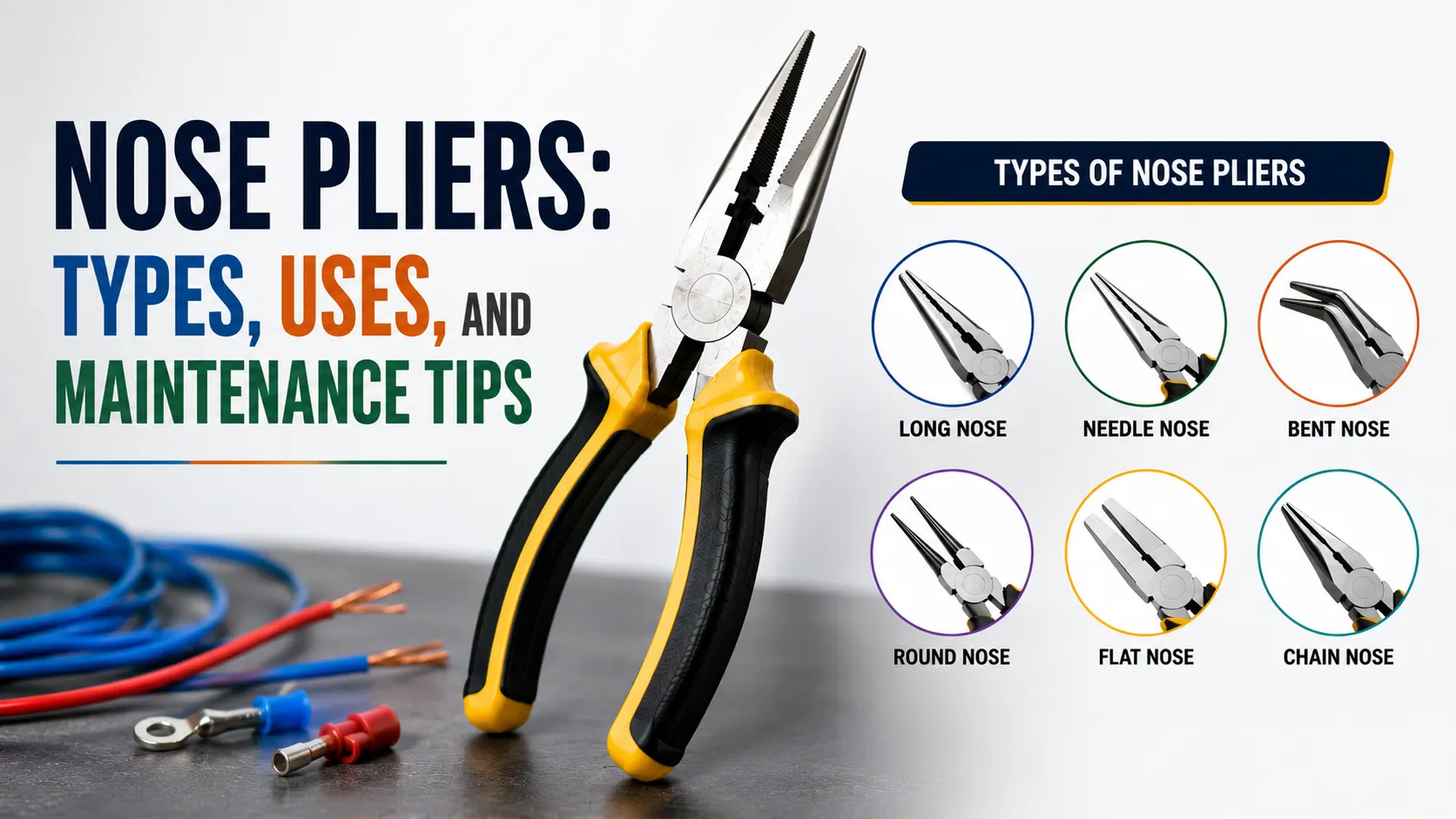
Nose pliers are one of the most commonly used hand tools in electrical, mechanical, automotive, and DIY applications. Known for their long, narrow jaws, these pliers are designed to grip, bend, twist, and handle wires or small objects in tight spaces where regular pliers cannot easily reach.
Whether you are an electrician working inside switchboards, a mechanic handling engine wiring, or a technician repairing electronics, nose pliers offer the precision and control needed for detailed work.
What Are Nose Pliers?
Nose pliers are precision hand tools with long, tapered jaws used for gripping, bending, twisting, and manipulating wires or small components in confined spaces.
They are commonly manufactured from high-grade materials like hardened steel or Chrome Vanadium (Cr-V) steel to provide durability, corrosion resistance, and long-term mechanical performance.
Quick Definition: Nose pliers are hand tools designed with pointed or elongated jaws for high-precision tasks, especially in electrical, mechanical, and electronics applications.
What Are Nose Pliers Used For?
Thanks to their unique design, nose pliers are incredibly versatile. Their primary applications include:
- Bending and Shaping Wires: Perfect for creating precise loops, links, or angles.
- Holding Small Components: Gripping tiny screws, washers, nuts, or pins that fingers cannot reach.
- Twisting and Splicing Cables: Securing electrical connections firmly.
- Precision Repairs: Extensively used in electronics maintenance, micro-soldering, and jewelry making.
- Tight Space Navigation: Accessing deeply recessed areas in automotive engines or industrial machinery.
Quick Overview: Types of Nose Pliers and Their Uses
| Plier Type | Jaw Shape & Design | Primary Industry / Use | Key Advantage |
| Long Nose | Straight, elongated & robust | Electrical & Mechanical | Deep reach with strong structural grip |
| Needle Nose | Ultra-slim, sharply pointed | Electronics & Micro-repairs | Ultimate precision for micro-components |
| Bent Nose | Angled jaws (45° or 90°) | Engine Bays & Machinery | Works around obstacles; better visibility |
| Round Nose | Completely conical & rounded | Jewelry Making & Crafts | Creates smooth, uniform wire loops |
| Flat Nose | Broad, flat gripping surface | Sheet Metal & Wire Straightening | Stable pressure distribution without twisting |
| Chain Nose | Tapered with flat inner surfaces | Wire Wrapping & Artisan Crafts | Secure grip that minimizes marks on soft metal |
| Duckbill Nose | Wide, flat, and thin (like a beak) | Aviation & Ribbon Cable Handling | High gripping force on thin, flat materials |
| Locking Nose | Long jaws with automatic clamp | Extraction & Heavy Welding | Hands-free clamping and extreme torque |
| Pistol Grip | Ergonomic handle offset from jaw | Deep Automotive & Plumbing | Maximum leverage in awkward, deep spaces |
| Tweezer Nose | Ultra-fine, tweezer-thin tips | Watchmaking & Micro-electronics | Maximum control over microscopic parts |
10 Essential Types of Nose Pliers
Different applications require different jaw shapes, angles, and designs. Below are the 10 most commonly used types of nose pliers in professional and DIY industries.
1. Long Nose Pliers
Long nose pliers feature straight, elongated jaws designed for deep reach and general gripping tasks.
- Common Uses: Electrical wiring, automotive repairs, and industrial maintenance.
- Advantages: Better reach, strong structural grip, and easy access to narrow spaces.
2. Needle Nose Pliers
Needle nose pliers are significantly slimmer, sharper, and more pointed than standard long nose pliers, making them suitable for ultra-delicate tasks.
- Common Uses: Electronics repair, circuit board (PCB) work, and fine wire handling.
- Advantages: Exceptional precision and improved control around micro-components.
3. Bent Nose Pliers
Bent nose pliers feature angled jaws (usually at 45° or 90°) that help users work around obstacles without blocking their line of sight.
- Common Uses: Industrial machinery maintenance, electrical assembly, and automotive engine repair.
- Advantages: Excellent side-angle access and vastly improved visibility of the work area.
4. Round Nose Pliers
Round nose pliers have completely rounded, conical jaws designed specifically for wire loops and smooth curves.
- Common Uses: Jewelry crafting, decorative wire art, and electrical loop creation for terminal screws.
- Advantages: Creates smooth, uniform loops without damaging, scratching, or nicking the wire.
5. Flat Nose Pliers
Flat nose pliers contain broad, flat inner gripping surfaces (duckbill-style but thicker) for holding and bending wider materials.
- Common Uses: Sheet metal handling, wire straightening, and structural craft applications.
- Advantages: Extremely strong surface-to-surface grip and stable pressure distribution.
6. Chain Nose Pliers
Chain nose pliers feature tapered jaws with flat inner surfaces, bridging the gap between round and flat nose profiles.
- Common Uses: Jewelry repair, wire wrapping, and fine electrical tasks.
- Advantages: Secure grip with precision handling capability, leaving fewer marks on soft metals.
7. Duckbill Nose Pliers
Duckbill pliers feature wide, flat, and thin jaws that resemble a duck’s bill. They provide a wider surface area for gripping thin items than standard needle-nose pliers.
- Common Uses: Aircraft maintenance, wire securing, and handling thin sheet metal or ribbons.
- Advantages: High gripping force on flat surfaces without twisting or slipping.
8. Locking Nose Pliers (Long Nose Vice-Grip)
These pliers combine the long-reach design of a nose plier with a mechanical locking mechanism that clamps down tightly on an object.
- Common Uses: Removing stripped screws, holding small parts in place for welding, and heavy-duty extraction.
- Advantages: Hands-free clamping power and extreme torque control.
9. Pistol Grip Nose Pliers
Pistol grip pliers feature an ergonomic, angled handle configuration similar to a pistol. The jaws are offset from the handle line.
- Common Uses: Deep engine bays, complex automotive routing, and hard-to-reach plumbing fixtures.
- Advantages: Maximum visibility and high leverage transfer in awkward or tight mechanical spaces.
10. Tweezer Nose Pliers
Tweezer nose pliers are ultra-fine, highly elongated precision tools with jaws as thin as standard tweezers but built with a plier pivot for stronger mechanical control.
- Common Uses: Micro-electronics, watchmaking, medical device assembly, and lab work.
- Advantages: Ultimate control over microscopic components with minimal structural pressure.
Difference Between Needle Nose and Long Nose Pliers
While many users use these terms interchangeably, there is a distinct technical difference:
| Feature | Long Nose Pliers | Needle Nose Pliers |
| Jaw Shape | Slightly broader, robust profile | Slimmer, sharper, and highly tapered |
| Strength | Higher structural strength for general tasks | Optimized for delicate, low-torque work |
| Common Use | Electrical and mechanical heavy-duty work | Electronics repair, micro-soldering, and jewelry |
| Precision Level | Moderate | Exceptionally High |
How to Choose the Right Nose Pliers
To select the perfect tool for your workshop or tool kit, consider the following parameters:
- Jaw Design: Choose straight jaws for general usage, bent/pistol grips for awkward angles, or round/chain jaws for artisan wire loops.
- Material Quality: Look for Chrome Vanadium (Cr-V) steel or high-carbon steel with a rust-resistant coating for industrial-grade durability.
- Handle Ergonomics: Multi-component, non-slip handles reduce hand fatigue and blisters during prolonged use.
- Insulation Rating: If you are working on live electrical installations, ensure the pliers feature VDE certified insulated handles (up to 1000V) for safety.
Nose Pliers Maintenance and Safety Tips
Proper maintenance extends tool life and ensures safe operation in professional environments.
Maintenance Checklist
- Clean After Use: Regularly wipe down the tool to remove dust, grease, metal filings, and moisture.
- Lubricate the Pivot Joint: Apply a drop of light machine oil to the pivot joint periodically to maintain smooth, friction-free movement.
- Store Correctly: Keep pliers inside a dry toolbox or organizer to prevent atmospheric corrosion (rust).
- Avoid Excessive Force: Never use nose pliers beyond their intended wire-gauge capacity, as this can permanently misalign or snap the jaws.
Safety Measures
- Always wear protective eyewear and gloves when cutting or bending springy industrial wires.
- Never use pliers as a hammer; it structurally weakens the pivot pin and ruins tool alignment.
- Always check the VDE insulation rating before working on electrical switchboards or components.
Conclusion
Nose pliers are indispensable precision hand tools across the electrical, automotive, aerospace, and manufacturing industries. Understanding the technical nuances between these 10 different jaw shapes ensures you pick the right tool for maximum efficiency and workplace safety.
For professional setups demanding industrial-grade reliability, investing in high-quality hand tools from trusted manufacturers like JCBL Hand Tools ensures superior gripping strength, tight tolerances, and an extended service life.
FAQs
Nose pliers are primarily designed for gripping, bending, twisting, and cutting wires or small objects in confined spaces where fingers or standard combination pliers cannot reach.
Not exactly. Needle nose pliers feature much slimmer, sharper, and more tapered jaws for delicate precision tasks, whereas long nose pliers have a sturdier profile meant for general-purpose mechanical work.
Yes, many industrial-grade nose pliers come equipped with integrated induction-hardened cutting edges near the pivot to cleanly cut soft wires and small cables.
Insulated handles (specifically VDE certified up to 1000V) are a crucial safety feature for electricians. They protect the user from accidental electrical shocks while working near live circuits, electrical switchboards, or automotive wiring systems.
To prevent corrosion, always wipe your pliers with a clean cloth after use to remove sweat, grease, and moisture. Periodically apply a drop of light machine oil to the pivot joint, and store the tool in a dry toolbox or a moisture-controlled storage cabinet.
Related Readings: