Category: Manufacturing & Engineering
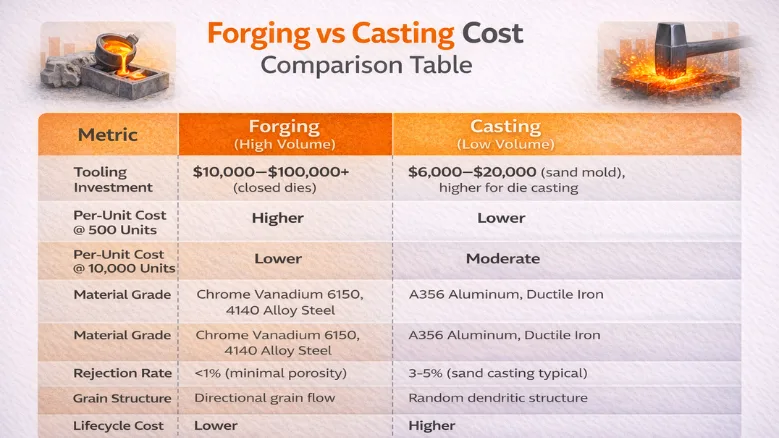
Forging vs Casting Cost Comparison: Which Is More Economical?Forging vs Casting Cost Comparison: Which Is More Economical?
Forging is more economical for high-volume production (10,000+ units) due to lower per-unit costs and durability, while casting is more economical for low-volume, complex shapes due to lower upfront tooling [...]
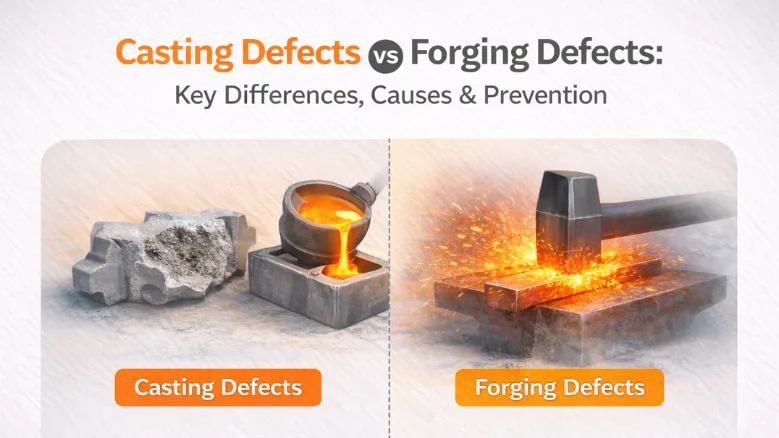
Casting Defects vs Forging Defects: Key Differences, Causes & PreventionCasting Defects vs Forging Defects: Key Differences, Causes & Prevention
The primary difference between casting defects and forging defects lies in their origin: casting defects, such as porosity and shrinkage, occur during molten metal solidification, while forging defects, like laps [...]
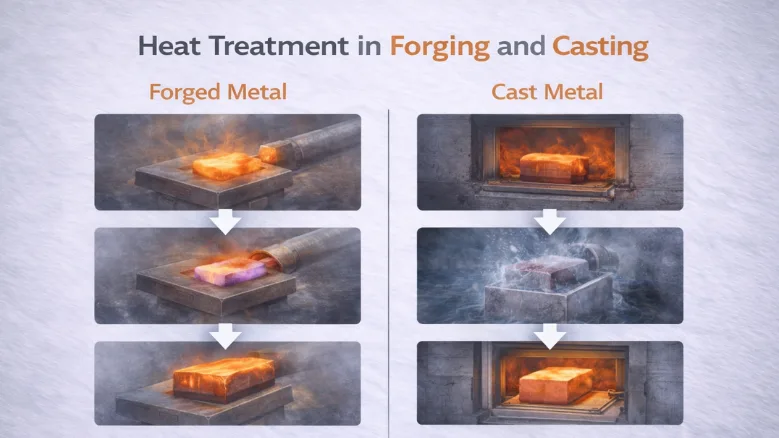
Heat Treatment in Forging and Casting: Process, BenefitsHeat Treatment in Forging and Casting: Process, Benefits
Heat treatment forging and heat treatment casting are controlled heating and cooling processes used to enhance the strength, hardness, toughness, and durability of metal components after shaping. These processes optimize [...]
Grain Structure in Forged vs Cast MetalGrain Structure in Forged vs Cast Metal
Grain structure in forged vs cast metal differs in grain alignment, density, and internal integrity. Forged metal develops compressed, directional grain flow that enhances strength, fatigue resistance, and impact performance. [...]
Types of Casting Processes Explained With Comparison & ApplicationsTypes of Casting Processes Explained With Comparison & Applications
Casting processes are manufacturing methods where molten metal is poured into a mold to create specific shapes. The main types of casting processes include sand casting, die casting, investment casting, [...]
Types of Forging Processes Explained (Complete Guide for Manufacturers & Exporters)Types of Forging Processes Explained (Complete Guide for Manufacturers & Exporters)
Forging processes are advanced metal forming techniques that use compressive forces to reshape metal, improving its strength, grain structure, and fatigue resistance. The four main types of forging processes are [...]
Hot vs Cold vs Warm Forging: Key Differences ExplainedHot vs Cold vs Warm Forging: Key Differences Explained
Hot, cold, and warm forging are primarily distinguished by temperature, and that one variable directly shapes strength, precision, cost, and overall manufacturing efficiency. Hot forging is used when strength and [...]
What Is Warm Forging?What Is Warm Forging?
Warm forging is a precision metal-forming process performed at intermediate temperatures (typically 600°C to 900°C), in which metals are deformed under controlled conditions to achieve a balance of high strength, [...]
What Is Hot Forging?What Is Hot Forging?
Hot forging is a metal forming process where metals are shaped above their recrystallization temperature to improve strength, toughness, and internal grain structure. It is widely used to manufacture high-performance [...]
What Is Cold Forging? Process, Benefits, Cost & Industrial ApplicationsWhat Is Cold Forging? Process, Benefits, Cost & Industrial Applications
Cold forging is a metal forming process in which metal is shaped at or near room temperature using high compressive force. It is widely used to manufacture high-precision components such [...]
What Is Casting in Manufacturing? Process, Types, ApplicationsWhat Is Casting in Manufacturing? Process, Types, Applications
Casting is a manufacturing process where molten metal is poured into a mold, cooled, and solidified to form a desired shape. It is widely used to produce complex components with [...]
What is Forging? Process, BenefitsWhat is Forging? Process, Benefits
Forging is a manufacturing process where metal is shaped using compressive force (usually after heating) to create stronger, denser, and more durable components. Unlike casting, forging does not melt the [...]