What Is Casting in Manufacturing? Process, Types, Applications
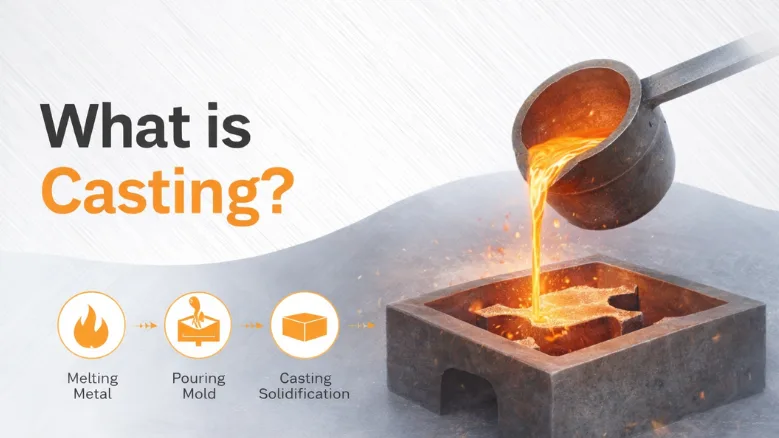
Casting is a manufacturing process where molten metal is poured into a mold, cooled, and solidified to form a desired shape.
It is widely used to produce complex components with intricate designs, internal cavities, and near-net-shape accuracy. From automotive parts to heavy machinery, casting plays a key role in cost-effective, large-scale production.
This guide explains what casting is, how the casting process works, where it is used, and how it compares to forging, so engineers, buyers, and manufacturing professionals can make informed decisions.
What Is Casting in Manufacturing?
Casting is a manufacturing process in which molten metal is poured into a mold, allowed to cool and solidify, and then removed to form a desired shape. It is widely used to produce complex components with internal cavities, intricate geometries, and near-net-shape accuracy.
Key Takeaways
- Casting is ideal for complex shapes and intricate designs
- It supports metals like cast iron, steel, aluminum, brass, and bronze
- It is cost-effective for large-scale production
- It is less suitable for high-impact or load-bearing applications compared to forging
How the Casting Process Works
Although there are different casting methods, most follow these core steps:
1. Mold Preparation
A mold is created based on the desired shape of the final product. Depending on the production requirement, molds can be made from sand, metal, ceramic, or composite materials.
Engineers also account for metal shrinkage during cooling, ensuring the final dimensions remain accurate.
2. Melting and Pouring
The selected metal is heated in a furnace until it becomes molten. Once it reaches the required temperature and composition, it is poured into the mold cavity.
Depending on the process, pouring may use:
- Gravity casting
- Pressure-assisted casting
This ensures the molten metal fills even the smallest details of the mold.
3. Cooling and Solidification
After pouring, the metal cools and solidifies inside the mold. The cooling rate directly affects:
- Internal grain structure
- Mechanical properties
- Surface finish
Controlled cooling is critical for maintaining product quality.
4. Removal and Finishing
Once solidified, the casting is removed from the mold. It may undergo:
- Cleaning (removal of excess material)
- Machining
- Surface finishing
- Quality inspection
Types of Casting Processes
Different casting methods are selected based on factors such as design complexity, production volume, and material requirements. Each process offers unique advantages depending on the application.
Sand Casting
Sand casting is one of the most widely used methods, especially for large components. It uses sand-based molds and is known for its flexibility and low tooling cost.
- Suitable for large parts and low-volume production
- Commonly used in heavy machinery and automotive components
Die Casting
Die casting involves forcing molten metal into metal molds under high pressure. It is ideal for producing high volumes of precise parts with excellent surface quality.
- Best for high-volume production
- Delivers smooth surface finish and tight tolerances
- Widely used in automotive and electronics industries
Investment Casting
Also known as the lost-wax process, investment casting is used for producing highly detailed and accurate components.
- Ideal for complex and precision parts
- Offers excellent surface finish and dimensional accuracy
- Common in aerospace, medical, and precision engineering applications
Centrifugal Casting
In this process, molten metal is poured into a rotating mold, using centrifugal force to distribute the material evenly.
- Best suited for cylindrical components
- Produces dense and defect-resistant structures
- Commonly used for pipes, tubes, and rings
Materials Used in Casting
Casting supports a wide range of metals. Selection depends on performance requirements:
- Cast Iron: Good wear resistance and vibration damping
- Carbon Steel: Strong and durable
- Alloy Steel: Enhanced mechanical properties
- Aluminum: Lightweight and corrosion-resistant
- Brass & Bronze: Good machinability and corrosion resistance
How to Choose the Right Material
Material selection depends on the following:
- Load and stress conditions
- Environmental exposure (corrosion, temperature)
- Cost and production volume
Applications of Casting in Industry
Casting is widely used across multiple industries due to its flexibility in design and production.
Common Applications
- Automotive components (engine blocks, housings)
- Pump and valve bodies
- Pipe fittings
- Machine bases
- Industrial enclosures
Industries That Rely on Casting
- Automotive
- Oil & Gas
- Construction
- Heavy machinery
- Power generation
Casting is especially useful when complex geometry and cost efficiency are more important than maximum strength.
Casting vs Forging: What’s the Difference?
Both casting and forging are used to shape metal, but they differ significantly in process and performance.
| Feature | Casting | Forging |
| Process | Molten metal poured into mold | Solid metal shaped using force |
| Strength | Lower | Higher |
| Design Flexibility | High | Limited |
| Internal Defects | Possible (porosity, shrinkage) | Minimal |
| Best Use | Complex shapes | High-stress applications |
In simple terms:
- Use casting for complex, detailed parts
- Use forging for strength, durability, and impact resistance
For a detailed technical breakdown, see the full comparison here:
“Difference Between Cast and Forged Tools”
Limitations of Casting
While casting is highly versatile, it has some limitations:
- Internal Defects: During solidification, defects like porosity, microvoids, and shrinkage cavities can develop, affecting structural integrity.
- Lower Mechanical Strength: Compared to forged components, cast parts generally have lower toughness and reduced impact resistance.
- Not Ideal for High-Stress Tools: Tools subjected to repeated impact, torsion, and cyclic loading require higher strength, making forging a better choice.
When Should You Choose Casting?
Casting is the right choice when:
- The part has complex geometry or internal cavities
- Near-net-shape manufacturing is required
- Production needs to be cost-effective at scale
- The application involves moderate or low mechanical stress
Casting in Industrial Manufacturing
From a manufacturing engineering perspective, casting remains essential because it enables design flexibility that most other processes cannot achieve.
However, selecting casting should always involve evaluating the following:
- Load conditions
- Performance expectations
- Lifecycle requirements
In many real-world applications, casting and forging are used together to balance cost, complexity, and strength.
Conclusion
Casting continues to be a core manufacturing process due to its ability to produce complex, cost-effective components at scale. While it may not always match the strength of forging, its design flexibility and production efficiency make it indispensable across industries.
For manufacturers and buyers, the key is simple: choose casting when design complexity matters more than maximum strength.
FAQs
Casting is a process where molten metal is poured into a mold and allowed to solidify into a specific shape.
Casting shapes metal in liquid form using molds, while forging shapes solid metal using force. Forged parts are generally stronger.
The main types include sand casting, die casting, investment casting, and centrifugal casting.
Casting is not ideal for high-strength or impact tools. Forging is usually preferred for such applications.
Casting is widely used in automotive, construction, oil & gas, heavy machinery, and power generation industries.
Related Post

Leading Supplier of Hand Tools in Poland
When it comes to precision, durability, and performance, hand tools play an essential role in [...]
Best Supplier of Hand Tools in Bulgaria
In today’s fast-paced world of construction, industrial manufacturing, automotive servicing, and home improvement, the importance [...]
Principais Fabricantes e Fornecedores de Ferramentas Manuais no Brasil
A JCBL Hand Tools é um dos mais confiáveis fabricantes de ferramentas manuais no Brasil, [...]