Global Combination Spanner Market Trends, Growth & Future Outlook (2026–2035)
- Combination Spanner Market: Key Overview
- What Is the Global Combination Spanner Market?
- Combination Spanner Market Size & Growth Forecast, 2026–2035
- Key Combination Spanner Market Trends
- What Is Driving Combination Spanner Market Growth?
- Market Segmentation
- Regional Outlook
- Competitive Landscape
- Standards and Procurement Considerations
- Future Outlook: 2026–2035
- Conclusion
- FAQs
The global combination spanner market was valued at USD 1.59 billion in 2025 and is projected to reach USD 2.54 billion by 2035, growing at a 4.6% CAGR from 2026 to 2035, as per the Research and Markets report. Asia-Pacific is currently the largest and fastest-growing regional market, supported by manufacturing expansion, automotive production, industrial maintenance, and increasing adoption of professional-grade tools.
Combination Spanner Market: Key Overview
| Market Indicator | Outlook |
| Market size, 2025 | USD 1.59 billion |
| Market size, 2026 | USD 1.72 billion |
| Forecast market size, 2035 | USD 2.54 billion |
| CAGR, 2026–2035 | 4.6% |
| Largest region | Asia-Pacific |
| Fastest-growing region | Asia-Pacific |
| Leading application | Automotive |
| Automotive share, 2025 | 30.5% |
What Is the Global Combination Spanner Market?
Combination spanners are hand tools that combine an open-end jaw with a ring or box-end head, allowing users to tighten or loosen fasteners using the same tool. They are widely used in automotive servicing, industrial assembly, construction, equipment maintenance, and general mechanical applications.
The market increasingly includes standard, ratchet, flex-head, offset, cranked, and stubby designs. Demand is shifting toward tools that improve access, speed, durability, and productivity in professional working environments.
Market definition note: Market estimates vary because some research providers measure combination spanners, combination spanner sets, or the broader hand-operated wrench category. This article uses Global Market Insights’ estimate for the combination spanner market; broader trade statistics are used only to provide supply-chain context.
Combination Spanner Market Size & Growth Forecast, 2026–2035
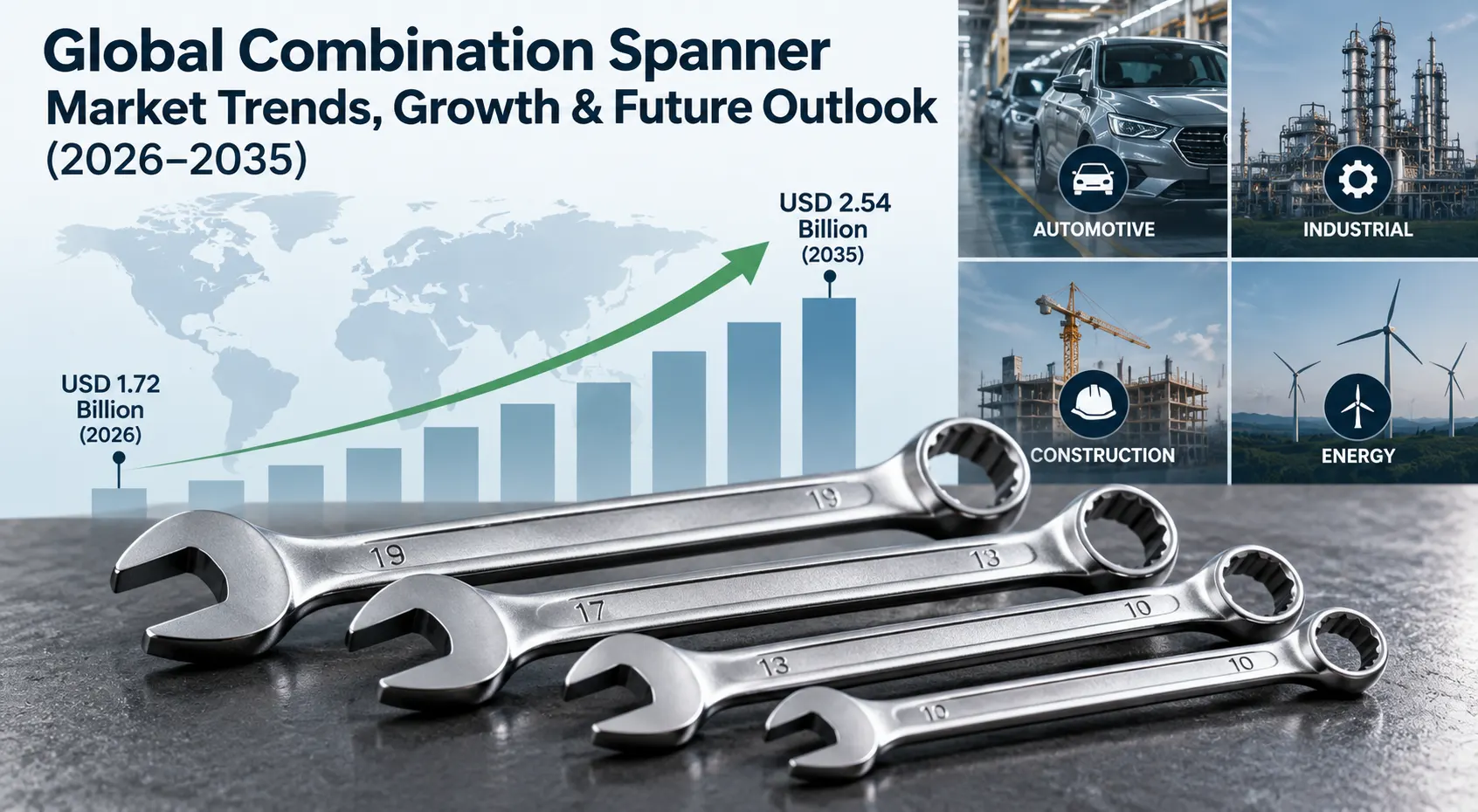
The combination spanner market is expected to increase from USD 1.72 billion in 2026 to USD 2.54 billion by 2035, representing a 4.6% CAGR. Standard combination spanners generated approximately USD 900 million in 2025, while ratchet combination spanners are identified as a faster-growing product category.
Growth is being supported less by simple increases in tool volumes and more by demand for professional-grade, application-specific, and productivity-oriented tools. Manufacturers and distributors are increasingly competing on ergonomics, durability, precision, corrosion resistance, access in confined spaces, and procurement convenience.
Key Combination Spanner Market Trends
1. Rising demand for ratchet and specialized designs
Standard combination spanners remain important, particularly in industrial and automotive maintenance. However, ratchet, flex-head, offset, and compact designs are gaining attention because they can improve accessibility and reduce the time required for repetitive fastening tasks.
2. Premium materials and durability are becoming purchasing factors
Professional buyers increasingly evaluate tools based on strength, dimensional accuracy, surface finish, corrosion resistance, and service life rather than price alone. Materials such as chrome vanadium steel remain important for durable professional tools.
For manufacturers, this creates opportunities for higher-value products rather than competing solely on volume and low cost.
3. Digital B2B procurement is changing distribution
Industrial buyers are increasingly using online channels to compare specifications, availability, pricing, and suppliers. Würth, a major industrial distribution group, reported EUR 5.2 billion in digital sales in 2025, representing 25.2% of group sales, illustrating the growing importance of digital purchasing in professional tools and industrial supplies.
4. Supply chain diversification is creating new sourcing opportunities
Manufacturers and buyers are reassessing sourcing strategies because of tariffs, geopolitical risks, and supply-chain concentration. This is particularly relevant to India and Southeast Asia, where industrial capacity and organized procurement are expanding.
What Is Driving Combination Spanner Market Growth?
1. Automotive production and maintenance
Automotive remains the largest application, accounting for 30.5% of the combination spanner market in 2025. Global vehicle production also increased from 92.7 million units in 2024 to 96.4 million in 2025, according to OICA. Automotive assembly, repair, aftermarket servicing, and equipment maintenance therefore remain important sources of tool demand.
Electrification is changing the requirements of automotive workshops rather than eliminating hand-tool demand. New vehicle architectures, battery systems, and conventional mechanical components all require specialized maintenance and fastening solutions.
2. Manufacturing and industrial MRO
Combination spanners are essential in assembly, machinery maintenance, and MRO activities. Asia-Pacific’s manufacturing scale is particularly important: Asia and Oceania accounted for 57.2% of global manufacturing value added in 2024, reinforcing the region’s importance as both a consumer and production base for industrial tools.
3. Infrastructure and energy investment
Construction, utilities, energy infrastructure, and equipment maintenance create recurring demand for durable fastening tools. Large-format spanners and application-specific designs can benefit from projects involving heavy equipment and industrial installations.
Market Segmentation
The global combination spanner market can be segmented by:
- Type: Standard, ratchet, flex-head, offset/cranked, stubby, and others
- Size: Small, medium, and large
- Material: Carbon steel, chrome vanadium steel, stainless steel, and others
- Application: Automotive, construction, manufacturing, aerospace and defense MRO, marine, energy and utilities, and DIY
- Distribution: Online and offline channels
Among these, automotive is currently the largest application, while specialized and ratchet designs offer attractive growth opportunities.
Regional Outlook
Asia-Pacific
The Asia-Pacific is the largest and fastest-growing combination spanner market. China’s manufacturing scale, expanding automotive sector, and established hand-tool supply chains make the region central to global demand and production.
North America
The United States accounts for the largest share of North America’s combination spanner market. Demand is supported by automotive aftermarket activity, industrial maintenance, construction, and professional tool replacement.
Europe
Germany is a major European market, supported by its automotive and industrial manufacturing base. European buyers also place strong emphasis on product quality, dimensional accuracy, and compliance with applicable standards.
India Opportunity
India is emerging as an important alternative manufacturing and export base for hand tools. NITI Aayog estimates that India exported approximately USD 600 million in hand tools in 2025, representing a 1.8% global share, and identifies potential for the country’s tools sector to exceed USD 25 billion in exports by 2035.
However, India still faces a 14–17% cost disadvantage relative to China, highlighting the need for greater manufacturing scale, productivity, infrastructure, and supply chain efficiency.
For combination spanner manufacturers, this creates opportunities in OEM supply, private-label production, export-oriented manufacturing, and premium professional tools.
Competitive Landscape
The combination spanner market includes major global brands alongside regional manufacturers. Apex Tool Group, Stanley Black & Decker, Snap-on, Gedore Group, and King Tony are among the leading companies; Apex Tool Group held more than 15% market share in 2025, while the top five collectively accounted for about 43%.
Indian manufacturers are also expanding their role in global hand-tool supply chains. JCBL Hand Tools manufactures and exports combination spanners for distributors, importers, OEMs, and industrial buyers, offering CR-V steel options and products manufactured to recognized specifications.
Key competitive factors include:
- Product durability and dimensional precision
- Standards compliance and quality consistency
- OEM/private-label customization
- Product range and specialized designs
- Reliable bulk supply and global distribution
For B2B buyers, suppliers that combine consistent quality, customization, competitive sourcing, and dependable delivery are increasingly well positioned.
Standards and Procurement Considerations
For B2B buyers, specifications matter alongside price. ISO 7738:2015 specifies the overall length and maximum head thickness of combination wrenches, including offset forms.
Procurement teams should evaluate dimensional accuracy, material grade, hardness, finish, corrosion resistance, warranty, testing documentation, and consistency across production batches rather than relying on brand or price alone.
Future Outlook: 2026–2035
The combination spanner market is expected to maintain steady growth through 2035 as automotive servicing, industrial MRO, manufacturing, construction, and infrastructure continue to generate recurring demand.
The strongest opportunities are likely to emerge around ratchet and specialized designs, premium professional tools, digital B2B distribution, and manufacturing diversification in Asia. For suppliers, future competitiveness will depend on combining quality and productivity improvements with reliable global sourcing and efficient distribution.
Conclusion
The global combination spanner market is set for steady growth through 2035, driven by automotive maintenance, industrial MRO, manufacturing expansion, and infrastructure investment. With demand shifting toward ratchet, specialized, durable, and professional-grade tools, manufacturers that combine product quality with efficient B2B distribution and competitive sourcing will be best positioned to capture emerging opportunities. Asia-Pacific, particularly India, is likely to remain an important hub for both market growth and global tool manufacturing.
FAQs
The global combination spanner market is estimated at USD 1.72 billion in 2026.
The market is projected to reach USD 2.54 billion by 2035, growing at a 4.6% CAGR from 2026 to 2035.
The Asia-Pacific region is the largest regional market and is also expected to record the fastest growth through 2035.
Key demand drivers include automotive manufacturing and maintenance, industrial MRO, construction, infrastructure investment, and the expansion of manufacturing activity in emerging economies.
Yes. India’s established hand-tool manufacturing base and government-backed ambition to increase tool exports create opportunities for domestic manufacturers and global sourcing partnerships. However, improving cost competitiveness and manufacturing scale remains important.
Related Post