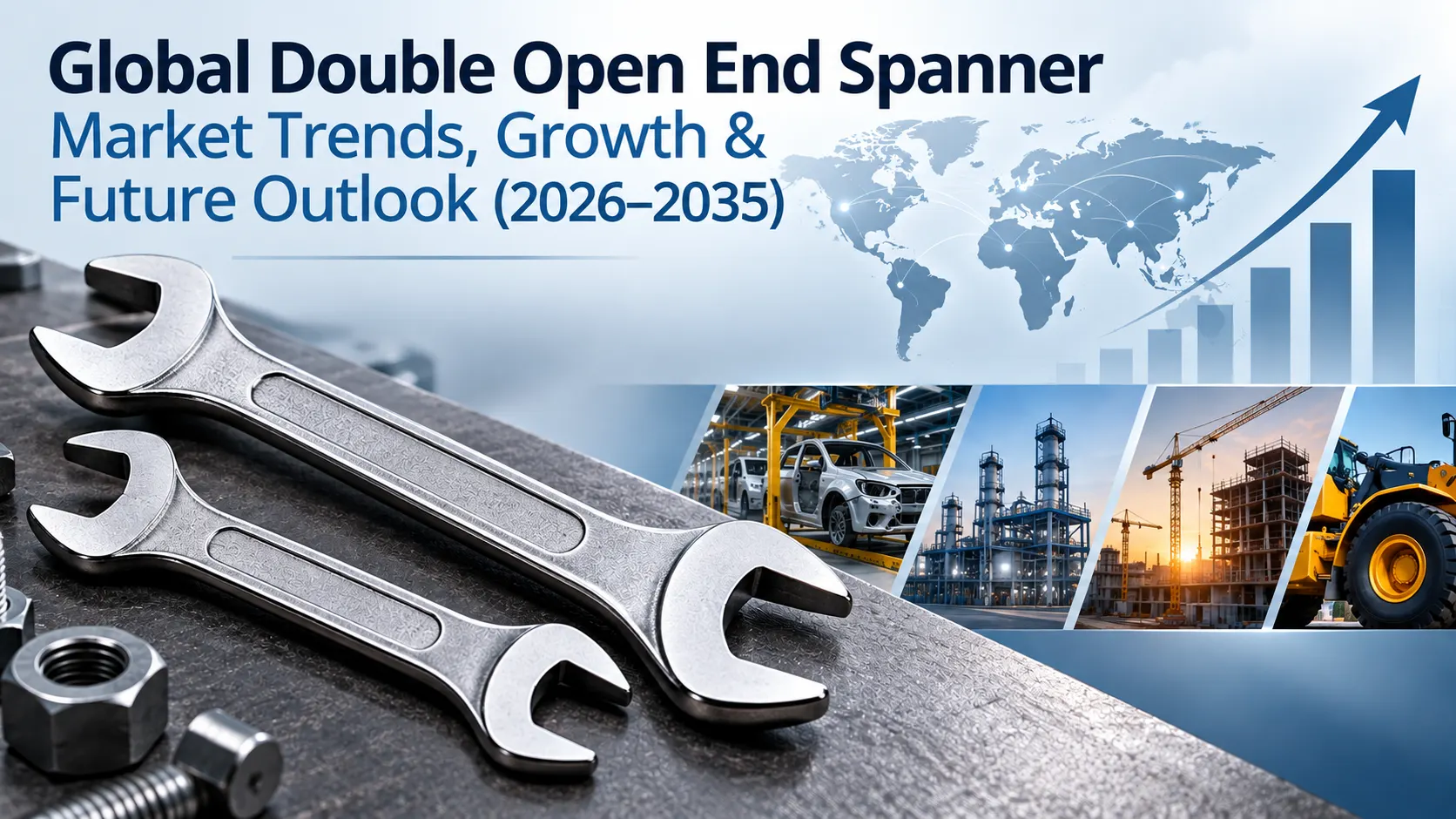
Global Double Open End Spanner Market Trends, Growth & Future Outlook (2026–2035)
- Double Open-End Spanner Market Overview
- Double Open End Spanner Market Size and Growth
- Key Trends Shaping the Double Open-End Spanner Market
- Key Growth Drivers
- Regional Outlook for the Double Open End Spanner Market
- India’s Role in the Global Double Open End Spanner Supply Chain
- Quality and Standards in B2B Procurement
- Double Open End Spanner Market Outlook 2026–2035
- Conclusion
- FAQs
The global double open-end spanner market is positioned for steady growth as automotive maintenance, industrial machinery, manufacturing, and professional repair applications continue to generate demand for durable fixed-size hand tools. According to 360iResearch, the global double open-end spanner market was valued at USD 126.37 million in 2025 and is estimated to reach USD 133.59 million in 2026, with a reported 6.68% CAGR through 2032, reaching USD 198.81 million.
For manufacturers, exporters, distributors, and industrial buyers, market growth is increasingly tied to product quality, dimensional consistency, material performance, standards compliance, and reliable global supply.
Double Open-End Spanner Market Overview
A double open-end spanner is a fixed-hand tool with two open-ended jaws, generally designed with different opening sizes at each end. The configuration allows one tool to serve two fastener sizes while maintaining a compact profile.
The market is primarily supported by demand from:
- Automotive manufacturing and repair
- Industrial machinery maintenance
- Engineering and fabrication
- Construction and infrastructure
- Professional workshops
- Industrial and hardware distribution
Unlike adjustable wrenches, double open-end spanners are manufactured for defined fastener sizes. This makes dimensional accuracy, jaw geometry, material strength, and manufacturing consistency particularly important for professional and B2B applications.
Double Open End Spanner Market Size and Growth
| Market indicator | Value |
| Market size, 2025 | USD 126.37 million |
| Estimated market size, 2026 | USD 133.59 million |
| Forecast market size, 2032 | USD 198.81 million |
| Reported CAGR, 2026–2032 | 6.68% |
These figures come from 360iResearch’s February 2026 market estimate. Because publicly available commercial reports use different product definitions and yield different estimates, the figures should be treated as source-specific market estimates rather than a universal industry benchmark.
For the 2033–2035 period, the market outlook is best viewed as a forward-looking assessment rather than a published exact-category forecast. Continued industrial maintenance demand, automotive activity, international sourcing, and professional-tool replacement are likely to remain important growth factors.
Key Trends Shaping the Double Open-End Spanner Market
Demand for High-Performance Steel and Alloy Materials
Material selection remains a major competitive factor in professional double open-end spanners. Manufacturers offer products in carbon steel and alloy grades, including chrome vanadium steel, to balance strength, durability, manufacturability, and cost.
For B2B buyers, the material specification should be evaluated alongside heat treatment, hardness, dimensional accuracy, and applicable testing requirements rather than treated as a standalone quality indicator.
Greater Focus on Dimensional Accuracy
Because double open-end spanners are fixed-size tools, accurate jaw dimensions are essential for proper fastener engagement.
This makes:
- Opening dimensions
- Jaw geometry
- Thickness
- Overall dimensions
- Size marking
important purchasing considerations for distributors, OEMs, and industrial users.
ISO 691 specifies tolerances for wrench and socket openings, reinforcing the importance of dimensional compatibility between a wrench and its corresponding fastener.
Product Differentiation Through Design and Finishing
Manufacturers are increasingly differentiating double open-end spanners through head profiles, handle designs, surface finishes, size ranges, and marking options.
For international buyers, finishes such as chrome or phosphate coatings can also support corrosion resistance and product presentation, while clearly marked sizes improve identification during workshop and maintenance operations.
Growing Importance of OEM and Private-Label Supply
B2B buyers increasingly evaluate suppliers on more than unit price. OEM and private-label requirements can include specified materials, dimensions, finishes, branding, packaging, testing, and documentation.
This creates opportunities for manufacturers capable of maintaining consistent specifications across large production batches.
Key Growth Drivers
Automotive Manufacturing and Maintenance
Automotive production, vehicle servicing, component maintenance, and repair workshops create recurring demand for fixed-size hand tools. Double open-end spanners are particularly relevant where technicians require commonly used metric or imperial sizes in compact tool sets.
Industrial Machinery Maintenance
Manufacturing plants and engineering operations depend on routine maintenance of machinery, equipment, and assemblies. This supports continued demand for durable spanners that can withstand repeated professional use.
Global B2B Sourcing
International trade data also demonstrate the scale of the broader non-adjustable wrench supply chain. As per WITS World Bank data, global exporters under HS 820411, which covers non-adjustable hand-operated wrenches and is broader than double open end spanners, included China at USD 644.3 million, Germany at USD 234.3 million, and India at USD 148.6 million in 2024. These figures should be viewed in the context of trade rather than as the double open-end spanner market size.
Regional Outlook for the Double Open End Spanner Market
Asia-Pacific
Asia-Pacific is an important manufacturing and sourcing region because of its large industrial base, automotive production, engineering capabilities, and established hand-tool supply chains.
China is a major exporter of non-adjustable hand-operated wrenches, while India has developed a substantial export-oriented manufacturing base. This gives the region an important role in both production and international supply.
Europe
European demand is supported by automotive, engineering, machinery maintenance, and professional tool applications. Buyers in the region typically place strong emphasis on dimensional consistency, standards, traceability, and product quality.
North America
North America remains an important demand center for professional and industrial hand tools, supported by automotive repair, manufacturing, maintenance, and distribution networks.
India’s Role in the Global Double Open End Spanner Supply Chain
India has growing relevance as a manufacturing and export base for non-adjustable hand tools. World Bank WITS data show that India exported USD 148.56 million of HS 820411 non-adjustable hand-operated wrenches in 2024, with the United States, Russia, Germany, Brazil, and the UAE among its leading destinations.
This trade category is broader than double open-end spanners, but it demonstrates India’s established export infrastructure for the product family.
The country’s broader tools sector also has significant growth ambitions. A 2025 NITI Aayog report identified an opportunity for India to expand hand and power tool exports substantially over the next decade, supported by manufacturing clusters, cost competitiveness, and stronger global integration.
For international buyers, India’s opportunity therefore extends beyond cost competitiveness to include OEM manufacturing, private-label production, customized specifications, and export-oriented supply.
Quality and Standards in B2B Procurement
Quality assurance is becoming increasingly important as distributors and industrial buyers seek consistent performance across bulk orders.
Key evaluation areas include:
- Material grade and traceability
- Forging and forming quality
- Heat treatment
- Hardness
- Jaw dimensions and tolerances
- Torque or torsional performance
- Surface finish
- Size marking
- Batch consistency
- Applicable standards and testing documentation
ISO 1711-1 establishes minimum requirements related to hardness and torsional strength for hand-operated wrenches and sockets, including open-end wrenches.
For procurement teams, these specifications provide a more meaningful basis for supplier comparison than price alone.
Double Open End Spanner Market Outlook 2026–2035
The market outlook through 2035 points toward steady, quality-led expansion rather than a technology-driven transformation.
The strongest opportunities are likely to come from:
- Automotive repair and manufacturing demand
- Industrial machinery maintenance
- Professional-grade tool replacement
- OEM and private-label manufacturing
- International B2B sourcing
- Demand for consistent, standards-oriented products
Manufacturers that combine reliable material quality, accurate dimensions, controlled heat treatment, consistent finishing, and scalable production will be better positioned to compete in export markets.
For importers and distributors, supplier qualification will remain critical as buyers increasingly assess product specifications, testing, consistency, packaging, and delivery capability alongside price.
Conclusion
The global double open-end spanner market is expected to maintain steady growth through the 2026–2035 outlook, supported by automotive, industrial maintenance, manufacturing, and professional repair applications. The reported market forecast indicates continued expansion through 2032, while broader trade data demonstrate an established international supply chain for non-adjustable wrenches.
For manufacturers and B2B buyers, the competitive focus will increasingly centre on material quality, dimensional accuracy, testing, consistent production, standards compliance, customization, and dependable global supply. India is also positioned to play a stronger role in this supply chain as its broader hand-tool manufacturing and export capabilities develop.
FAQs
The global double open-end spanner market is estimated at USD 133.59 million in 2026, according to 360iResearch. The same source forecasts a 6.68% CAGR through 2032.
Automotive maintenance, industrial machinery servicing, professional workshops, manufacturing activity, and international B2B sourcing are key demand drivers.
Common material categories include carbon steel and alloy steels such as chrome vanadium steel, depending on the required strength, durability, finish, and price positioning.
Double open-end spanners are fixed-size tools. Accurate jaw dimensions help ensure proper engagement with the intended fastener and reduce the risk of poor fit or tool damage.
India is an established exporter of non-adjustable hand-operated wrenches and has a growing hand-tool manufacturing ecosystem. Its export infrastructure and manufacturing capabilities make it relevant for international OEM, distributor, and private-label sourcing.
Related Post