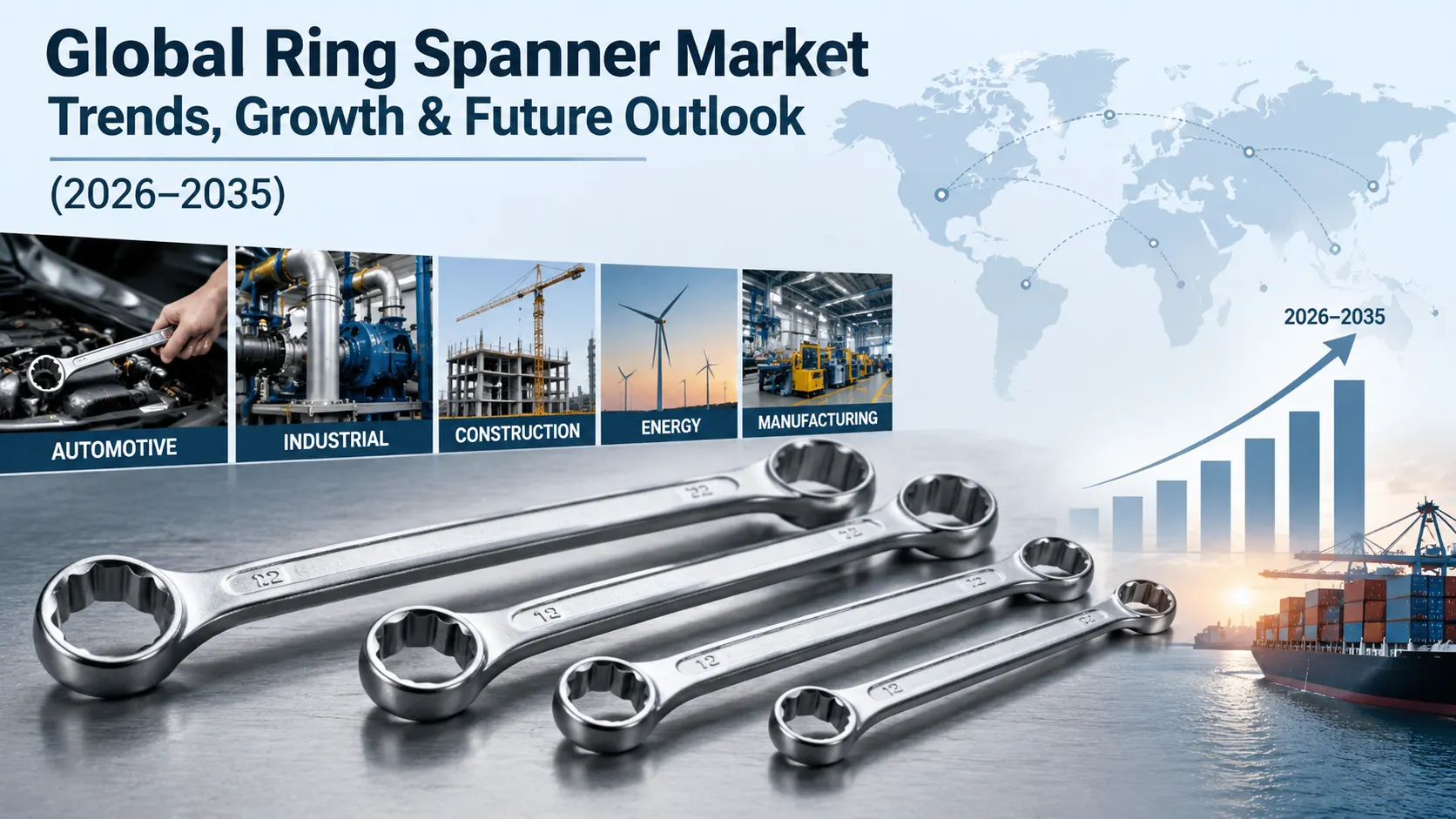
Global Ring Spanner Market Trends, Growth & Future Outlook (2026–2035)
- What Is a Ring Spanner?
- What Is Driving the Global Ring Spanner Market?
- Key Ring Spanner Market Trends Through 2035
- Ring Spanner Market by Product and Application
- Regional Ring Spanner Market Outlook
- India’s Role in the Global Ring Spanner Supply Chain
- What Should B2B Buyers Look for in a Ring Spanner Supplier?
- Ring Spanner Market Future Outlook 2026–2035
- Conclusion
- FAQs
The global ring spanner market is supported by recurring demand from automotive servicing, industrial maintenance, manufacturing, construction, and machinery repair. Unlike highly specialized tools, ring spanners serve routine fastening applications across multiple industries, creating a broad and relatively resilient B2B demand base.
From 2026 to 2035, market development is expected to be influenced by professional-grade tool demand, specialized product designs, manufacturing quality, global sourcing diversification, and growth in emerging industrial economies. For manufacturers and distributors, these changes are shifting competition beyond price toward performance, consistency, customization, and supply reliability.
Because international trade databases generally group ring spanners within broader fixed-wrench classifications, the most reliable market assessment combines ring-spanner trade evidence with relevant fixed-wrench and wider hand-tool indicators.
What Is a Ring Spanner?
A ring spanner is a hand-operated wrench with a closed ring-shaped head designed to grip a nut or bolt from multiple sides. The enclosed head provides greater contact with the fastener than an open-ended wrench, making ring spanners suitable for controlled tightening and loosening.
Common commercial forms include double-ended, offset, deep, bi-hexagonal, and heavy-duty ring spanners, available in metric and imperial sizes.
What Is Driving the Global Ring Spanner Market?
1. Automotive Maintenance and Repair
Automotive manufacturing, commercial vehicle servicing, and aftermarket repair remain important demand sources. Workshops require multiple spanner sizes for routine maintenance, component replacement, and mechanical repairs.
The recurring nature of vehicle maintenance also creates replacement and replenishment demand for professional hand tools.
2. Industrial Machinery Maintenance
Manufacturing plants and engineering operations use ring spanners for equipment installation, adjustment, inspection, and repair. As industrial facilities become more equipment-intensive, reliable hand tools remain necessary for maintenance teams and technicians.
3. Construction and Infrastructure
Construction and infrastructure projects generate demand for tools used in mechanical assembly, equipment installation, and maintenance. Growth in industrial and infrastructure activity therefore supports demand for durable hand tools.
4. Replacement and Workshop Expansion
Ring spanners are also recurring-purchase products. Tools may be replaced because of wear, damage, or loss, while expanding workshops and maintenance teams require additional tools and larger size ranges.
Key Ring Spanner Market Trends Through 2035
1. Performance Is Becoming More Important Than Price Alone
Professional buyers increasingly evaluate tools based on their total working life rather than purchase price alone.
Important specifications include:
- Steel grade and material consistency
- Forging quality
- Heat treatment
- Hardness and strength
- Dimensional accuracy
- Surface finish
- Corrosion resistance
- Torque performance
This is creating greater differentiation between commodity tools and professional or industrial-grade products.
2. Demand Is Moving Toward Application-Specific Designs
Standard ring spanners remain essential, but specialized configurations allow manufacturers to address different working environments.
Examples include:
- Offset ring spanners for restricted access
- Deep-pattern designs for recessed fasteners
- Double-ended spanners for multiple sizes
- Heavy-duty or slogging ring spanners for industrial applications
- Metric and imperial sets for different markets
Product specialization gives manufacturers opportunities to compete through design and application suitability rather than simply through volume.
3. Global Tool Sourcing Is Diversifying
China remains a dominant manufacturing and export base for fixed hand-operated wrenches. Under HS 820411, China exported approximately $644.3 million of products in 2024, compared with about $148.6 million from India. This classification covers non-adjustable hand-operated wrenches and is broader than ring spanners, so it should be viewed in the trade context rather than as ring-spanner market size.
For B2B buyers, this broader supply-chain activity highlights the growing importance of evaluating alternative manufacturing locations and maintaining multiple sourcing options.
4. Private-Label and Customized Supply Are Becoming More Relevant
Distributors, retailers, and industrial suppliers increasingly source tools under their own brands.
This creates opportunities for manufacturers that can provide:
- Customized sizes and configurations
- Private-label branding
- Packaging development
- Consistent bulk production
- Export documentation
- Repeat-order capability
Ring Spanner Market by Product and Application
By Product Type
The market includes:
- Single-ended ring spanners
- Double-ended ring spanners
- Offset ring spanners
- Deep ring spanners
- Bi-hexagonal ring spanners
- Heavy-duty and slogging ring spanners
- Ring spanner sets
By Application
Major application areas include:
- Automotive
- Industrial machinery
- Manufacturing
- Construction
- Agriculture
- Equipment maintenance
- General mechanical repair
The most suitable design depends on factors such as fastener size, accessibility, required torque, and operating environment.
Regional Ring Spanner Market Outlook
1. North America
North America remains an important demand market because of its established automotive aftermarket, industrial maintenance activity, and professional tool distribution network.
The United States imported approximately $329.7 million of HS 820411 products in 2024. India accounted for approximately $44.5 million of those imports, demonstrating an established trade relationship between Indian fixed-wrench suppliers and the US market.
2. Europe
Europe combines large automotive and engineering industries with strong expectations around product quality, safety, and compliance.
Germany is both a major producer and exporter of non-adjustable hand-operated wrenches, while markets such as Poland, Spain, France and Italy also participate actively in international trade.
3. Asia-Pacific
The Asia-Pacific is central to both manufacturing and consumption. China remains the dominant exporter within the broader fixed-wrench classification, while India has established a significant export base.
Industrialization, automotive production, manufacturing expansion, and infrastructure development will continue to support regional demand.
4. Latin America, the Middle East, and Africa
These markets offer opportunities through automotive servicing, construction, agriculture, infrastructure, and industrial equipment maintenance. Demand is particularly relevant for distributors supplying workshops and industrial users.
India’s Role in the Global Ring Spanner Supply Chain
India is already an established exporter of fixed hand-operated wrench products rather than simply an emerging sourcing destination.
India exported approximately $148.6 million and 36.4 million kg under HS 820411 in 2024. Its leading destinations included the United States, Russia, Germany, Brazil, and the UAE.
The country’s wider hand-tool manufacturing ecosystem also strengthens its position. NITI Aayog identifies Jalandhar and Ludhiana in Punjab, along with manufacturing clusters in Maharashtra and Rajasthan, among India’s important hand-tool production locations.
However, India also faces challenges, including scale, raw-material costs, and competitiveness against established manufacturing economies. NITI Aayog estimates a 14–17% cost disadvantage compared with China for India’s tools industry.
For global buyers, India’s opportunity therefore depends on competing through quality, engineering capability, customization, reliable production, and export readiness, rather than price alone.
What Should B2B Buyers Look for in a Ring Spanner Supplier?
A supplier should be evaluated across both technical and commercial criteria.
- Material: Verify the steel grade and consistency of incoming material.
- Forging: Controlled forging is important for producing a strong and uniform tool.
- Heat treatment: Proper heat treatment affects hardness, strength and service life.
- Dimensional accuracy: Ring openings must consistently match specified fastener sizes.
- Testing: Depending on the product and applicable standards, buyers may require dimensional, hardness, torque, and visual inspections.
- Surface finish: Finishing and corrosion protection affect durability and appearance.
- Production capacity: Suppliers should be capable of maintaining quality across repeat bulk orders.
- Customization: Private labeling, packaging, sizes, and product configurations may be important for distributors and brands.
- Export capability: Experience with international documentation, packaging, and logistics can reduce supply chain friction.
Ring Spanner Market Future Outlook 2026–2035
The ring spanner market is likely to experience steady, application-led demand rather than sudden disruptive growth. Its underlying use cases, including fastening, maintenance, repair, and mechanical assembly, are embedded across multiple industries.
Three developments are likely to shape the market through 2035.
2026–2028: Sourcing and Quality Become Stronger Differentiators
B2B buyers are likely to place greater emphasis on supplier reliability, quality consistency, material specifications, and manufacturing transparency as global supply chains continue to diversify.
2029–2031: Greater Product Specialization
Demand for application-specific designs, professional-grade tools, specialized sizes, and customized/private-label products can create opportunities beyond conventional commodity spanners.
2032–2035: Manufacturing Capability Drives Competitiveness
Automation, process control, inspection systems, and production traceability are likely to become increasingly important for manufacturers competing for international orders.
The broader hand-tool outlook provides a positive structural backdrop. NITI Aayog estimates the global hand-tool market at approximately $34 billion in 2025, with the potential to reach around $60 billion by 2035. This is a broader category forecast, not a ring-spanner forecast, but it indicates the underlying expansion of the market in which ring spanners operate.
Conclusion
The global ring spanner market is supported by recurring requirements across automotive, industrial, construction, and maintenance applications. Its future is therefore closely connected to the continued use and servicing of vehicles, machinery, and mechanical equipment worldwide.
Through 2035, the strongest opportunities are likely to emerge around professional-grade products, specialized designs, private-label manufacturing, and diversified global sourcing. For manufacturers and exporters, long-term competitiveness will depend increasingly on consistent quality, controlled production, customization, and dependable international supply—not simply on offering the lowest price.
FAQs
The global ring spanner market comprises manufacturers, distributors, and buyers of closed-head spanners used across automotive, industrial, construction, manufacturing, and maintenance applications. International trade statistics generally group ring spanners within broader fixed-wrench classifications.
Key trends include demand for professional-grade tools, specialized designs, consistent manufacturing quality, private-label supply, and diversification of global sourcing.
Automotive maintenance, industrial machinery, manufacturing, construction, agriculture, and general equipment maintenance are major application areas.
India has an established hand-tool manufacturing ecosystem and significant exports of non-adjustable hand-operated wrench products, with the United States, Europe, Russia, Brazil, and the UAE among its export destinations.
Buyers should assess material, forging, heat treatment, dimensional accuracy, testing, surface finish, production capacity, customization capability, and export experience.
Related Post