How CNC Machining Improves Precision in Industrial Hand Tools
Industrial hand tools must deliver consistent accuracy, reliable performance, and long-term durability in demanding environments. Even small dimensional variations can affect fastening accuracy, grip alignment, torque transfer, and operational safety. This is why CNC machining has become a key manufacturing process in modern industrial tool production.
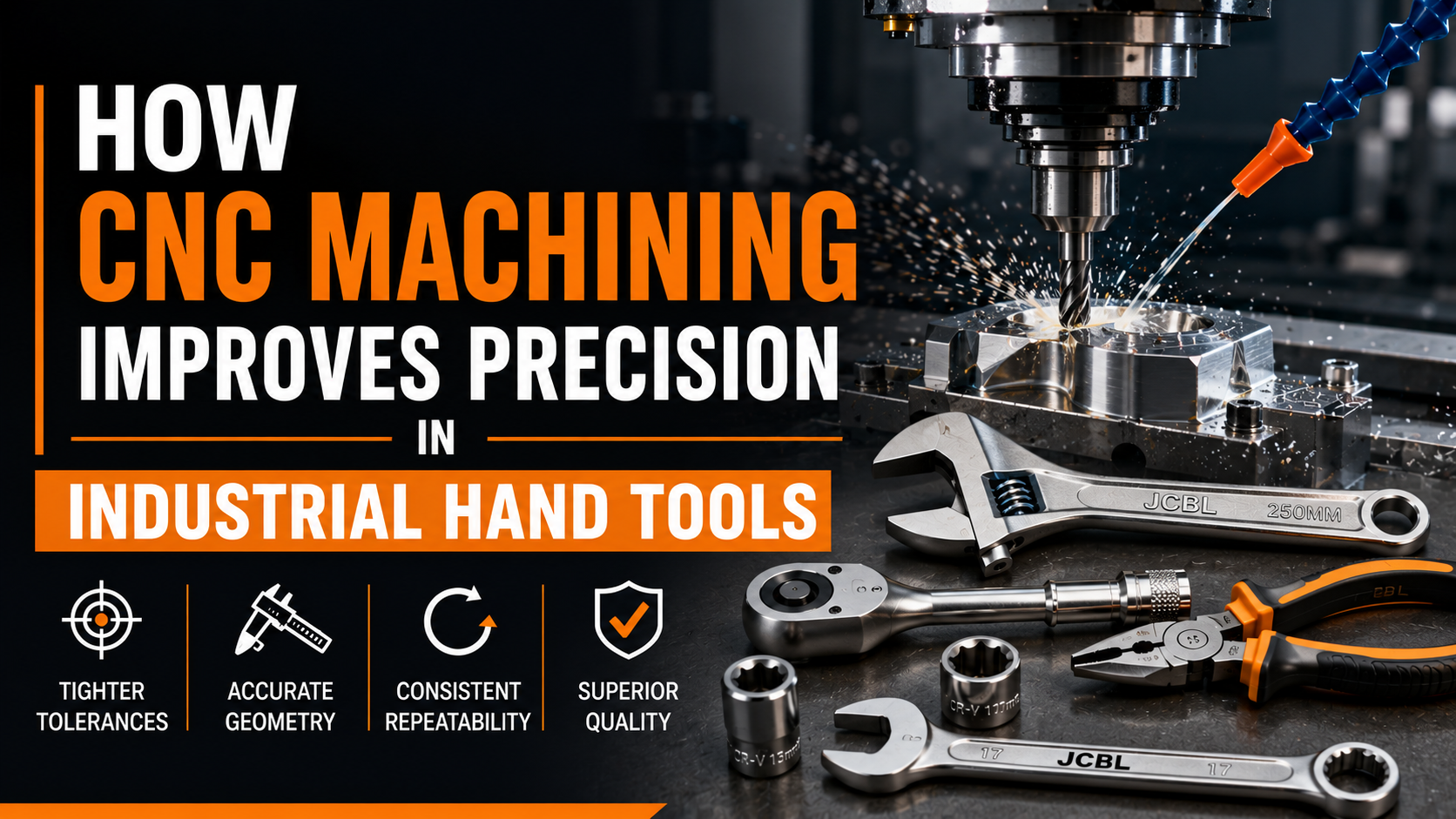
CNC machining improves precision in industrial hand tools by producing components with tight tolerances, accurate geometry, repeatable dimensions, and consistent surface finishes. Using computer-controlled manufacturing systems, manufacturers can reduce production variation and maintain uniform quality across large-volume production runs.
Quick Answer: How Does CNC Machining Improve Precision?
- Maintains tight machining tolerances
- Reduces dimensional variation
- Improves repeatability across batches
- Creates accurate tool geometry
- Enhances surface finish quality
- Minimizes human manufacturing error
- Supports consistent industrial-grade quality
What Is CNC Machining in Industrial Tool Manufacturing?
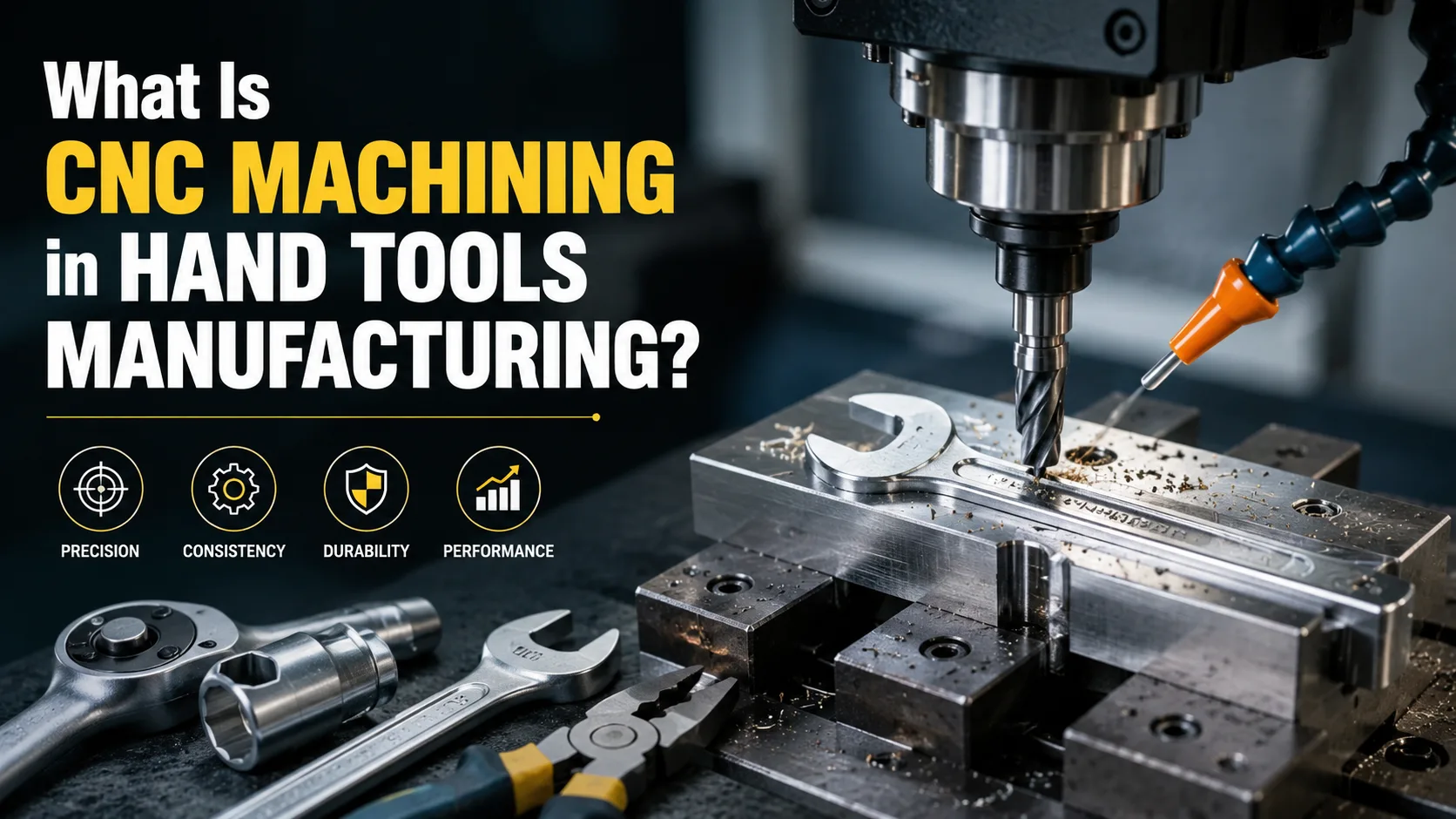
CNC machining, or Computer Numerical Control machining, is a precision manufacturing process that uses programmed software to control cutting, drilling, milling, and shaping operations. In industrial hand tool manufacturing, CNC machines help produce highly accurate components from materials such as hardened steel, stainless steel, and alloy steel.
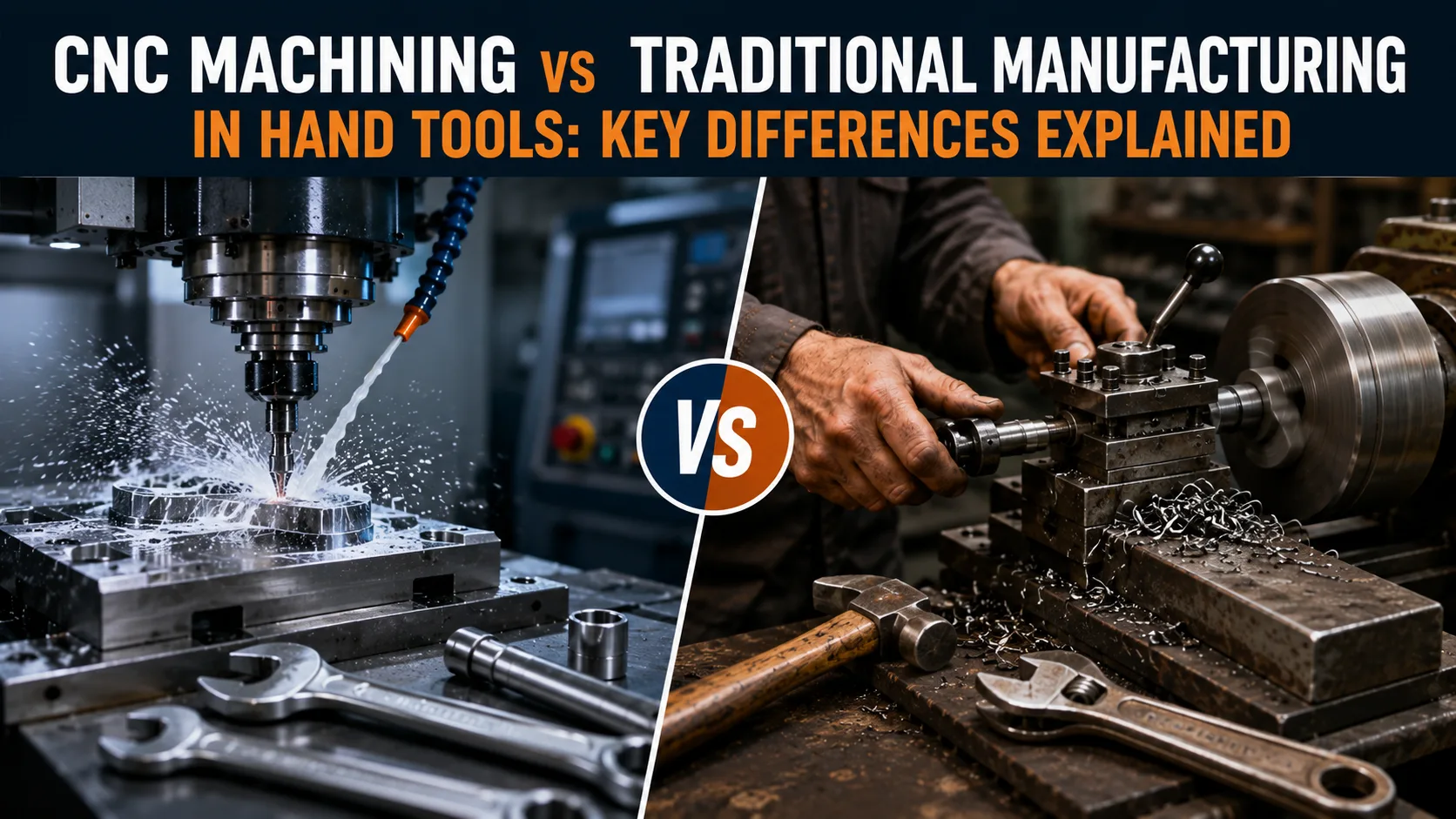
Unlike manual machining, CNC systems follow digital instructions with minimal deviation. This allows manufacturers to maintain better consistency, accuracy, and production efficiency compared to traditional hand tool manufacturing methods.
Common CNC-Machined Industrial Hand Tools
- Torque wrench components
- Sockets and ratchets
- Industrial pliers
- Precision screwdrivers
- Hex and Allen tools
- Adjustable wrench parts
- Cutting and gripping tools
CNC machining is a computer-controlled manufacturing process used to produce industrial hand tools with precise dimensions, tight tolerances, and consistent production quality.
How CNC Machining Improves Precision in Industrial Hand Tools
CNC machining improves precision in industrial hand tools by producing components with consistent dimensions, accurate geometry, and minimal production variation. Using computer-controlled manufacturing processes, manufacturers can maintain stable quality across large production runs while meeting strict industrial tolerance requirements.
1. Maintains Tight Tolerances
CNC machining maintains tight tolerances to improve fitting accuracy, alignment, and tool performance.
Accurate dimensions are critical in industrial hand tools because even small variations can affect fastening precision and gripping performance. CNC machines follow programmed cutting paths to produce components with minimal deviation, helping tools perform consistently during industrial use.
- Produces accurate component dimensions
- Reduces dimensional variation
- Improves fitting and alignment
- Supports consistent tool performance
2. Reduces Manufacturing Errors
CNC machining reduces human error through automated and repeatable manufacturing processes.
Unlike manual machining, CNC systems use programmed instructions to repeat the same operations with high accuracy across every production batch. This helps manufacturers maintain stable quality control and reduce inconsistencies.
- Minimizes manual measurement errors
- Improves production accuracy
- Reduces manufacturing variation
- Supports repeatable production
3. Improves Production Consistency
CNC machining improves repeatability by maintaining consistent specifications across large-scale production runs.
Consistency is important for B2B buyers sourcing industrial hand tools in bulk quantities. CNC machining helps manufacturers produce uniform components using standardized machining parameters.
| Precision Factor | CNC Machining Benefit |
| Dimensional Accuracy | Consistent sizing |
| Repeatability | Uniform production |
| Surface Finish | Reduced wear |
| Quality Control | Lower variation |
- Maintains batch consistency
- Improves quality control
- Supports bulk production requirements
- Reduces product variation
4. Creates Accurate Tool Geometry
CNC machining produces precise tool geometry for better gripping, fastening, and cutting performance.
Industrial hand tools require accurate edge profiles and working angles to function properly. CNC machining helps create consistent geometries in tools such as pliers, cutters, sockets, and Allen tools.
- Produces accurate edge profiles
- Improves gripping accuracy
- Reduces slippage and uneven wear
- Enhances operational reliability
5. Improves Surface Finish and Fit
CNC machining improves surface finish quality for smoother operation and better component fitting.
Controlled cutting paths and precision tooling help create smoother edges and cleaner finishes. This improves component interaction while reducing friction and premature wear.
- Improves surface consistency
- Enhances fitting accuracy
- Reduces friction and wear
- Supports smoother operation
Why Precision Matters in Industrial Hand Tools
Precision is critical in industrial hand tools because it directly affects performance, reliability, and operational safety. Tools with inaccurate dimensions or poor alignment can lead to fastening errors, reduced gripping accuracy, uneven force distribution, and faster component wear during industrial use.
For example, a poorly machined socket may not fit securely on fasteners, while inconsistent cutter alignment can reduce cutting efficiency and create unnecessary stress on the tool. High-precision manufacturing helps industrial hand tools perform consistently under demanding working conditions while maintaining better durability and operational accuracy.
Why Precision Is Important in Industrial Hand Tools
- Ensures accurate fastening and gripping
- Reduces slippage during industrial operations
- Improves torque and cutting accuracy
- Minimizes component wear and damage
- Enhances operational safety and reliability
- Supports consistent performance under heavy use
- Extends tool lifespan in demanding environments
- Helps maintain quality consistency across bulk production orders
Industries That Benefit Most from CNC-Machined Hand Tools
- Automotive Manufacturing: Automotive production and repair operations require precise fastening and assembly tools. CNC-machined hand tools help improve torque accuracy and fitting precision.
- Aerospace Industry: Aerospace applications often involve strict tolerance requirements where dimensional accuracy is critical for assembly and maintenance operations.
- Heavy Equipment and Machinery: Industrial machinery maintenance requires precision tools capable of handling high-load fastening and servicing applications.
- Industrial Manufacturing Facilities: Factories and production facilities rely on consistent tool performance for machine maintenance, assembly operations, and equipment servicing.
- Industrial Maintenance Operations: Maintenance professionals often require tools capable of maintaining dimensional stability and reliable performance under continuous use conditions.
Conclusion
CNC machining plays an important role in improving precision in industrial hand tools by maintaining tight tolerances, reducing production variation, improving repeatability, and creating accurate tool geometry. These advantages help manufacturers produce industrial-grade tools with consistent quality and reliable performance.
For B2B buyers, importers, and industrial distributors, CNC-machined hand tools offer better manufacturing consistency, improved dimensional accuracy, and stronger quality assurance across large-volume production orders.
FAQs
CNC machining improves tool accuracy by using computer-controlled manufacturing processes that maintain precise dimensions, consistent geometry, and repeatable production quality.
Tight tolerances help industrial hand tools maintain accurate fitting, proper alignment, reduced wear, and reliable performance during industrial applications.
Depending on the machine type, material, and application, CNC machining can achieve tolerance levels measured in microns for high-precision industrial components.
Industrial manufacturers use CNC machining to improve dimensional accuracy, maintain production consistency, reduce manufacturing errors, and support high-volume precision manufacturing.
CNC-machined hand tools are often more reliable because accurate machining improves component fitting, reduces uneven stress, and supports consistent manufacturing quality.