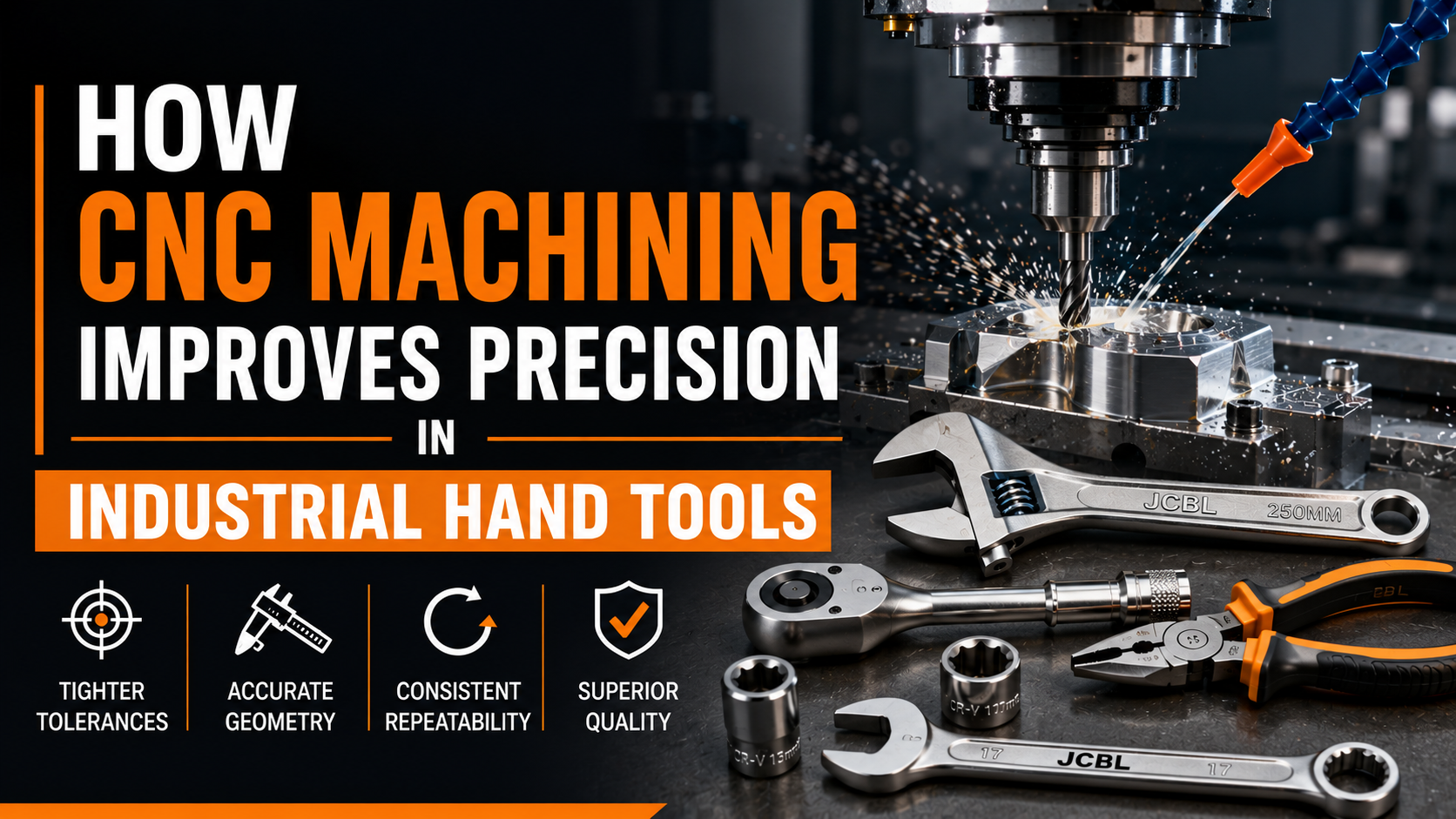
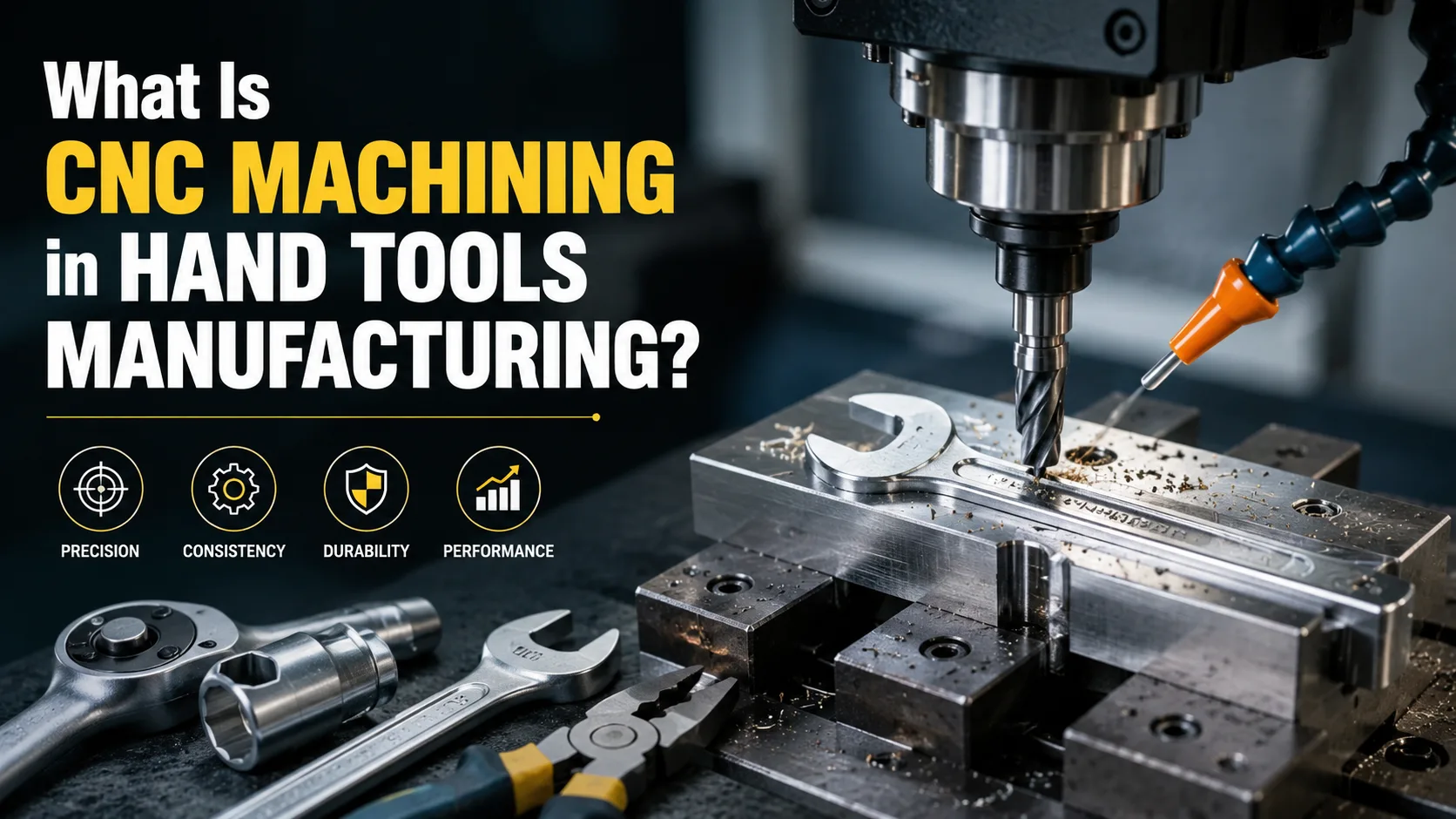
CNC Machining vs Traditional Manufacturing in Hand Tools: Key Differences Explained
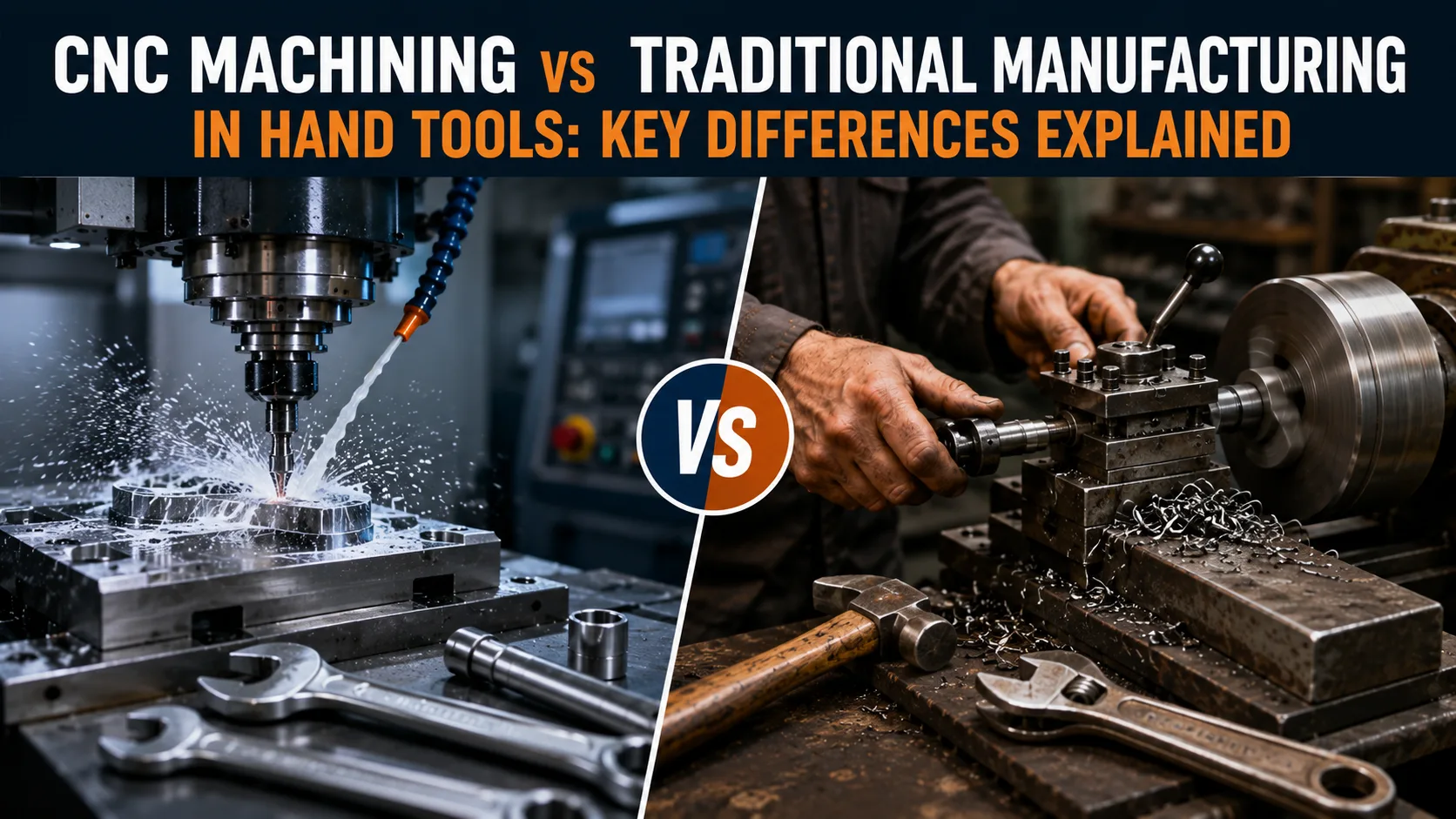
CNC machining and traditional manufacturing are two widely used methods in hand tools production, each serving different industrial requirements. CNC machining relies on computer-controlled automation for precision manufacturing, while traditional methods depend on manual machining processes and operator skill.
This comparison is important for OEM suppliers, industrial buyers, and export manufacturers evaluating production efficiency, scalability, and quality consistency in hand tools manufacturing.
CNC Machining vs Traditional Manufacturing: Quick Comparison
| Factor | CNC Machining | Traditional Manufacturing |
| Precision Control | High, computer-driven tolerance accuracy | Depends on operator skill and manual control |
| Production Method | Automated and programmed | Manual or semi-manual machining |
| Batch Consistency | Highly repeatable output | Variation between batches possible |
| Scalability | Suitable for large-scale OEM production | Limited scalability |
| Setup Requirement | High initial programming/setup | Lower initial setup complexity |
| Production Stability | Consistent and controlled | Variable depending on operator |
What Is the Difference Between CNC Machining and Traditional Manufacturing?
1. Production Control System
CNC machining is controlled through programmed digital instructions, while traditional manufacturing depends on manual machine operation.
In CNC systems, every cutting movement is predefined through software, ensuring precise and repeatable execution. Traditional manufacturing relies on operator decisions during machining, making the process more flexible but less standardized.
- CNC = automated digital control system
- Traditional = manual machine handling
- CNC ensures repeatable process execution
2. Manufacturing Precision
CNC machining delivers higher and more consistent precision than traditional manufacturing.
CNC systems maintain tight tolerances using automated toolpaths and programmed settings. Traditional methods achieve precision through manual calibration, which can vary depending on operator experience and machine handling.
- CNC ensures consistent dimensional accuracy
- Traditional precision varies by operator skill
- CNC reduces production variation in batches
3. Production Scalability
CNC machining is better suited for large-scale production, while traditional manufacturing is limited to smaller batches.
CNC systems are designed for continuous operation with minimal variation, making them ideal for OEM and industrial-scale production. Traditional manufacturing requires more manual involvement, limiting scalability in high-volume environments.
- CNC supports continuous mass production
- Traditional is better for small/medium batches
- CNC scales efficiently for OEM supply chains
4. Operational Efficiency
CNC machining offers higher operational efficiency due to reduced manual intervention.
CNC systems minimize downtime by automating machining sequences and reducing repeated setup work. Traditional manufacturing requires frequent manual adjustments, which slows down production cycles.
- CNC reduces setup repetition
- Traditional needs frequent manual adjustments
- CNC improves cycle-time stability
5. Design Execution Capability
CNC machining enables more complex and precise tool designs than traditional manufacturing.
CNC systems support multi-axis machining and advanced geometries required in modern industrial hand tools. Traditional manufacturing is more limited when producing intricate or highly detailed components at scale.
- CNC supports complex geometries
- Multi-axis machining possible in CNC
- Traditional methods have design limitations
Which Manufacturing Method Is Better for Industrial Hand Tools?
CNC machining is generally considered better for industrial hand tools that require:
- high precision
- consistent quality
- scalable production
- OEM manufacturing capability
- export-grade standards
Traditional manufacturing may still be practical for smaller production runs or simpler manual fabrication processes.
For modern industrial manufacturing environments, CNC machining offers stronger long-term advantages in efficiency, repeatability, and production scalability.
Why Global Hand Tool Manufacturers Are Adopting CNC Technology
Global industrial markets increasingly demand:
- precision-engineered hand tools
- consistent product quality
- faster production timelines
- scalable OEM supply capability
To meet these requirements, manufacturers are investing in CNC machining systems that improve operational efficiency and maintain standardized production quality.
CNC technology also helps manufacturers remain competitive in international export markets where dimensional accuracy and repeatable manufacturing standards are critical.
Conclusion
CNC machining and traditional manufacturing serve different roles in hand tools production, but CNC systems offer clear advantages in precision control, scalability, and production consistency.
For OEM manufacturers and industrial suppliers, CNC machining provides the operational reliability required for modern hand tools manufacturing, especially in export-driven and large-scale production environments where consistency and accuracy are critical.
FAQs
Yes. CNC machining generally provides better precision, consistency, production efficiency, and scalability for industrial hand tools manufacturing.
Manufacturers use CNC machines to improve dimensional accuracy, reduce production variability, and maintain consistent quality during large-scale manufacturing.
Yes. Traditional manufacturing is still used for small-scale production, manual fabrication, repair work, and certain finishing operations.
CNC machining provides better precision because production operations are controlled through automated computer programming systems.
Yes. CNC machining supports faster production, repeatable quality, and scalable manufacturing capacity for OEM and export-oriented hand tools production.