Difference Between Cast and Forged Tools
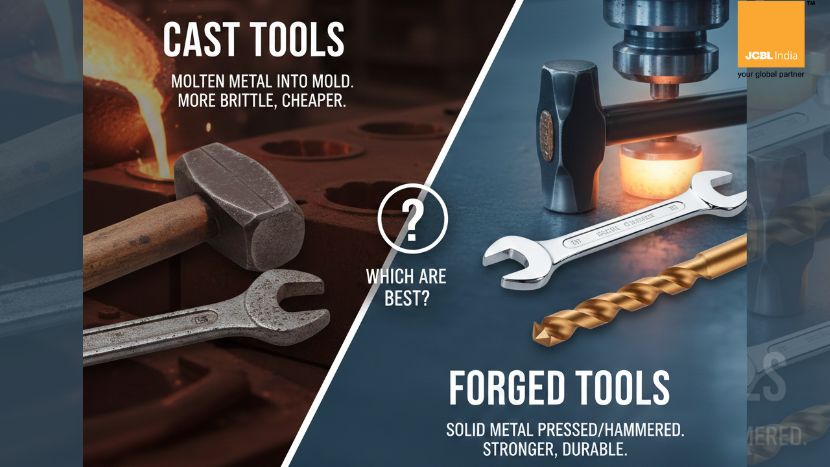
Forged tools are stronger, more durable, and better suited for high-impact and heavy-duty applications, while cast tools are ideal for complex shapes and cost-effective, low-stress use.
The core difference between casting and forging lies in how the metal is processed; this directly impacts strength, grain structure, durability, and safety. For industries such as automotive, construction, and manufacturing, choosing the right type of tool is critical for both performance and risk reduction.
This guide explains the difference between cast and forged tools, helping professionals make informed, application-specific decisions.
Cast vs Forged Tools: Quick Comparison
| Feature | Forged Tools | Cast Tools |
| Manufacturing Process | Compressed under high pressure | Molten metal poured into molds |
| Strength | Very high | Moderate |
| Grain Structure | Aligned and dense | Random and porous |
| Impact Resistance | Excellent | Low |
| Durability | Long service life | Prone to wear/cracking |
| Shape Complexity | Limited | Highly complex possible |
| Cost | Higher | Lower |
Note: For strength, safety, and reliability, the forged tools are suitable, whereas for design complexity and cost efficiency, choose casting tools.
What Is Casting in Manufacturing?
Casting is a process where molten metal is poured into a mold and solidified into a desired shape. It is widely used to manufacture components that require complex geometries, cavities, or large structures that are difficult to achieve through other methods.
How Casting Works
- Metal is heated until it becomes liquid
- The molten metal is poured into a mold cavity
- It cools and solidifies into shape
- The mold is removed to reveal the final component
Advantages of Casting
- Enables intricate and detailed designs
- Cost-effective for large-scale production
- Minimal material wastage
Limitations of Casting
- Porosity risk (internal air pockets)
- Weaker grain structure compared to forging
- Lower resistance to impact and fatigue stress
Casting is best suited for low-stress applications where design complexity is a priority.
What Is Forging Process in Metal?
Forging is a manufacturing process where metal is shaped using compressive forces while in a heated solid state. Unlike casting, the metal is not melted. Instead, it is mechanically deformed, resulting in a denser and stronger internal structure.
How Forging Works
- Metal is heated to a high temperature
- It is shaped using hammering, pressing, or rolling
- The component is cooled and finished
Advantages of Forging
- Superior mechanical strength and toughness
- High resistance to impact, fatigue, and stress
- Improved structural integrity and reliability
- Longer operational lifespan
Limitations of Forging
- Higher production cost
- Limited capability for highly intricate shapes
Forging is ideal for safety-critical and load-bearing applications.
Cast vs Forged Tools: Key Differences Explained
1. Manufacturing Method
Forged tools are shaped under high pressure, making them dense and structurally strong. Cast tools are formed by pouring molten metal into molds, which allows flexibility in design but reduces structural integrity.
2. Grain Structure
Forging aligns the metal’s grain flow, significantly improving strength and fatigue resistance. Casting results in a non-uniform grain structure, often containing micro-voids.
3. Strength and Durability
Forged tools exhibit higher tensile strength and longer lifespan, while cast tools are more prone to cracking under stress.
4. Impact Resistance
Forged components can withstand repeated impact and shock loads, whereas cast tools may fail under similar conditions.
5. Cost and Production
Casting is generally more economical for large volumes, while forging involves higher manufacturing costs but delivers superior performance.
Which Tools Are Forged vs Cast?
Common Forged Tools (High-Performance Applications)
- Wrenches and spanners
- Pliers and pincers
- Hammers (sledgehammers, ball-peen)
- Chisels and punches
- Industrial fasteners
These tools are used in high-torque, high-impact environments, making forging essential.
Common Cast Tools (Low-Stress Applications)
- Bench vices and pipe vices
- Machine frames and bases
- Large tool bodies
- Decorative or structural components
These are suitable for applications where complex geometry matters more than strength.
When to Choose Cast vs Forged Tools
Choose Forged Tools If:
- The application involves high impact or repeated stress
- Safety and reliability are critical
- Long-term durability is required
- Used in industrial, automotive, or construction environments
Choose Cast Tools If:
- The component requires complex shapes or large structures
- The application involves low mechanical stress
- Cost efficiency is a priority
Why Forged Tools Are Preferred in Industrial Applications
Forged tools are widely used across industries due to their superior mechanical properties and safety performance.
- Enhanced grain flow improves load-bearing capacity
- No internal porosity, reducing failure risk
- Higher fatigue resistance under cyclic loads
- Better shock absorption, minimizing breakage
According to materials engineering research published in journals such as Materials Science and Engineering, forged metals consistently demonstrate greater structural integrity and fatigue strength compared to cast metals.
This is why forged tools are standard in:
- Automotive workshops
- Construction sites
- Heavy manufacturing units
Conclusion
Both casting and forging are essential manufacturing processes, each serving distinct industrial needs based on application requirements. Casting is best suited for producing complex, cost-effective components where intricate shapes are required, while forging is critical for applications that demand high strength, durability, and safety. In professional and industrial environments, forged tools consistently outperform cast alternatives due to their superior reliability and long-term performance under stress. For businesses focused on efficiency and safety, investing in quality orthopedic supports alongside precision-engineered forged tools can significantly enhance operational performance and reduce the risk of tool failure.
FAQs
Yes, forged tools are stronger and more durable because their grain structure is compressed and aligned, making them ideal for heavy-duty and high-impact applications.
Forged steel is stronger than cast steel due to its dense and uniform grain structure, which improves resistance to stress, impact, and fatigue.
Forged tools offer higher strength, better durability, improved impact resistance, and longer service life compared to cast tools.
Cast tools are best used in low-stress applications that require complex shapes, such as machine frames, vices, and large structural components.
Related Post
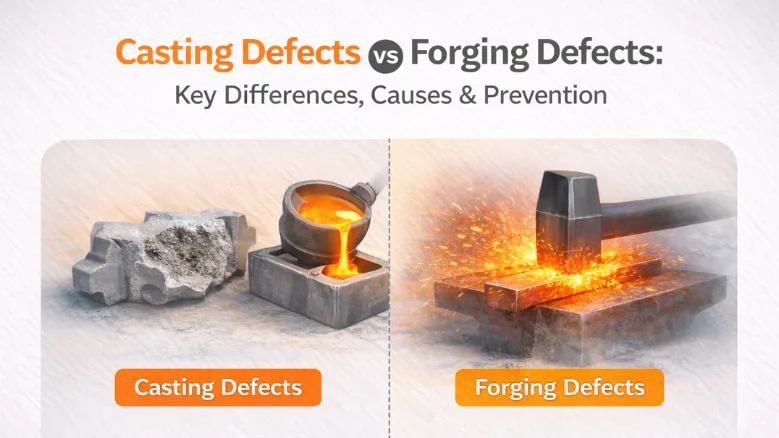
Casting Defects vs Forging Defects: Key Differences, Causes & Prevention
The primary difference between casting defects and forging defects lies in their origin: casting defects, [...]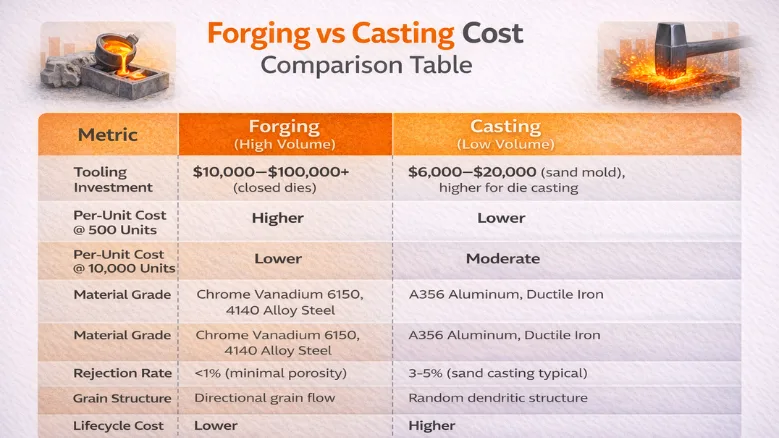
Forging vs Casting Cost Comparison: Which Is More Economical?
Forging is more economical for high-volume production (10,000+ units) due to lower per-unit costs and [...]