Hot vs Cold vs Warm Forging: Key Differences Explained
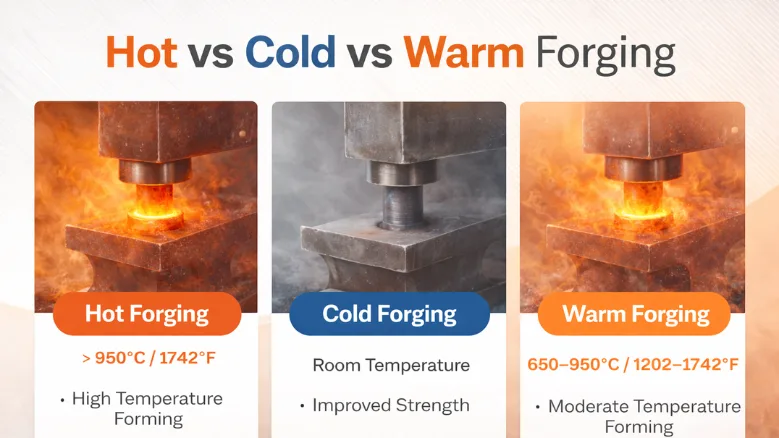
Hot, cold, and warm forging are primarily distinguished by temperature, and that one variable directly shapes strength, precision, cost, and overall manufacturing efficiency.
Hot forging is used when strength and durability matter most. Cold forging is preferred when precision and surface finish are critical. Warm forging sits in between and is chosen when both strength and accuracy are required in the same component.
- Hot forging → maximum strength
- Cold forging → highest precision
- Warm forging → balanced performance
Why Forging Matters in Hand Tool Manufacturing
Forging is what gives a tool its real strength, not just its shape.
When metal is forged, its internal grain structure is compressed and aligned with the shape of the tool. This makes it significantly stronger than cast or machined parts, especially under repeated stress or impact. That’s why forged tools last longer and perform more reliably in industrial environments.
- Improves strength and fatigue resistance
- Eliminates internal defects
- Increases durability under heavy use
- Reduces failure risk in demanding applications
How Temperature Impacts the Forging Process
The role of temperature in forging is simple but powerful, it controls how the metal behaves during shaping.
At higher temperatures, metal becomes soft and flows easily into complex shapes, but you lose some dimensional accuracy. At lower temperatures, the metal resists deformation, which improves precision but requires significantly more force.
- Higher temperature for easier shaping, lower accuracy
- Lower temperature for higher precision, higher force
- Mid-range temperature for controlled balance
Hot Forging: Built for Strength and Impact
Hot forging is the go-to process when tools need to withstand heavy loads, shock, and continuous use.
The metal is heated above its recrystallization temperature (typically above 900°C for steel), allowing its internal structure to reform during shaping. This removes internal stresses and aligns the grain flow along the tool’s geometry, which is critical for strength.
Because of this, hot-forged tools can absorb impact without cracking and maintain structural integrity over time. The trade-off is that the process is less precise, so additional machining is often required.
- Highest strength and toughness
- Ideal for impact and load-bearing tools
- Supports complex shapes
- Lower dimensional accuracy
- Requires post-processing
Cold Forging: Precision and Consistency at Scale
Cold forging is all about accuracy and repeatability.
Since the process happens at room temperature, there is no thermal expansion to deal with. This allows manufacturers to achieve tight tolerances and excellent surface finish straight out of the die. The metal also becomes harder during deformation, which improves surface strength.
However, the process requires very high pressure and is better suited for simpler shapes and high-volume production.
- Excellent dimensional accuracy
- Smooth surface finish
- Minimal material waste
- Ideal for mass production
- Limited design flexibility
Warm Forging: A Smarter Middle Ground
Warm forging is often misunderstood as just a compromise, but in reality, it’s a strategic choice.
By working at intermediate temperatures (around 600–800°C), manufacturers get better metal flow than cold forging and better accuracy than hot forging. This reduces forming force, improves tool life, and still maintains good mechanical strength.
That’s why warm forging is increasingly used in modern manufacturing, where both performance and efficiency matter.
- Balanced strength and precision
- Lower forming force compared to cold forging
- Reduced oxidation compared to hot forging
- Longer die life
- Suitable for medium-duty applications
Key Differences That Actually Matter
If you strip everything down, the difference between these processes comes down to what problem you’re trying to solve.
Hot forging solves strength challenges. Cold forging solves precision challenges. Warm forging solves situations where you need both without overcomplicating production.
- Choose hot forging for durability and impact resistance
- Choose cold forging for tight tolerances and finish
- Choose warm forging for performance balance
How to Choose the Right Forging Process
Choosing the right forging method isn’t about picking the “best” one—it’s about matching the process to the application.
Start by looking at how the tool will be used. High-impact tools naturally require hot forging, while precision components need cold forging. If the requirement sits somewhere in between, warm forging usually delivers better value.
It’s also important to look beyond unit cost. Factors like machining, tooling wear, and production scale can significantly impact the total cost.
- High load or shock → hot forging
- Tight tolerances → cold forging
- Mixed requirements → warm forging
- High-volume production → cold forging is efficient
- Custom or heavy parts → hot forging is more suitable
Best Forging Method Based on Tool Type
Different tools demand different properties, which is why all three forging methods are widely used.
For heavy-duty tools, strength is non-negotiable, making hot forging the preferred choice. Precision tools rely on exact dimensions, which is where cold forging excels. For professional tools used across multiple applications, warm forging offers the best balance.
- Hot forging: Hammers, chisels, heavy spanners
- Cold forging: Sockets, pliers, fastening tools
- Warm forging: Combination spanners, industrial tools
What B2B Buyers Should Really Look For
From a procurement perspective, the forging method tells you a lot about the quality of the final product.
A capable supplier doesn’t just manufacture tools—they select the right forging process based on application requirements. This ensures consistency, reduces failure rates, and improves long-term performance.
- Consistent process control and temperature management
- Proper material selection and grain structure integrity
- Capability for heat treatment and finishing
- Ability to scale production without compromising quality
Conclusion
There’s no single forging method that works for every situation.
Hot forging delivers unmatched strength, cold forging delivers precision, and warm forging provides a balance of both. The key is to align the process with the actual use case of the tool rather than choosing based on cost alone.
- Strength-focused applications → hot forging
- Precision-focused applications → cold forging
- Balanced requirements → warm forging
FAQs
Hot forging offers the highest strength because it optimizes grain flow and removes internal defects.
Cold forging provides the best dimensional accuracy and surface finish.
It depends on the application. Warm forging is better for balanced performance, while hot forging is better for extreme strength.
The main difference is temperature; hot forging improves strength, while cold forging improves precision.
All three are used, depending on whether the tool requires strength, precision, or a balance of both.
Related Readings
- What Is Forging?
- What Is Hot Forging?
- What Is Cold Forging?
- What Is Warm Forging?
- Closed-Die vs Open-Die Forging: Process & Key Differences
- Types of Forging Processes Explained
- Grain Structure in Forged vs Cast Metal
- Heat Treatment in Forging and Casting
- Casting Defects vs Forging Defects
- Forging vs Casting Cost Comparison
- What Is Casting?