Global Double-Ended Ring Spanner Market Trends, Growth & Future Outlook (2026–2035)
- Double-Ended Ring Spanner Market Overview
- Key Trends in the Double-Ended Ring Spanner Market
- Double-Ended Ring Spanner Market Segmentation
- Regional Outlook for Double-Ended Ring Spanners
- Double-Ended Ring Spanner Manufacturers and Competitive Landscape
- Manufacturing Considerations for Double-Ended Ring Spanners
- Double-Ended Ring Spanner Market Outlook 2026–2035
- Conclusion
- FAQs
The global double-ended ring spanner market is developing around demand for versatile, durable, and precision-manufactured tools used for fastening, maintenance, repair, and mechanical assembly. A double-ended ring spanner combines two ring sizes in one tool, allowing users to work with different fasteners without carrying separate tools.
Recent category-specific market research evaluates the double-ended ring spanner market through sales volume, consumption value, average selling price, manufacturer performance, regional demand, product type, and sales channel. This provides a more relevant basis for understanding the market than broader hand-tool statistics.
Double-Ended Ring Spanner Market Overview
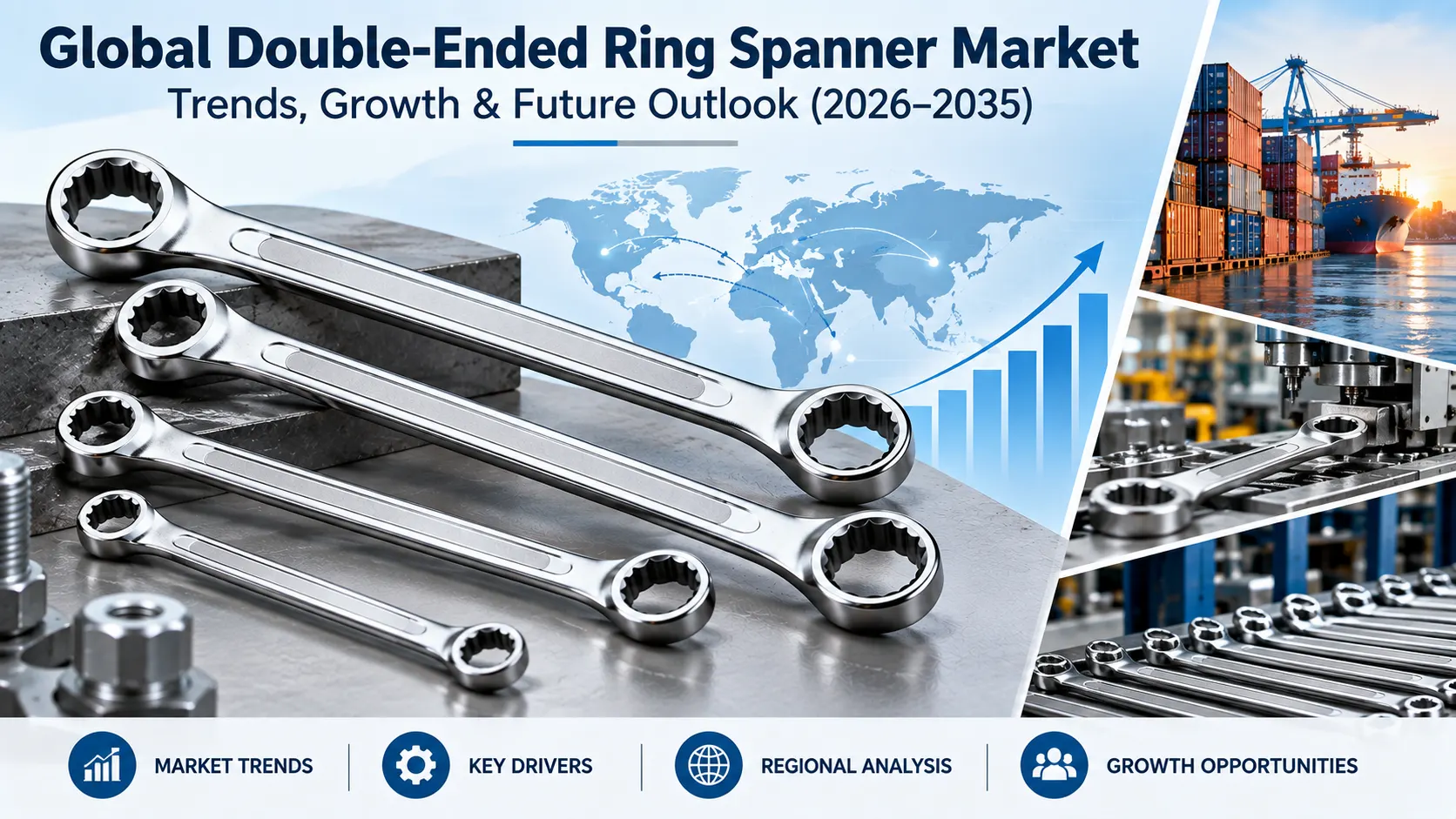
Double-ended ring spanners are professional fastening tools with enclosed ring ends in two different sizes, allowing one tool to accommodate multiple fasteners. Their enclosed profile provides a secure grip around compatible nuts and bolts, while the double-ended configuration improves tool versatility for maintenance, repair, and assembly work.
The double-ended ring spanner market is primarily differentiated by product design and sales channel. Category-specific market research identifies straight and offset ring spanners as the main product types. Straight designs are suited to applications where the fastener is directly accessible, while offset designs provide additional clearance when surrounding components restrict access. The market is also assessed across online and offline sales channels, reflecting the different purchasing routes used for professional and industrial tools.
The competitive landscape is evaluated through manufacturer-level indicators, including sales volume, revenue, average selling price, and market share, alongside regional and country-level demand. This makes product configuration, pricing, manufacturing scale, and geographic sales important indicators when assessing market development.
Note: Publicly available versions of current Double-Ended Ring Spanner market reports do not disclose the underlying global market value and CAGR figures. Accordingly, this article does not use an estimated market size that cannot be independently verified.
Key Trends in the Double-Ended Ring Spanner Market
1. Growing Focus on Precision-Made Ring Profiles
For double-ended ring spanners, dimensional accuracy is critical because the ring must fit the intended fastener correctly. Consistent opening dimensions, alignment, and profile geometry can directly influence tool usability and force application.
For manufacturers and B2B buyers, this makes controlled production, dimensional inspection, and consistent tooling important considerations when evaluating suppliers.
2. Straight and Offset Designs Address Different Requirements
The double-ended ring spanner market is commonly segmented into straight and offset designs. This distinction reflects differences in accessibility rather than simply appearance.
Straight designs are suitable where the fastener can be approached directly, while offset configurations can provide additional clearance where surrounding components restrict access. Category-specific market research identifies straight and offset products as separate market segments.
3. Material and Manufacturing Process Remain Important
Material selection and manufacturing method influence the strength, durability, and dimensional consistency of a double-ended ring spanner.
Depending on the required specification, manufacturers may use carbon steel or Chrome Vanadium (CRV) steel, along with manufacturing processes such as forging or stamping. Heat treatment, including controlled hardening and tempering, is also important for achieving the mechanical properties required for professional fastening applications.
For importers, distributors, and OEM buyers, evaluating material grade together with manufacturing controls provides a more useful basis for supplier comparison than relying on finish or appearance alone.
4. Product Specifications Are Becoming More Diverse
The market includes different size combinations, profiles, and configurations designed for varying fastening requirements. Metric size ranges, specialized sizes, and application-specific configurations allow buyers to build product portfolios around their target markets.
For B2B procurement teams, this creates demand for suppliers capable of maintaining consistent specifications across multiple sizes rather than supplying only individual standard tools.
Double-Ended Ring Spanner Market Segmentation
The category-specific research identifies several important dimensions within the market.
By Type
- Straight Double-Ended Ring Spanners
- Offset Double-Ended Ring Spanners
The two configurations serve different access and clearance requirements.
By Sales Channel
- Online sales
- Offline sales
The inclusion of both channels indicates that double-ended ring spanners are distributed through digital purchasing platforms as well as conventional tool and industrial distribution networks.
By Region
The global market research covers:
- North America
- Europe
- Asia-Pacific
- South America
- Middle East & Africa
The category research further provides country-level analysis across major markets, including China, Japan, South Korea, India, Southeast Asian countries, Australia, the United States, Canada, Mexico, Germany, France, the United Kingdom, Italy, and Russia.
Regional Outlook for Double-Ended Ring Spanners
Asia-Pacific
Asia-Pacific is an important region within the double-ended ring spanner market, with country-level analysis covering China, Japan, South Korea, India, Southeast Asia, and Australia. The availability of country-specific market data allows manufacturers and distributors to evaluate differences in sales, consumption, and competitive activity across individual markets.
Europe
The European market includes established tool markets such as Germany, France, the United Kingdom, and Italy, alongside Russia and other countries covered in category-specific research. Market competition in this region is assessed through manufacturer performance, product sales, and regional demand.
North America
The category research covers the United States, Canada, and Mexico, providing country-level data for evaluating double-ended ring spanner sales and consumption within the region.
Middle East, Africa, and South America
The research also covers markets including the UAE, Saudi Arabia, Egypt, South Africa, Brazil, Argentina, and Colombia. These markets form part of the regional assessment of double-ended ring spanner demand and competitive activity.
Double-Ended Ring Spanner Manufacturers and Competitive Landscape
The competitive landscape includes manufacturers and suppliers operating across different geographic markets and product segments. Category-specific research evaluates companies using metrics such as sales quantity, revenue, average selling price, gross margin, and market share.
For B2B buyers, competition within the market extends beyond price. Important supplier-selection factors include:
- Material specification and consistency
- Manufacturing process
- Dimensional accuracy
- Heat-treatment controls
- Surface finish
- Size availability
- Production capacity
- OEM and private-label capability
- Packaging and export readiness
- Consistency across bulk orders
This is particularly relevant for importers and distributors purchasing multiple sizes or building private-label tool ranges.
Manufacturing Considerations for Double-Ended Ring Spanners
Manufacturing consistency is particularly important for double-ended ring spanners because every working end must maintain the specified dimensions and profile.
A quality-focused production process can include:
- Material selection according to the required specification.
- Forming or forging to establish the basic tool geometry.
- Machining and sizing to achieve accurate ring dimensions.
- Heat treatment to develop the required hardness and strength.
- Dimensional inspection to verify working-end accuracy.
- Surface finishing to provide the specified appearance and protection.
- Final inspection before bulk packing and dispatch.
For international B2B buyers, these controls are important when assessing whether a supplier can maintain consistent quality across repeated production batches.
Double-Ended Ring Spanner Market Outlook 2026–2035
The outlook for the double-ended ring spanner market will increasingly be shaped by precision manufacturing, product diversification, material selection, and dependable bulk production.
The category-specific market studies provide a framework for monitoring this development through sales quantity, consumption value, average selling price, manufacturer performance, product type, and regional demand.
For manufacturers, exporters, and B2B buyers, the strongest opportunities are likely to center on:
- Consistent production across multiple sizes
- Straight and offset configurations
- Durable steel specifications
- Accurate ring dimensions
- Reliable heat-treatment processes
- Application-specific product ranges
- OEM and private-label manufacturing
- Efficient online and offline distribution
Conclusion
The global double-ended ring spanner market represents a distinct segment of professional fastening tools, with current market research tracking product type, sales channels, regional performance, pricing, and manufacturer-level activity.
The market’s development through 2035 should therefore be assessed through product-specific sales, regional demand, manufacturer performance, and product specifications, rather than unrelated hand-tool or automotive market figures. For B2B buyers, manufacturers, and exporters, precision, material consistency, manufacturing quality, and reliable bulk supply will remain central to competing in the global double-ended ring spanner market.
FAQs
A double-ended ring spanner is used for tightening and loosening compatible nuts and bolts. With two ring ends in different sizes, one tool can handle multiple fastener sizes while providing enclosed contact around the fastener.
The main difference is the position and angle of the ring ends. Straight double-ended ring spanners are suited to direct access, while offset designs provide additional clearance when fasteners are located in recessed or restricted areas.
Double-ended ring spanners can be manufactured from materials such as carbon steel and Chrome Vanadium (CRV) steel. The appropriate material depends on the required strength, durability, application, and product specification.
B2B buyers should evaluate material grade, manufacturing process, dimensional accuracy, heat treatment, finish, available sizes, quality-control procedures, production capacity, and OEM or private-label capabilities before selecting a supplier.
Yes. Manufacturers can offer different size combinations and configurations, including straight and offset designs. The available range depends on the manufacturer’s product specifications and production capabilities.
Look for a manufacturer with established production capabilities, consistent quality-control processes, appropriate material and heat-treatment facilities, multiple size and configuration options, and experience in bulk, OEM, or export supply.
Related Post