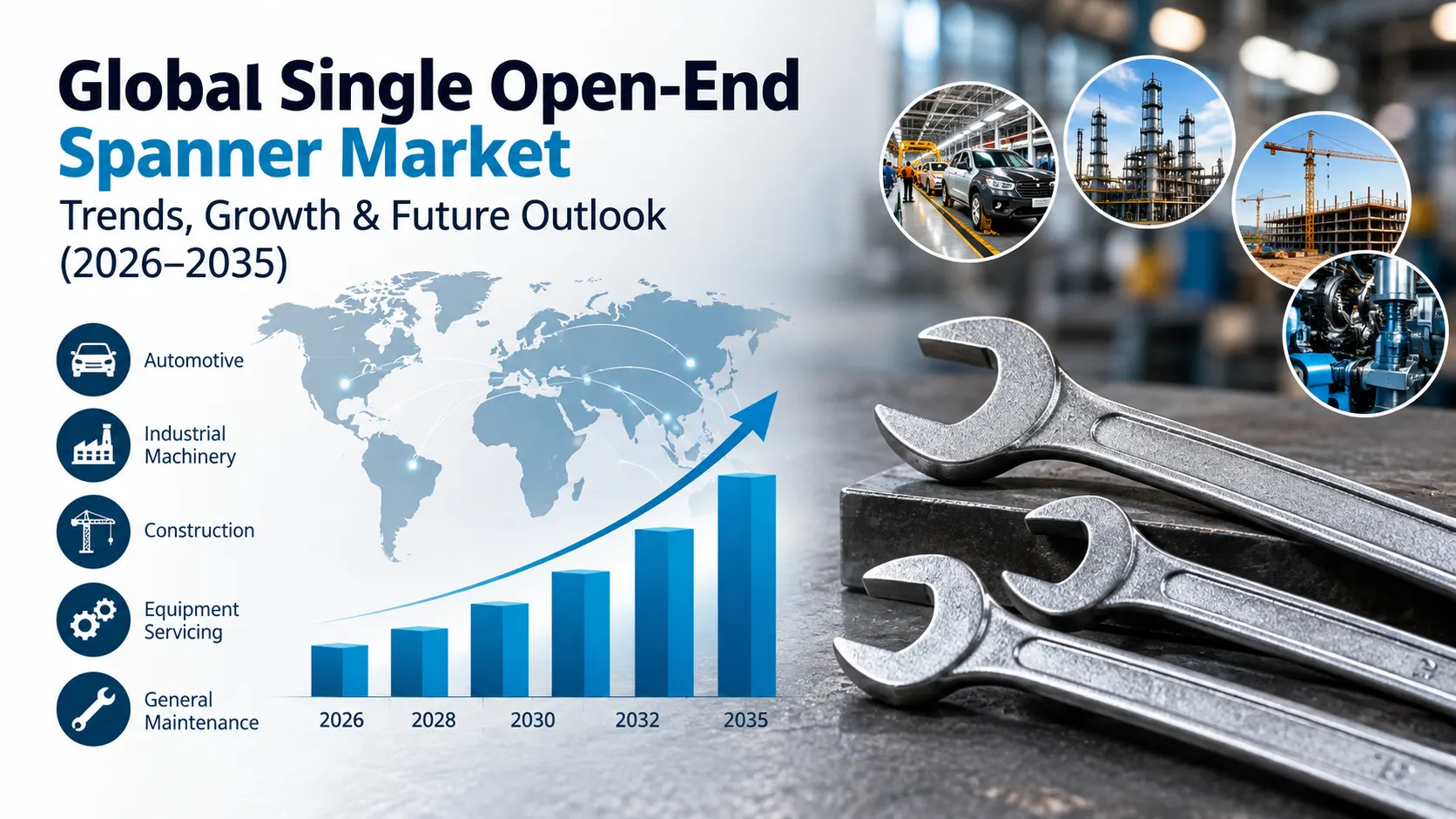
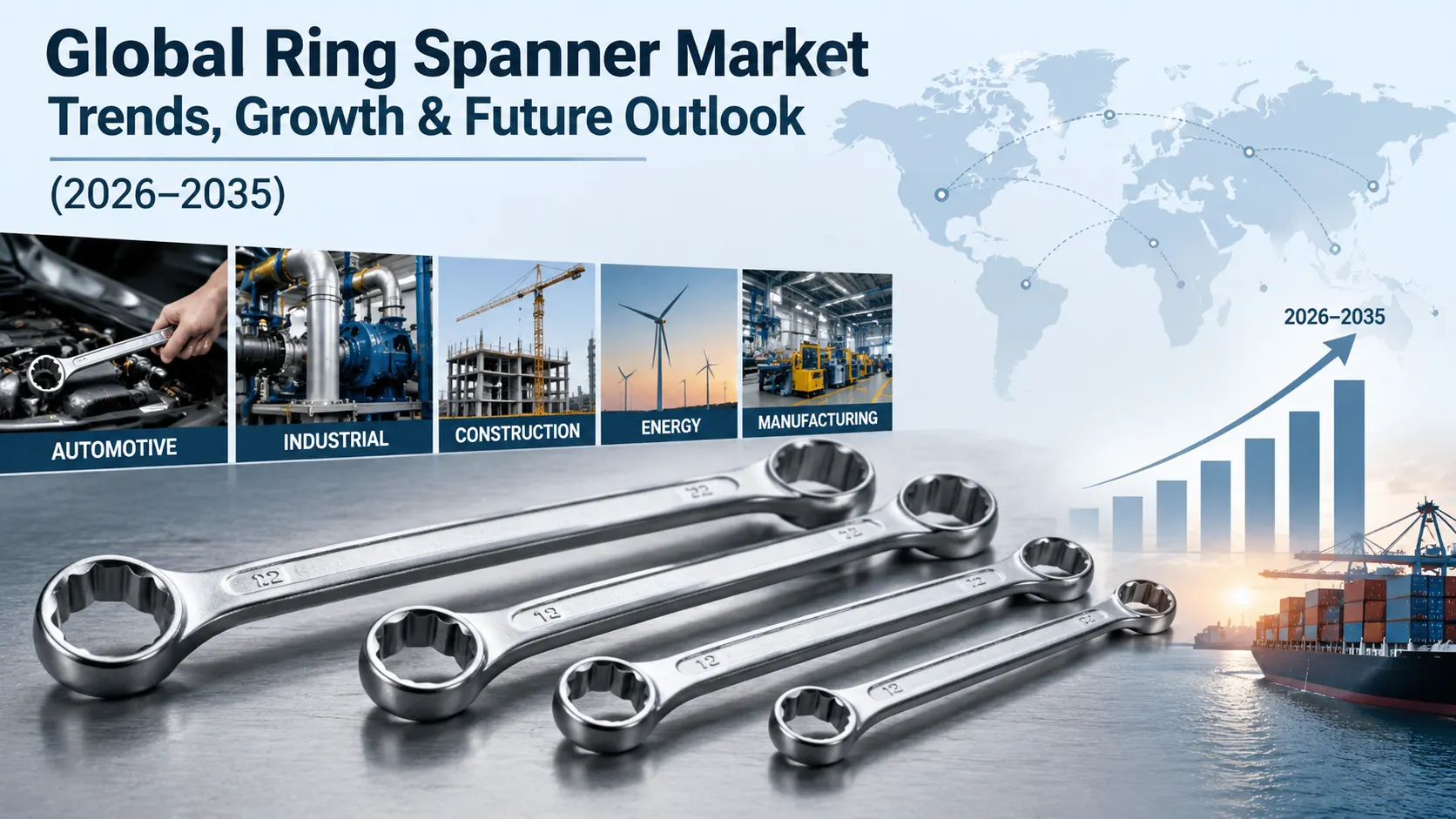
Global Spanner Market Trends, Growth & Future Outlook (2026–2035)

The global spanner market is supported by demand from automotive, construction, manufacturing, industrial maintenance, MRO, infrastructure, and other mechanical applications. Because market-research firms often report individual spanner categories separately, the market is best assessed using a combination of segment-level forecasts and international trade data. Available evidence points to continued growth across adjustable, combination, and non-adjustable spanner categories, alongside rising demand for reliable, specification-driven tools.
For B2B manufacturers, exporters, and buyers, the market is also changing in another important way, and product quality, manufacturing consistency, customization, and supply-chain reliability are becoming increasingly important alongside price.
Global Spanner Market Size and Growth
There is no single universally reported figure for the entire global spanner market because research firms classify spanners by product type, application, or market scope. Adjustable spanners, combination spanners, and other wrench categories may therefore be reported separately.
A more reliable view of the global market combines spanner-specific market forecasts with international trade data and broader hand-tool market evidence. The most directly relevant available estimates include:
| Market Indicator | Latest Available Evidence |
| Adjustable spanners | $2.26B |
| Combination spanners | $1.59B |
| Global hand-tools market | ~$34B |
| Spanners & wrenches within hand tools | ~ |
Grand View Research estimates the global adjustable spanner market at $2.26 billion in 2025, rising to $2.39 billion in 2026 and $3.49 billion by 2033 at a 5.6% CAGR. Asia-Pacific held the largest regional share at 39.4% in 2025. Also, Global Market Insights estimates the combination spanner market at $1.59 billion in 2025, reaching $2.54 billion by 2035 at a 4.6% CAGR.
NITI Aayog provides broader market context, estimating the global hand-tools market at approximately $34 billion and identifying spanners and wrenches as about 12% of the global hand-tool trade market.
International trade data provides another view of global spanner demand. For example, World Bank trade data for HS 820411, covering non-adjustable hand-operated wrenches, shows substantial cross-border trade between major manufacturing and consuming markets. This customs category represents only one portion of the overall spanner market, but it provides a measurable indicator of international B2B demand and supplier competitiveness.
What Is Driving Spanner Market Growth?
1. Automotive Manufacturing and Maintenance
Automotive remains a major application for spanners, particularly combination and adjustable designs used in vehicle assembly, workshops, and maintenance.
The combination spanner market’s automotive application accounted for 30.5% of the market in 2025, according to Global Market Insights.
The wider automotive sector is also undergoing structural change. Global electric-car sales exceeded 17 million units in 2024, up more than 25% year over year, and represented more than 20% of worldwide new-car sales, according to the International Energy Agency.
This does not mean EV adoption automatically increases spanner consumption. Rather, continued vehicle production, servicing, and industrial assembly maintain a large professional-tool ecosystem while changing the applications and specifications required from tools.
2. Construction and Infrastructure
Construction is another important demand driver, particularly for adjustable spanners and larger-format industrial tools.
Grand View Research expects the construction application for adjustable spanners to grow at a 5.8% CAGR over its forecast period.
Infrastructure, utilities, mechanical installation, and equipment maintenance also create recurring requirements for hand-operated fastening tools.
3. Industrial Manufacturing and MRO
Manufacturing expansion supports demand for spanners used in machinery assembly, plant maintenance, and MRO activities.
For B2B buyers, this favors tools that provide consistent dimensions, appropriate hardness, mechanical strength and long service life, rather than products selected purely on initial purchase price.
4. Emerging-Market Industrialization
The broader global hand-tools market provides useful context for spanner demand. NITI Aayog estimates the global hand-tools market at approximately $34 billion, with projections reaching $60 billion by 2035 at about a 4.5% CAGR. Its analysis identifies spanners and wrenches as approximately 12% of the global hand-tool trade market.
This broader market is supported by industrialization, infrastructure development, manufacturing expansion, and recurring maintenance requirements, end-use conditions that also support demand for professional spanners.
Key Spanner Market Trends for 2026–2035
1. Adjustable Spanners Remain a High-Growth Segment
Adjustable spanners represent one of the measurable growth segments within the broader global spanner market. Their ability to accommodate multiple fastener sizes makes them useful across automotive, construction, maintenance, and general mechanical applications.
Grand View Research estimates that the adjustable spanner market will grow from $2.26 billion in 2025 to $3.49 billion by 2033, with a 5.6% CAGR. Steel represented the largest material segment at 54.0% of 2025 revenue, while automotive was the leading application at 34.9%.
2. Combination Spanners Are Becoming More Performance-Oriented
The combination spanner category is evolving beyond conventional fixed-head designs. Combination spanners represent another significant segment of the global spanner market, with demand increasingly shaped by productivity and professional-use requirements.
Standard combination spanners remained the largest product type in 2025, generating approximately $900 million, while ratchet-style designs are identified as the fastest-growing type because they can reduce repositioning between strokes.
For professional users, this reflects a broader move toward productivity, accessibility, and task-specific tool design.
3. Digital B2B Procurement Is Expanding
Industrial buyers increasingly have access to online B2B procurement platforms and manufacturer-direct channels.
This is changing how tools are sourced, compared, and reordered, particularly for smaller industrial businesses that previously depended more heavily on traditional distributors.
4. Quality and Material Specifications Matter More
For professional and industrial applications, buyers increasingly evaluate:
- Steel grade and material consistency
- Forging quality
- Heat treatment
- Hardness
- Dimensional accuracy
- Surface finish
- Corrosion resistance
- Batch-to-batch consistency
Chrome-vanadium steel is widely used across professional combination-spanner ranges, while steel remains the dominant material in adjustable spanners.
India’s Role in the Global Spanner Market
India is already an established exporter of spanners and wrenches rather than merely a future sourcing opportunity.
World Bank WITS shows that India exported approximately $148.6 million of non-adjustable hand-operated wrenches under HS 820411 in 2024, representing about 36.4 million kg. The United States was India’s largest destination at approximately $41.9 million, followed by Russia, Germany, Brazil and the UAE. NITI Aayog’s analysis also estimates that India accounts for approximately 5% of global spanner and wrench trade.
Together, these figures demonstrate India’s established position in international spanner supply chains.
What Should B2B Buyers Look for in a Spanner Manufacturer?
As the market becomes more quality-focused, buyers should evaluate manufacturers on:
- Raw-material quality: Specified and consistent steel grades.
- Forging capability: Controlled and repeatable production.
- Heat treatment: Appropriate hardness and mechanical properties.
- Dimensional accuracy: Reliable fit across production batches.
- Quality testing: Inspection of dimensions, hardness and mechanical performance.
- Surface finishing: Consistent finish and corrosion resistance.
- Production capacity: Ability to handle recurring bulk requirements.
- Customization: OEM, private-label and specification-based production.
- Export readiness: Packaging, documentation and logistics capability.
- Batch consistency: Stable quality across large-volume orders.
For global procurement teams, the most competitive supplier is therefore not necessarily the one offering the lowest unit price. Total value increasingly depends on quality consistency, tool life, supply reliability and the ability to meet precise specifications.
Spanner Market Outlook 2026–2035
The available evidence points to moderate, sustained growth across major spanner categories rather than a short-term surge. Adjustable spanners are projected to grow at 5.6% annually through 2033, reaching approximately $3.49 billion, while combination spanners are projected to grow at 4.6% through 2035, reaching approximately $2.54 billion.
Although these forecasts cover specific product segments rather than the entire spanner category, they indicate a positive outlook for professional spanner demand.
Across the broader market, growth is likely to be shaped by:
- Automotive manufacturing and aftermarket maintenance
- Construction and infrastructure development
- Industrial manufacturing and MRO
- Expansion of professional-grade tool adoption
- Digital B2B procurement
- Product innovation such as ratchet and flex-head designs
- Greater supply-chain diversification
For manufacturers and exporters, the opportunity lies increasingly in reliable, specification-driven, and export-ready spanners, while B2B buyers will place greater emphasis on quality assurance, consistency, and supply-chain resilience.
Conclusion
The global spanner market is moving toward steady, quality-driven growth, with automotive, construction, manufacturing, MRO, and infrastructure continuing to support demand. While market forecasts vary by spanner type, the available segment data and international trade flows point to sustained global demand for reliable professional tools.
For manufacturers and exporters, the opportunity lies beyond competitive pricing. Consistent quality, precision manufacturing, product customization, export readiness, and dependable supply are becoming key differentiators in global B2B sourcing. As procurement becomes more specification-driven, suppliers that can deliver performance at scale will be better positioned for the 2026–2035 market.
FAQs
There is no single universally accepted figure for the entire global spanner market because research firms classify spanner categories differently. Available estimates put the adjustable spanner market at $2.26 billion in 2025 and the combination spanner market at $1.59 billion, while broader hand-tool data identifies spanners and wrenches as a significant product category within global hand-tool trade.
Growth varies by spanner category. The adjustable spanner market is projected to grow at 5.6% CAGR from 2026 to 2033, while the combination spanner market is projected to grow at 4.6% from 2026 to 2035. These figures represent specific segments rather than a single forecast for the entire spanner market.
Asia-Pacific is the leading region in the available adjustable and combination spanner market estimates. Asia-Pacific accounted for 39.4% of adjustable spanner revenue in 2025.
Automotive, construction, manufacturing, industrial maintenance, MRO, energy and infrastructure are key application areas for spanners.
Yes. India exported approximately $148.6 million of non-adjustable hand-operated wrenches under HS 820411 in 2024, with major destinations including the United States, Russia, Germany, Brazil and the UAE.
Businesses should assess material specifications, forging and heat treatment, dimensional accuracy, hardness, finish, testing, production capacity, customization, export capability, and batch consistency rather than evaluating suppliers solely on price.
Related Post