Export Documentation for Hand Tool Shipments: Complete Importers Guide
- What Documents Should Importers Request for Hand Tool Shipments?
- Why Export Documentation Matters for Importers
- Core Export Documents to Verify Before Dispatch
- Region-Specific Compliance & Documentation Requirements
- Common Documentation Mistakes That Cause Import Delays
- Pre-Shipment Documentation Verification Checklist
- Choosing a Hand Tool Supplier with Reliable Document Practices
- FAQs
When importing hand tools from manufacturers, exporters, or OEM suppliers, documentation plays a critical role in ensuring smooth customs clearance, regulatory compliance, and timely delivery. Missing or inaccurate paperwork can lead to customs delays, additional inspections, unexpected port costs, and shipment holds.
This guide explains the key export documents importers should request and verify before purchasing hand tools from overseas manufacturers and suppliers.
What Documents Should Importers Request for Hand Tool Shipments?
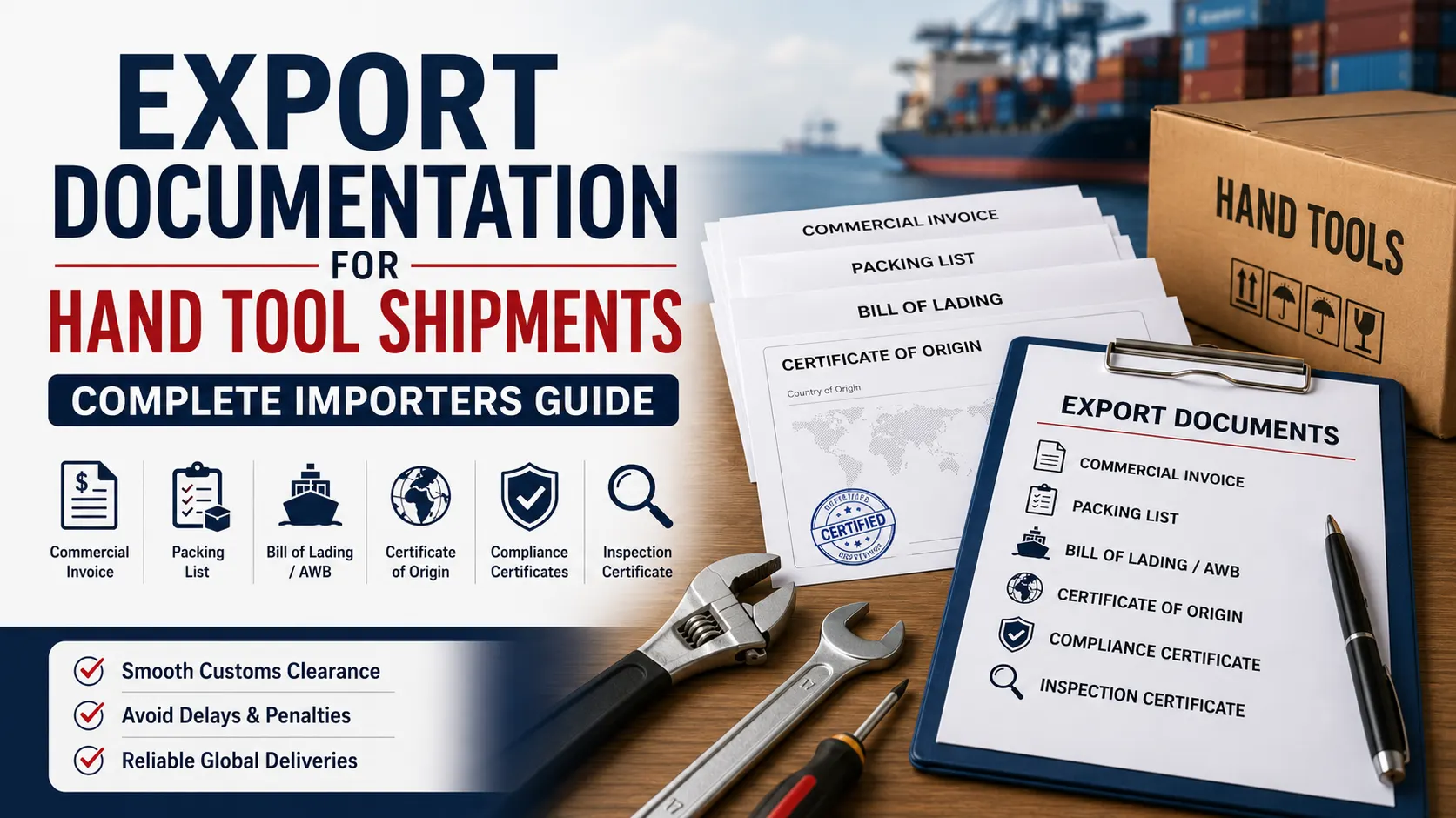
Importers purchasing hand tools from international suppliers should typically request a Commercial Invoice, Packing List, Bill of Lading or Air Waybill, and a Certificate of Origin. Depending on the destination country and product specifications, supplementary paperwork such as Product Compliance Certificates, Insurance Certificates, or Pre-Shipment Inspection Certificates may also be required to verify value, origin, and regulatory compliance.
Quick Reference: Export Documents for Tool Imports
| Document Name | Primary Purpose | Key Fields for Importers to Verify |
| Commercial Invoice | Customs valuation and duty assessment. | HS Chapter 82 Codes, explicit tool descriptions, unit price, and agreed Incoterms. |
| Packing List | Verification of physical shipment contents. | Total cartons, pallet count, exact net/gross weight, and shipping marks. |
| Bill of Lading (B/L) / AWB | Contract of carriage and proof of shipment. | Accurate consignee/notify party details and matching container numbers. |
| Certificate of Origin (COO) | Verification of manufacturing country. | Chamber of Commerce stamp to leverage trade benefits or avoid anti-dumping duties. |
| Compliance Certificates | Demonstration of regulatory compliance. | Region-specific safety or quality standards (e.g., ANSI, ASME, DIN, or BIS declarations). |
| Inspection Certificate | Product quality and quantity verification. | Third-party inspection reports (when required by the buyer or local regulations). |
Why Export Documentation Matters for Importers
For industrial and retail tool buyers, accurate export paperwork ensures:
- Efficient Customs Clearance: Minimizes the risk of border delays and unexpected port storage fees (demurrages).
- Accurate Tariff Calculation: Ensures goods are assessed under the correct duty structures to avoid financial penalties.
- Supply Chain Continuity: Helps maintain stock levels by preventing extended shipment holds at the port of entry.
Core Export Documents to Verify Before Dispatch
Commercial Invoice & HS Chapter 82 Classification
The Commercial Invoice is the primary legal document used by customs authorities to calculate duties and taxes. Hand tools fall strictly under HS Chapter 82 of the international Harmonized System.
Importers must ensure the invoice features clear, specific tool descriptions rather than generic terms. For example, the invoice should explicitly specify the tool type—such as “Combination Spanners,” “Mortise Chisels,” or “Machinist Hammers”—along with the tool’s standard material type. Ensure the supplier applies the correct 8-digit HS code classification corresponding to the tool’s specific mechanical function.
Packing List & Weight Verification
The Packing List provides a detailed logistical breakdown of the shipment packaging. Because hand tools are dense and exceptionally heavy, custom authorities frequently cross-check the declared weights on the paperwork against physical scale readings at the port. Importers should double-check that the net and gross weights match perfectly across the Packing List, Commercial Invoice, and shipping documents.
Bill of Lading (B/L) or Air Waybill (AWB)
Issued by the carrier, this document acts as a cargo receipt and a contract of carriage. For sea freight, a Bill of Lading is required to legally claim ownership of the goods at the destination. Importers must review this document before departure to ensure that company names, addresses, and tax identifiers are completely free of typos.
Certificate of Origin (COO)
A Certificate of Origin officially confirms where the hand tools were manufactured. This document is essential for customs authorities to determine applicable tariffs, verify eligibility for Free Trade Agreements (FTAs), or check for anti-dumping regulations that might apply to specific tool categories from certain manufacturing hubs.
Region-Specific Compliance & Documentation Requirements
Import regulations and mandatory compliance documents vary significantly depending on the destination market and product category.
- United States: Regulatory authorities and commercial buyers frequently look for compliance with ANSI/ASME structural standards. Importers should verify if specific tool categories require detailed material grade declarations before entry.
- Europe & UK: Depending on the product type and target retail sector, some European buyers may request GS (Geprüfte Sicherheit), DIN, or CE-related compliance documentation to meet regional market standards.
- India: Hand tools entering the Indian market are often subject to strict Quality Control Orders (QCOs). Shipments must comply with relevant BIS (Bureau of Indian Standards) licensing and marking regulations where applicable.
- Middle East & Australia: Countries in the Middle East often require a formalized, legalized Certificate of Origin alongside specific conformity certificates (like a CoC). Australian customs place a heavy emphasis on biosecurity, requiring strict packaging cleanliness and clear wood-treatment declarations for heavy transport crates.
Common Documentation Mistakes That Cause Import Delays
Minor paperwork errors remain a leading cause of international supply chain disruptions. Importers should actively watch out for:
- Vague Product Descriptions: Listing items simply as “Hardware” or “Iron Tools” instead of using precise commercial taxonomy.
- Mismatched Data: Discrepancies in total carton counts, weights, or values between the invoice and the packing list.
- Incorrect HS Code Subheadings: Applying generic steel codes instead of specific Chapter 82 classifications.
- Improper Product Markings: Missing or non-compliant country-of-origin labels on the physical products or immediate packaging, which may be required by destination-market regulations.
Pre-Shipment Documentation Verification Checklist
Before authorizing an overseas supplier to dispatch a hand tool shipment, importers should verify that the following items are complete:
- ✓ Commercial Invoice: Includes correct 8-digit HS Chapter 82 codes and exact tool descriptions.
- ✓ Packing List: Declared net and gross weights are fully consistent across all shipping paperwork.
- ✓ Bill of Lading / AWB: Consignee and notify party corporate details match the importer of record perfectly.
- ✓ Certificate of Origin: Available and authorized by the relevant chamber of commerce if required for tariff preferences.
- ✓ Compliance Documentation: Applicable quality certificates or testing logs (such as ASME, DIN, or BIS declarations) verified.
- ✓ Incoterms Alignment: Shipping terms, unit values, and freight responsibilities match the original purchase order.
Choosing a Hand Tool Supplier with Reliable Document Practices
Choosing a factory that excels in documentation saves you from unexpected container detention fees. Reliable hand tool manufacturers don’t just forge high-quality steel; they proactively provide pre-filled document drafts early in the production cycle and understand the specific customs thresholds of your destination market. Importers should work with hand tool manufacturers and suppliers that can provide complete export documentation, product traceability, and destination-market compliance support before shipment dispatch. Working with partners that follow disciplined documentation practices reduces supply chain risks, avoids costly port delays, and ensures an efficient import experience.
JCBL Hand Tools supports global importers with complete export documentation, product traceability, and compliance assistance to help ensure smoother customs clearance and reliable international sourcing.
FAQs
Importers should typically request a Commercial Invoice, Packing List, Bill of Lading or Air Waybill, Certificate of Origin, and any required compliance or inspection certificates before shipment dispatch. Verifying these documents prior to departure ensures that any data mismatches are corrected while the cargo is still accessible at the manufacturing source.
Customs authorities primarily utilize the Commercial Invoice, along with the declared shipment value and the specific HS Code classification, to determine applicable import duties, taxes, and tariffs.
Incorrect documentation can result in immediate customs holds, mandatory physical cargo inspections, unexpected port storage fees (demurrages), monetary fines, or absolute shipment rejection by border authorities.
No, compliance certificate requirements vary significantly by country, product category, and buyer specifications. Importers should always verify destination-market regulations and customer expectations before production begins.
A Material Test Report may be requested by buyers or specific regulatory bodies to verify a tool’s baseline chemical and mechanical safety properties. For industrial hand tools, it helps confirm the general metal classification and ensure the product meets standard hardness parameters required to perform heavy-duty tasks safely.