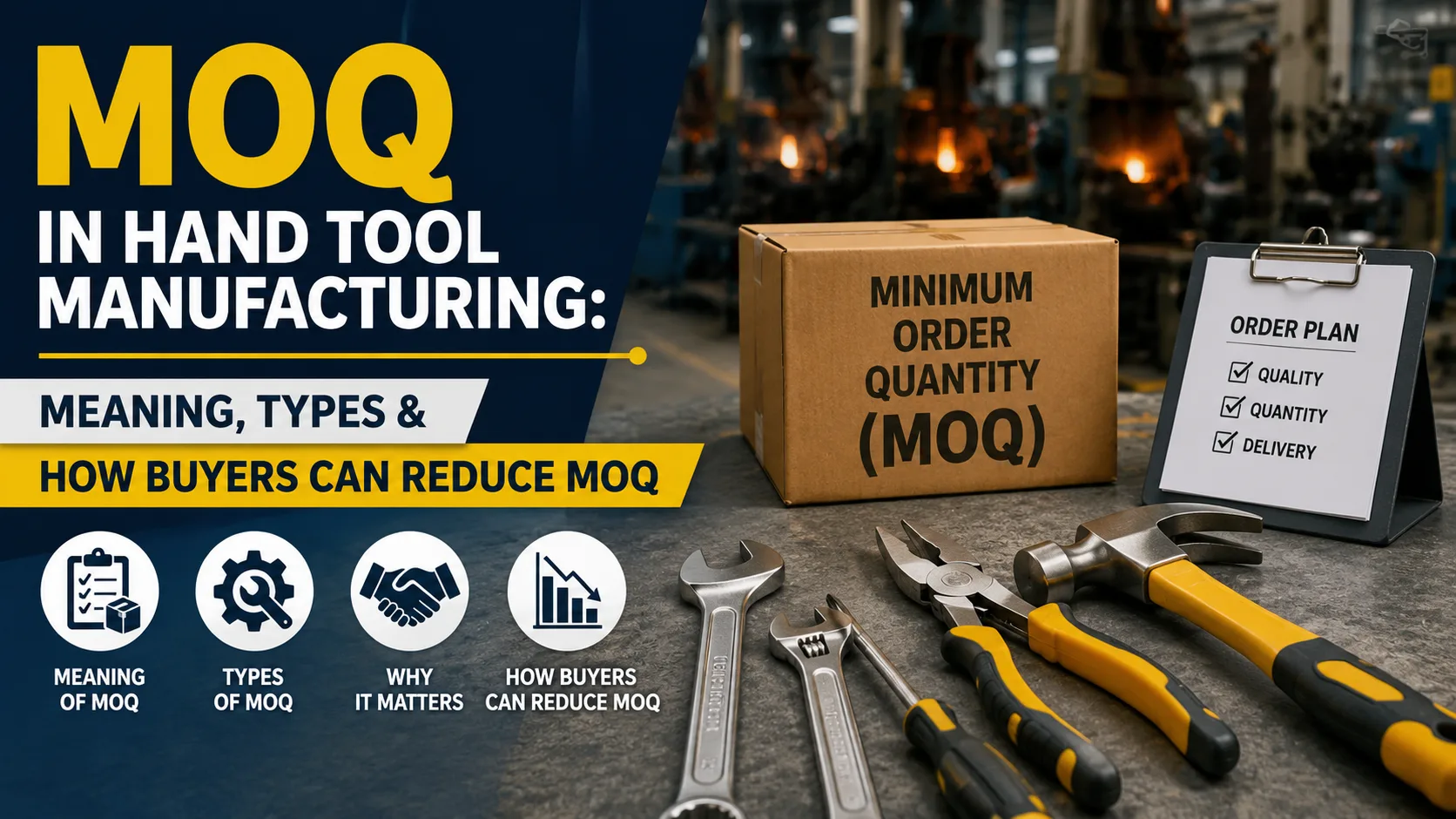
MOQ in Hand Tool Manufacturing: Meaning, Types & How Buyers Can Reduce MOQ
- What is MOQ in Hand Tool Manufacturing?
- Why Do Hand Tool Manufacturers Set MOQ?
- Typical MOQ Range in Hand Tool Manufacturing
- Factors That Increase MOQ in Hand Tool Manufacturing
- Can Buyers Negotiate MOQ?
- Low MOQ vs High MOQ: Which is Better?
- MOQ vs MOA in Manufacturing
- How to Choose the Right Hand Tool Manufacturer Based on MOQ
- Conclusion
- FAQs
When sourcing industrial hand tools, one of the first terms buyers encounter is MOQ. Whether you are an importer, distributor, OEM buyer, or private label brand, understanding MOQ is essential for planning inventory, managing costs, and selecting the right manufacturer.
MOQ directly affects pricing, customization options, packaging, and production feasibility. A clear understanding of MOQ also helps buyers negotiate better and avoid unnecessary sourcing challenges.
What is MOQ in Hand Tool Manufacturing?
MOQ (Minimum Order Quantity) in hand tool manufacturing refers to the minimum number of units a manufacturer requires for a production order.
Manufacturers set MOQ to ensure production remains commercially viable. It helps cover raw material procurement, machine setup, labor, packaging, and operational costs.
For example, a manufacturer producing forged spanners may require a minimum order quantity because steel procurement, forging die setup, heat treatment, and finishing processes become inefficient for very small batches.
In simple terms, MOQ helps manufacturers maintain production efficiency while offering competitive pricing to buyers.
Why Do Hand Tool Manufacturers Set MOQ?
MOQ is not set randomly. It is usually based on manufacturing economics and production efficiency.
| Factor | Why It Affects MOQ |
| Raw Material Procurement | Steel and alloy materials are often purchased in bulk quantities |
| Forging & Tooling Setup | Machine setup and die preparation involve fixed production costs |
| Labor Costs | Small production batches increase per-unit labor cost |
| Packaging Requirements | Custom boxes, labels, and printing often require bulk quantities |
| Export Logistics | Shipping smaller volumes increases freight cost per unit |
In industrial hand tool manufacturing, MOQ is generally lower for standard catalog products and higher for customized OEM tools.
Factories producing large export volumes usually optimize production schedules around batch manufacturing. Very small orders can interrupt workflow efficiency and increase operational costs.
Typical MOQ Range in Hand Tool Manufacturing
MOQ varies depending on the product category, customization level, and production process.
| Product Type | Typical MOQ Range |
| Standard Hand Tools | Lower MOQ |
| OEM Branded Tools | Medium to high MOQ |
| Customized Forged Tools | Higher MOQ |
| Private Label Tool Kits | MOQ depends on packaging complexity |
There is no universal MOQ across the industry. The actual quantity depends on:
- Product complexity
- Forging requirements
- Surface finishing
- Packaging type
- Export destination
- Manufacturer capability
For example, a standard hammer or plier may have a lower MOQ compared to a fully customized insulated tool kit with retail packaging.
Factors That Increase MOQ in Hand Tool Manufacturing
Several production-related factors can increase the minimum order quantity.
- Custom Branding: Laser engraving, logo stamping, and private labeling often require dedicated production setup. Manufacturers may increase MOQ to justify these additional processes.
- Special Tool Design: Custom forged tools require new dies and tooling development. Since tooling costs are significant, manufacturers usually prefer larger production volumes.
- Export Packaging: Retail-ready packaging, barcode labeling, color boxes, and blister packaging generally involve minimum printing requirements from packaging suppliers.
- Multiple Product Variants: Different sizes, colors, finishes, or specifications reduce production efficiency and increase inventory complexity, which can raise MOQ requirements.
Can Buyers Negotiate MOQ?
Yes. MOQ in hand tool manufacturing can often be negotiated depending on the product type, customization level, and long-term business potential.
Experienced manufacturers sometimes offer flexibility for trial orders or new market entry projects.
Buyers can reduce MOQ by:
- Choosing standard catalog products
- Using common packaging instead of custom retail boxes
- Combining multiple SKUs in one container
- Starting with a trial order
- Building long-term supplier relationships
- Reducing customization in the first order
Many export-oriented manufacturers also offer lower MOQ for repeat customers with stable procurement plans.
Low MOQ vs High MOQ: Which is Better?
Both low MOQ and high MOQ have advantages depending on the buyer’s business model.
| Low MOQ | High MOQ |
| Lower initial investment | Better per-unit pricing |
| Easier product testing | Higher production efficiency |
| Reduced inventory risk | More customization flexibility |
| Faster inventory turnover | Lower manufacturing cost |
Small businesses and first-time importers often prefer lower MOQ to test product demand before scaling procurement.
On the other hand, large distributors usually benefit from higher MOQ because bulk production reduces per-unit cost and improves profit margins.
MOQ vs MOA in Manufacturing
MOQ and MOA are commonly confused in industrial sourcing.
| Term | Meaning |
| MOQ | Minimum Order Quantity |
| MOA | Minimum Order Amount |
How to Choose the Right Hand Tool Manufacturer Based on MOQ
MOQ should not be the only factor when selecting a manufacturer. A reliable hand tool manufacturer should also offer:
- Production Capability: The manufacturer should have sufficient forging, machining, heat treatment, and finishing capacity.
- OEM & Export Experience: Experienced exporters generally manage documentation, packaging, and compliance requirements more efficiently.
- Quality Consistency: Consistent hardness, dimensional accuracy, coating quality, and durability are critical in industrial tools.
- Packaging Support: Good manufacturers provide flexible packaging solutions for distributors, wholesalers, and private label brands.
- Scalability: The supplier should be capable of handling larger orders as your business grows.
Choosing an extremely low MOQ supplier without evaluating manufacturing capability can sometimes lead to inconsistent quality and supply issues.
Conclusion
MOQ plays a major role in hand tool manufacturing because it directly affects production efficiency, pricing, customization, and supply chain planning.
For buyers, understanding MOQ helps in making better sourcing decisions, managing inventory risk, and negotiating effectively with manufacturers.
Instead of focusing only on the lowest MOQ, businesses should evaluate overall manufacturing capability, product quality, export experience, and long-term scalability when selecting a hand tool supplier.
FAQs
A good MOQ depends on the product type, customization level, and sourcing budget. Standard hand tools usually have lower MOQ compared to customized OEM products.
MOQ helps manufacturers maintain production efficiency and manage raw material, labor, packaging, and setup costs effectively.
Yes. Many manufacturers offer lower MOQ for standard products or trial export orders, especially for first-time buyers.
Yes. Custom branding, forging dies, retail packaging, and special finishes usually increase minimum production requirements.
Not always. Lower MOQ reduces inventory risk but often increases per-unit manufacturing cost.