How to Choose Between Forging and Casting
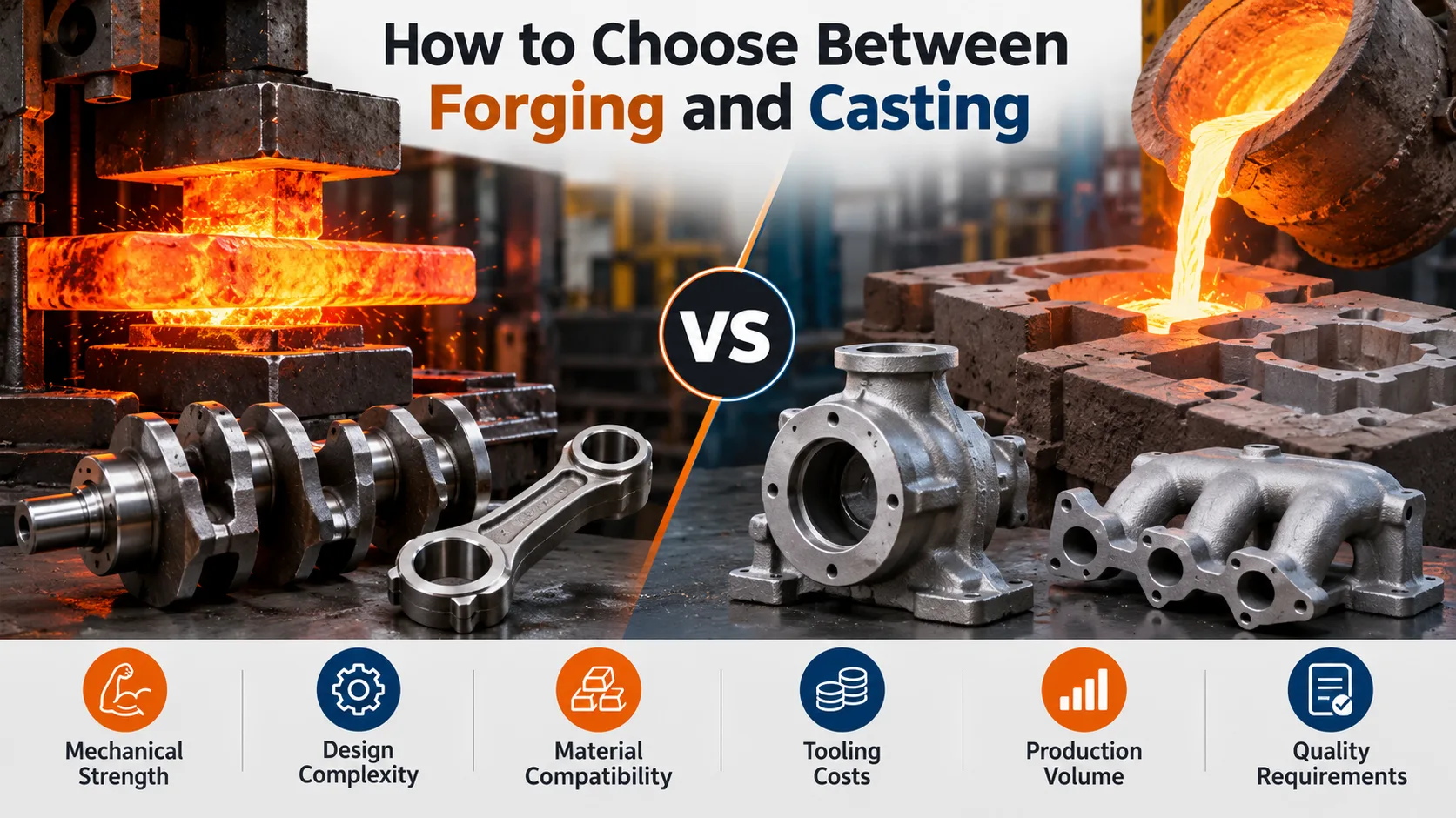
Choosing between forging and casting depends on the component’s strength requirements, geometry, material, production volume, and total manufacturing cost. Forging is often preferred for components requiring high fatigue resistance and toughness, while casting suits complex shapes and internal passages. The best process is the one that meets the component’s engineering specifications, operating conditions, and production targets at an acceptable total cost.
Forging vs. Casting: Key Differences
Forging shapes solid metal through compressive forces, whereas casting involves pouring molten metal into a mold and allowing it to solidify. The difference affects material structure, design flexibility, manufacturing costs, and achievable component properties.
| Factor | Forging | Casting |
| Manufacturing method | Deformation of solid metal | Solidification of molten metal |
| Mechanical properties | Often offers high toughness and fatigue resistance | Depend on alloy, solidification, defects, and heat treatment |
| Design complexity | Suited to shapes compatible with forging dies | Accommodates complex geometries and internal passages |
| Tooling costs | Can be substantial, particularly for closed-die forging | Vary by method; sand casting often has lower tooling costs |
| Typical applications | Shafts, connecting rods, crankshafts | Pump housings, valve bodies, manifolds |
Neither process is universally superior. The right choice depends on the component’s intended function and manufacturing requirements.
6 Factors to Consider When Choosing Between Forging and Casting
1. Mechanical Strength and Fatigue Resistance
Forging is often preferred for components exposed to repeated loads, impact, or high stress because metal deformation can improve grain structure and fatigue performance. Casting can also meet demanding strength requirements when the alloy and process are properly controlled.
Choose forging for fatigue-critical parts; consider casting when verified mechanical properties meet the application requirements.
2. Part Geometry and Design Complexity
Casting accommodates complex shapes, internal passages, and integrated features. Forging is better suited to geometries that can be formed efficiently using dies.
Choose casting for complex housings and manifolds; choose forging for suitable solid components requiring demanding mechanical performance.
3. Material and Alloy Compatibility
Alloy composition, forgeability, castability, heat treatment, and operating conditions determine process suitability. The same alloy may exhibit different properties depending on how it is manufactured.
Before deciding, verify the material grade, required properties, and applicable specifications.
4. Tooling Costs and Production Volume
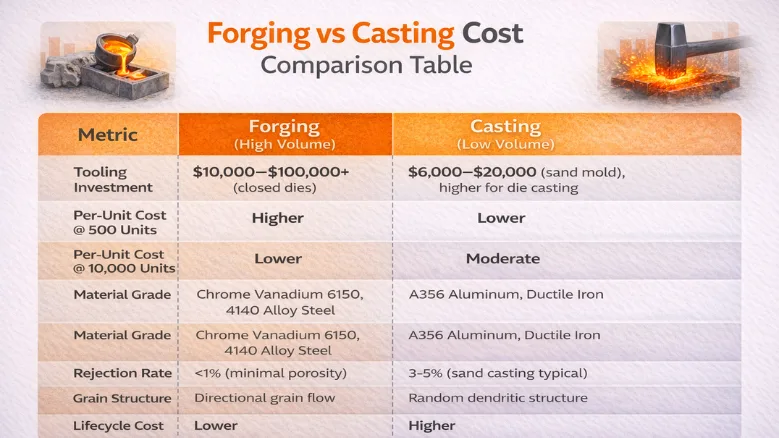
Forging dies can require significant upfront investment, while casting costs vary by method. Production volume influences how tooling costs affect the final unit price.
Compare tooling, production volume, machining, lead time, and total cost per finished component. Neither process is universally cheaper.
5. Dimensional Accuracy and Machining
Both processes may require machining to achieve specified tolerances and surface finishes. Requirements depend on component design and the capabilities of the selected process.
Evaluate machining allowances, finishing, inspection, and rejected-part costs alongside the initial manufacturing price.
6. Quality Standards and Operating Conditions
Pressure, temperature, fatigue, and environmental exposure determine the component’s performance and inspection requirements.
Confirm applicable material standards, mechanical testing, defect acceptance criteria, and traceability requirements before selecting a supplier.
Forging vs. Casting: A Practical Selection Example
Consider an industrial equipment manufacturer evaluating two different components: a rotating shaft and a pump housing.
- Rotating shaft: If the shaft experiences repeated torsional loads and requires high fatigue resistance, forging may be the preferred starting point, provided the material and geometry are suitable.
- Pump housing: If the housing requires complex internal passages and integrated mounting features, casting may offer greater design flexibility and reduce assembly requirements.
These are illustrative examples, not universal recommendations. Final selection requires evaluating the actual drawings, material specifications, operating conditions, and manufacturing costs.
How to Make the Final Manufacturing Decision
Before requesting quotations from forging or casting suppliers, evaluate these seven factors:
- Service conditions: What loads, temperatures, and environmental conditions must the component withstand?
- Material specifications: Which alloy and mechanical properties are mandatory?
- Design geometry: Can the component be manufactured efficiently using either process?
- Dimensional requirements: What tolerances, surface finishes, and machining operations are necessary?
- Production volume: How many components are required annually?
- Quality assurance: Which testing, inspection, certification, and traceability requirements apply?
- Total cost: What is the cost per accepted component, including tooling, machining, finishing, inspection, and scrap?
Providing suppliers with the component drawing, material grade, expected annual volume, and quality requirements will help them assess feasibility and submit comparable quotations.
Conclusion
Choosing between forging and casting requires balancing mechanical performance, design complexity, material suitability, production volume, and total manufacturing cost. Forging is often favored for fatigue-critical components with suitable geometries, while casting offers advantages for complex shapes and integrated features.
For B2B buyers and design engineers, the most reliable approach is to define the component specifications, validate manufacturing feasibility with qualified suppliers, and compare the cost and performance of finished components against the same acceptance criteria.
FAQs
Forging is often preferred for components requiring high fatigue resistance and toughness, while casting suits complex geometries and internal features. The choice depends on material specifications, operating conditions, and design requirements.
Not always. Forging may involve higher die costs, while casting costs vary by method. Compare tooling, production volume, machining, inspection, and total cost per finished component.
Higher volumes can help offset forging die costs. Casting may suit lower-volume production, depending on the method, geometry, and tooling requirements. Request quotations based on your expected order quantity.
Yes. Properly designed cast components can meet load-bearing requirements when the alloy, casting process, and quality controls deliver the specified mechanical properties.
Casting generally accommodates intricate shapes, internal passages, and integrated features more readily. Forging suits geometries that can be formed efficiently with dies.
Provide the component drawing, material grade, annual production volume, dimensional tolerances, operating conditions, finishing requirements, and inspection standards. These details help suppliers assess feasibility and quote accurately.