Heat Treatment of Forged Hand Tools: Hardening and Tempering
- What Is Heat Treatment of Forged Hand Tools?
- How Do Hardening and Tempering Affect Forged Hand Tools?
- What Is the Heat Treatment Process for Forged Hand Tools?
- What Happens When Forged Hand Tools Are Improperly Heat-Treated?
- How Is Heat Treatment Quality Tested in Forged Hand Tools?
- How Do Heat-Treatment Requirements Differ Across Forged Hand Tools?
- What Should B2B Buyers Check When Evaluating Heat-Treated Forged Hand Tools?
- Conclusion
- FAQs
Heat treatment of forged hand tools is a controlled heating and cooling process that modifies steel hardness, strength, toughness, and wear resistance. Hardening increases hardness through austenitizing and quenching, while tempering adjusts the hardened steel’s properties to reduce brittleness and improve toughness. Together, these processes help forged tools withstand the mechanical stresses encountered during use.
For hand tool manufacturers and industrial buyers, the objective is not simply to achieve high hardness. It is to establish the right balance of hardness, toughness, dimensional stability, and durability for the tool’s intended application.
What Is Heat Treatment of Forged Hand Tools?
Heat treatment modifies the microstructure of steel to achieve specified mechanical properties. In forged hand tools, it helps control how the finished tool responds to impact, torque, abrasion, and repeated loading.
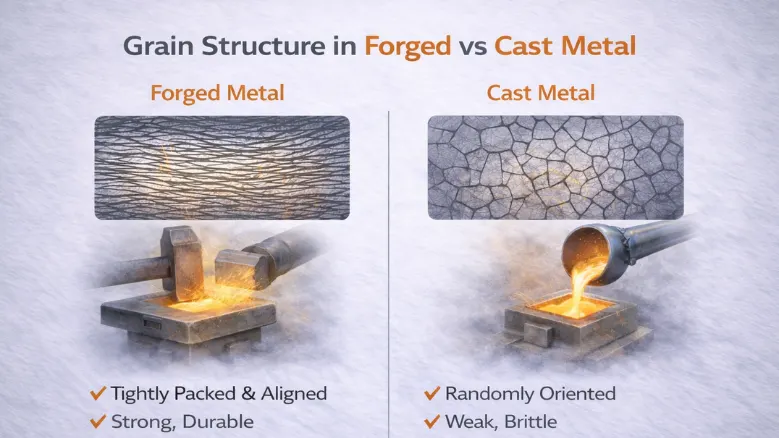
Forging shapes heated metal through compressive forces, while heat treatment controls the properties of the steel after shaping. Although forging can refine the grain structure when properly controlled, the final properties also depend on the steel grade, forging conditions, cooling history, and subsequent heat treatment.
The required treatment varies by tool design. A striking tool, a wrench, and a cutting tool do not necessarily require the same hardness or toughness.
How Do Hardening and Tempering Affect Forged Hand Tools?
Hardening and tempering are complementary heat treatment processes that determine the hardness, toughness, and wear resistance of forged hand tools. Hardening increases hardness, while tempering reduces brittleness and adjusts toughness for the tool’s intended application.
1. Hardening: Improving Hardness and Wear Resistance
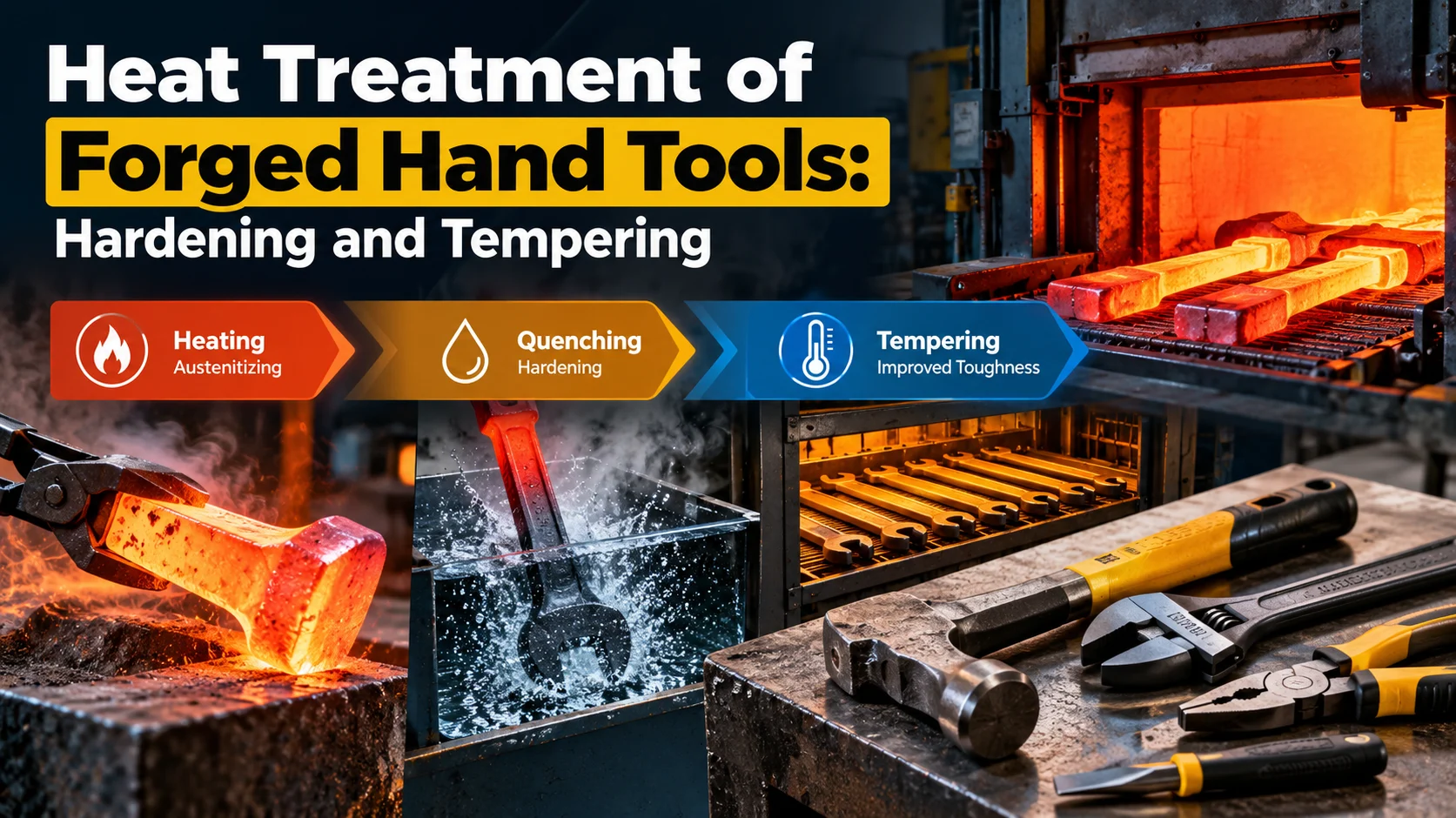
Hardening involves heating steel to its specified austenitizing temperature, holding it for the required time, and rapidly cooling it through quenching. This process typically forms martensite in hardenable steels, increasing hardness and resistance to wear.
Key effects of hardening:
- Increases hardness: Helps the tool resist surface deformation and wear.
- Improves wear resistance: Supports performance in applications involving repeated contact and friction.
- Requires controlled quenching: Improper cooling can cause cracking, distortion, or excessive residual stress.
The appropriate hardening parameters depend on the steel grade, tool geometry, and required mechanical properties.
2. Tempering: Balancing Hardness and Toughness
Tempering involves reheating hardened steel to a controlled temperature below its lower critical transformation temperature, holding it for a specified duration, and cooling it appropriately. It modifies the hardened microstructure, reduces residual stresses, and generally improves toughness.
Key effects of tempering:
- Reduces brittleness: Helps the tool withstand mechanical loads with a lower risk of brittle failure.
- Adjusts hardness: Establishes the required balance between hardness and toughness.
- Improves service reliability: Helps reduce susceptibility to cracking or chipping under impact, depending on the tool design and application.
The tempering temperature and duration must match the steel grade and performance requirements.
In conclusion, hardening develops the required hardness, while tempering adjusts hardness and toughness to help forged hand tools perform reliably under their intended working conditions.
What Is the Heat Treatment Process for Forged Hand Tools?
The heat treatment process must be adapted to the material, tool geometry, and required mechanical properties. A typical production sequence includes the following stages.
- Forging and initial cooling: The steel is shaped into the required tool geometry. The subsequent cooling conditions influence the material’s microstructure and the need for preliminary treatment.
- Preliminary heat treatment, if required: Normalizing or another suitable treatment may be used to refine or condition the microstructure before hardening.
- Controlled heating: The tool is heated to the temperature specified for its steel grade. Appropriate temperature uniformity and holding time help achieve the required transformation throughout the relevant section.
- Quenching: The heated tool is cooled using a suitable quenching medium and controlled process. The choice depends on hardenability, section thickness, geometry, and the risk of distortion or cracking.
- Tempering: The hardened tool is reheated under controlled conditions to obtain the required balance of hardness, toughness, and residual stress.
- Inspection and verification: The finished tool is checked against applicable hardness, dimensional, and defect-acceptance requirements.
Not every forged hand tool follows an identical sequence. Heat-treatment parameters must be established for the specific steel grade and product design rather than copied from a generic temperature chart.
What Happens When Forged Hand Tools Are Improperly Heat-Treated?
Incorrect heat treatment can compromise tool performance even when the forging itself meets dimensional requirements.
| Heat-treatment issue | Potential effect on the tool |
| Insufficient hardening | Low hardness and accelerated wear |
| Excessive hardness or inadequate tempering | Increased brittleness and cracking risk |
| Unsuitable quenching conditions | Distortion, residual stresses, or cracking |
| Excessive heating or holding | Grain growth and potentially reduced toughness |
| Inconsistent temperature control | Non-uniform hardness and inconsistent performance |
These defects can increase rejection rates, shorten service life, and create product reliability concerns. Their actual causes must be established through process records, material verification, and appropriate inspection rather than assumed from the failure alone.
How Is Heat Treatment Quality Tested in Forged Hand Tools?
Heat treatment quality is verified against defined product specifications and acceptance criteria. The following checks help manufacturers and B2B buyers assess whether the finished tools meet their requirements.
- Hardness testing: Rockwell or another suitable hardness test verifies whether the specified hardness range has been achieved. The test method and measurement location must be appropriate for the component.
- Microstructural examination: Metallographic analysis can help assess the resulting microstructure and investigate suspected heat-treatment problems.
- Crack inspection: Suitable nondestructive testing methods can identify detectable cracks or other discontinuities where required.
- Dimensional inspection: Measurements verify that distortion during heat treatment has not caused the tool to exceed specified tolerances.
- Process documentation: Recorded heat-treatment parameters, material traceability, and inspection results support consistency and quality assurance.
Hardness alone does not establish overall tool quality. A tool may meet its hardness specification yet fail to deliver the required toughness or resistance to impact. Verification should therefore reflect the tool’s intended application and applicable product requirements.
How Do Heat-Treatment Requirements Differ Across Forged Hand Tools?
Different tools experience different mechanical stresses, so their heat-treatment requirements must reflect their working conditions.
- Hammers and striking tools: Working surfaces require suitable hardness and wear resistance, while the design must provide appropriate impact toughness. Striking faces must also meet applicable safety and product requirements.
- Wrenches and spanners: The steel must resist deformation under torque while providing the strength and toughness required by the design.
- Pliers and gripping tools: Jaw hardness, wear resistance, and resistance to deformation influence gripping performance and service life.
- Chisels and cutting tools: The cutting edge requires sufficient hardness and wear resistance without becoming excessively susceptible to chipping.
These are application-level considerations, not universal hardness prescriptions. The appropriate treatment depends on the material, geometry, intended loading, and relevant product specification.
What Should B2B Buyers Check When Evaluating Heat-Treated Forged Hand Tools?
For industrial procurement teams, evaluating heat treatment requires more than comparing stated hardness values. Buyers should verify whether the manufacturer’s process and inspection controls support the tool’s intended use.
Before approving a supplier, check:
- Material specification: Confirm the steel grade and its traceability to the supplied product or batch.
- Hardness requirements: Review the specified hardness range, test method, and measurement locations.
- Process control: Ask how heating, quenching, and tempering parameters are controlled and documented.
- Inspection capability: Verify the availability of appropriate hardness testing, dimensional inspection, and defect assessment.
- Batch consistency: Review relevant inspection records and acceptance criteria for production batches.
- Standards and compliance: Confirm conformity with applicable product standards, contractual specifications, and customer requirements.
These checks help buyers assess manufacturing consistency and determine whether the tools are suitable for their operating conditions. Supplier claims should be supported by relevant test results and quality documentation.
Conclusion
The heat treatment of forged hand tools directly influences hardness, toughness, wear resistance, and manufacturing consistency. Hardening develops the required hardness, while tempering adjusts the hardened steel’s properties for its intended working conditions.
For manufacturers and industrial buyers, reliable performance depends on selecting the appropriate steel, controlling the heat-treatment process, and verifying the finished product against defined quality requirements. A well-controlled process helps deliver forged hand tools that meet their specified mechanical and dimensional requirements.
FAQs
Heat treatment modifies the steel’s mechanical properties to achieve the required hardness, toughness, and wear resistance. It helps forged hand tools withstand the stresses associated with their intended applications.
Hardening uses controlled heating and quenching to increase steel hardness. Tempering reheats the hardened steel below its lower critical transformation temperature to adjust hardness, reduce residual stresses, and generally improve toughness.
No. Excessive hardness can increase brittleness and the risk of cracking or chipping. The appropriate hardness depends on the tool’s design, steel grade, and operating conditions.
Cracking may result from unsuitable quenching conditions, excessive thermal or transformation stresses, material defects, or an inappropriate heat-treatment process. Determining the actual cause requires material and process investigation.
No. Heat-treatment requirements vary with steel composition, hardenability, geometry, section thickness, and intended application. Process temperatures and hardness targets must be established for the specific tool and material.