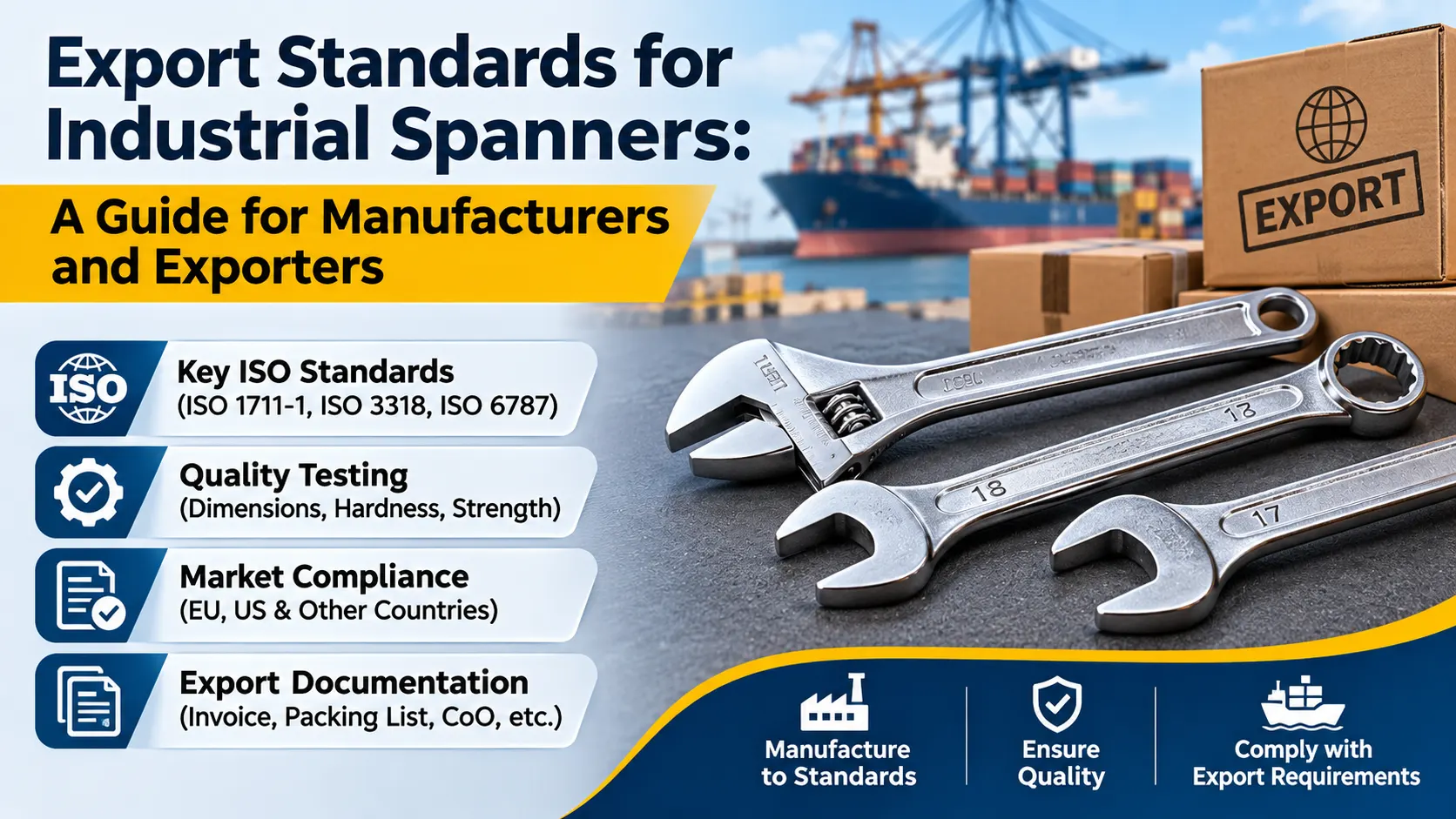
Export Standards for Industrial Spanners: A Guide for Manufacturers and Exporters
- What Are the Export Standards for Industrial Spanners?
- Key ISO Standards for Industrial Spanners
- Quality Testing Requirements for Export-Grade Spanners
- Export Compliance Requirements by Destination Market
- Documents Required to Export Industrial Spanners from India
- How to Ensure Industrial Spanners Meet Export Requirements
- Conclusion
- FAQs
Exporting industrial spanners requires manufacturers to meet applicable product standards, buyer specifications, quality requirements, and destination-country regulations. For Indian exporters, understanding these requirements helps demonstrate product conformity, prepare accurate shipment documents, and reduce avoidable compliance issues.
This guide explains the relevant ISO standards, quality checks, export documentation, and compliance steps for industrial spanner manufacturers and suppliers.
What Are the Export Standards for Industrial Spanners?
Export standards for industrial spanners define technical requirements for product dimensions, hardness, mechanical performance, and other specified characteristics. Exporters must identify the applicable product standard, destination-country regulations, and buyer requirements before shipping.
These requirements serve different purposes:
- Product standards: Specify technical requirements for particular tool types.
- Destination-market regulations: Establish applicable legal obligations for imported products.
- Buyer specifications: Define contractual requirements, including tolerances, testing, inspection, and packaging.
Compliance with one category does not automatically satisfy the others.
Key ISO Standards for Industrial Spanners
The applicable ISO standard depends on the spanner design and the characteristics being assessed. Three relevant standards are:
| ISO standard | What it covers |
| ISO 1711-1:2019 | Minimum Rockwell hardness and torsional strength values for covered hand-operated wrenches and sockets |
| ISO 3318:2016 | Maximum outside head dimensions for specified open-ended, box, and combination wrenches |
| ISO 6787:2018 | Dimensions, adjustable-jaw clearance, and performance test conditions for adjustable wrenches |
These standards are not interchangeable or universally applicable to every spanner. Manufacturers should verify the product scope and current edition before specifying compliance. ISO 1711-1:2019 was confirmed by ISO in 2025 as remaining current.
Important: Manufacturing to an ISO standard is not the same as holding ISO certification. Do not claim certification unless the relevant certification has actually been obtained.
Quality Testing Requirements for Export-Grade Spanners
Export-grade spanners should be inspected against the applicable standard, approved technical drawings, and buyer specifications. The following checks may be required.
1. Dimensional Inspection
Verify jaw opening, head dimensions, overall dimensions, and specified tolerances. Accurate dimensions help ensure that the spanner fits the intended fastener correctly.
2. Hardness and Mechanical Performance
Check hardness and torsional strength where required by the applicable standard. These tests help assess whether the tool meets specified mechanical performance requirements.
3. Material and Heat Treatment
Verify the specified steel grade and heat-treatment process through appropriate production records and material checks. Additional material testing may be required by the buyer.
4. Surface Finish and Corrosion Resistance
Inspect for cracks, burrs, and surface defects. Perform corrosion-resistance testing when required by the product specification, coating requirements, or buyer contract.
5. Marking and Traceability
Check that required size markings, manufacturer identification, and batch information are legible and accurate. Maintain inspection records that link the finished products to their production batches.
Testing methods, acceptance limits, and sampling frequency must follow the applicable requirements rather than a generic checklist.
Export Compliance Requirements by Destination Market
Industrial spanner exporters must verify the rules applicable to the product and importing country.
- European Union: Check applicable product safety legislation, chemical restrictions, and labeling obligations. Ordinary hand spanners do not automatically require CE marking; it applies only when relevant EU legislation requires it.
- United States: Verify applicable federal, state, and product-specific requirements, alongside the importer’s technical specifications.
- Other international markets: Check national standards, import regulations, labeling rules, and any applicable conformity-assessment requirements.
Specialized tools may face different requirements depending on their design and intended use. Exporters should confirm the applicable rules through official regulatory sources before shipping rather than assume the same requirements apply worldwide.
Documents Required to Export Industrial Spanners from India
Indian exporters must prepare documentation according to customs procedures, the shipment method, destination requirements, and the buyer’s contract.
Common export documents include:
- Commercial invoice and packing list: Record product descriptions, quantities, transaction values, and package details.
- Shipping bill: Supports export customs clearance in India.
- Bill of lading or air waybill: Provides transport documentation for sea or air freight.
- Certificate of origin: Establishes origin when required by the importing country, buyer, or applicable trade arrangement.
- Inspection reports or test certificates: Provide evidence of product conformity when contractually or legally required.
The Directorate General of Foreign Trade’s Certificate of Origin platform provides information and services for relevant origin documentation. Indian exporters should also consult current DGFT and Indian Customs guidance to confirm applicable procedures.
Not every shipment requires every certificate. Confirm the documentary requirements with the buyer, freight forwarder, and relevant authorities before dispatch.
How to Ensure Industrial Spanners Meet Export Requirements
Manufacturers can use this checklist before releasing an export order:
- Identify the market and product: Confirm the destination country and exact spanner type.
- Verify applicable standards: Check the standard’s scope, current edition, and relevant technical requirements.
- Approve buyer specifications: Document material, dimensions, tolerances, finish, and required tests.
- Inspect the production batch: Record results and resolve non-conformities before shipment.
- Verify markings and packaging: Match product identification, quantities, and packaging to the purchase order.
- Check export documentation: Confirm customs, transport, origin, and buyer-specific documents before dispatch.
International buyers should request the applicable product standard, approved technical specification, and relevant inspection or test reports when evaluating a supplier. Manufacturers should be prepared to provide the documentation required by the contract.
Conclusion
Exporting industrial spanners successfully requires manufacturers to align product specifications, quality testing, destination-market obligations, and shipment documentation. Verifying these requirements before production and dispatch helps Indian exporters demonstrate conformity and meet international buyers’ expectations.
FAQs
Applicable standards depend on the spanner type and export requirements. ISO 1711-1 covers specified mechanical properties, ISO 3318 covers specified wrench head dimensions, and ISO 6787 addresses adjustable wrenches.
Not universally. Exporters must establish whether certification is legally required, specified by the buyer, or voluntarily pursued. Compliance with an ISO standard does not itself establish ISO certification.
Requirements vary by product and specification. Checks may include dimensional inspection, hardness, torsional strength, material verification, surface inspection, and corrosion-resistance testing where applicable.
Not automatically. CE marking is required only when the product falls under EU legislation that mandates it. Exporters should verify the rules applicable to their specific product.
Common documents include a commercial invoice, packing list, shipping bill, and applicable transport document. A certificate of origin and inspection or test reports may also be required.
Buyers should verify the applicable product standard, approved dimensions and materials, required test reports, traceability, product marking, and ability to supply the agreed export documentation.