Export Documentation for Spanner Shipments: A Complete Guide for Indian Exporters
- What Documents Are Required to Export Spanners from India?
- Key Documents Required for Spanner Export Shipments
- Additional Export Compliance Requirements for Spanner Shipments from India
- Step-by-Step Export Documentation Process for Spanners
- Common Documentation Mistakes to Avoid
- Export Documentation Checklist for Spanner Shipments
- Conclusion
- Frequently Asked Questions (FAQs)
Exporting spanners from India requires accurate documentation to meet customs requirements, establish shipment details, and facilitate international trade. Errors in product classification, shipment declarations, or commercial documents can result in customs queries, clearance delays, and payment complications.
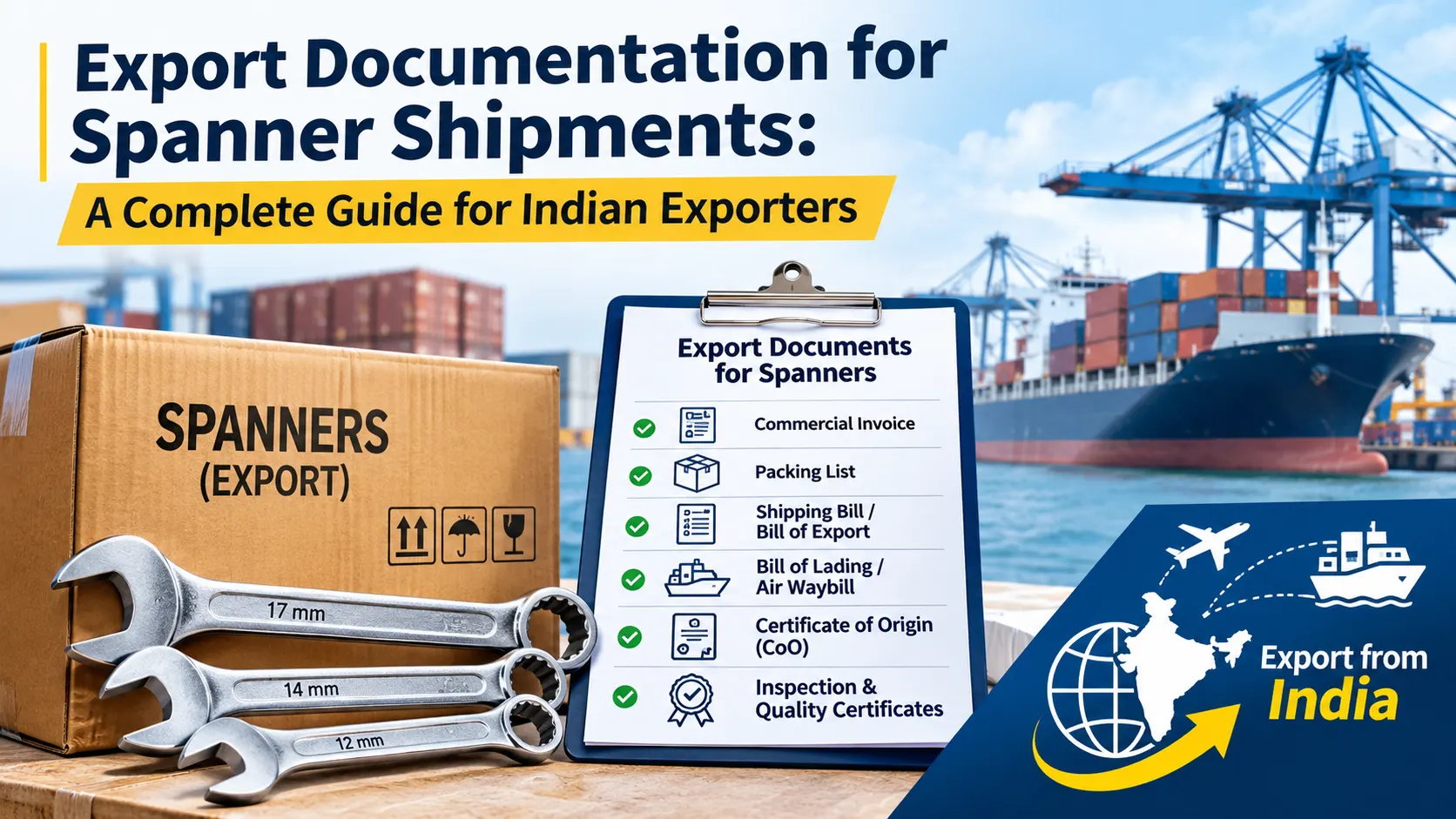
Under India’s Foreign Trade Policy (FTP) 2023, the three principal categories of mandatory export documents are a transport document, a commercial invoice cum packing list, and a shipping bill or applicable export declaration. Additional documents, such as a Certificate of Origin, inspection certificate, and insurance certificate, depend on the buyer’s requirements, shipping arrangement, and destination-country regulations.
This guide explains the export documentation required for spanner shipments from India and the compliance steps manufacturers and exporters should follow.
What Documents Are Required to Export Spanners from India?
The three principal mandatory export document categories under Paragraph 2.06 of India’s Foreign Trade Policy are:
1. Transport Document
A transport document may be a Bill of Lading, Airway Bill, Lorry Receipt, Railway Receipt, or Postal Receipt, depending on the shipping method. It provides evidence that the carrier has received the cargo for transportation.
2. Commercial Invoice cum Packing List
This records the transaction value, product details, quantities, and packaging information. Separate commercial invoices and packing lists are also accepted.
3. Shipping Bill or Bill of Export
This serves as the customs declaration for exporting goods through the applicable mode of transport.
Additional documentation may be required for specific products, trade agreements, or destination-country compliance.
Key Documents Required for Spanner Export Shipments
1. Commercial Invoice
A commercial invoice records the transaction between the Indian spanner exporter and the overseas buyer. Customs authorities use it to assess the declared value and verify the nature of the exported goods.
For spanner shipments, the invoice should include:
- ✓Exporter’s and buyer’s names and addresses.
- ✓Invoice number and date.
- ✓Product description, including spanner type and specifications.
- ✓Quantity and unit price.
- ✓Total shipment value and currency.
- ✓Applicable HS code.
- ✓Country of origin.
- ✓Payment terms and agreed Incoterms.
Descriptions such as adjustable spanners, combination spanners, and socket sets should be identified accurately rather than grouped under a generic description like hand tools.
2. Packing List
A packing list specifies how the spanners are packed and distributed across the export consignment. It helps customs officials, freight forwarders, and buyers verify the shipment.
It should specify:
- ✓Spanner types and sizes.
- ✓Quantity per carton or package.
- ✓Total number of packages.
- ✓Net and gross weight.
- ✓Package dimensions.
- ✓Packaging type, such as cartons, boxes, or pallets.
For mixed-size or bulk shipments, the packing list should clearly identify the quantity of each product type.
3. Shipping Bill
A shipping bill is the customs declaration used for exporting goods from India by sea or air. Under Section 50 of the Customs Act, 1962, exporters must electronically present the prescribed export declaration through the customs automated system.
It records the exporter and consignee details, product description, HS classification, quantity, declared value, and applicable export declarations.
After customs assessment and any required examination, the shipment receives a Let Export Order (LEO), authorizing its export.
For exports by land, the applicable declaration is generally a Bill of Export rather than a shipping bill.
4. Bill of Lading or Air Waybill
The transport document provides evidence that the carrier has received the cargo for transportation.
- Bill of Lading (B/L): Used for sea freight. It serves as a cargo receipt and evidence of the contract of carriage. Depending on its type, it may also function as a document of title.
- Air Waybill (AWB): Used for air freight. It provides evidence of cargo receipt and the contract of carriage but is generally non-negotiable.
The shipper, consignee, cargo description, package count, and other shipment details should be consistent with the commercial documents.
5. Certificate of Origin (CoO)
A Certificate of Origin identifies the country where the exported spanners originate. For products manufactured in India, it establishes Indian origin when the applicable origin criteria are satisfied.
There are two main types:
- Non-preferential CoO: Establishes origin for general customs and trade purposes.
- Preferential CoO: Supports claims for reduced or zero import duties under applicable Free Trade Agreements (FTAs) or Preferential Trade Agreements (PTAs), subject to their rules of origin.
Indian exporters should obtain the certificate through an authorized issuing agency using the applicable DGFT procedure.
6. Inspection and Quality Certificates
An inspection or quality certificate records whether exported spanners meet specified product requirements. Overseas buyers may request these documents as part of their purchase contracts or supplier approval procedures.
Depending on the agreed specifications, inspection may cover:
- ✓Dimensional accuracy and tolerances.
- ✓Material composition.
- ✓Hardness and mechanical properties.
- ✓Surface finish and corrosion protection.
- ✓Functional performance and workmanship.
These certificates are not universally mandatory for every spanner shipment.
7. Insurance Certificate
An insurance certificate provides evidence of cargo insurance against specified transportation risks.
Its requirement depends on the agreed Incoterms and contractual arrangements. Under CIF and CIP Incoterms, the seller must arrange insurance in accordance with the applicable rules. Under other delivery terms, the buyer may arrange coverage.
Additional Export Compliance Requirements for Spanner Shipments from India
Besides shipment-specific documents, Indian exporters must address these regulatory and procedural requirements.
1. Import Export Code (IEC)
The Import Export Code issued by the Directorate General of Foreign Trade (DGFT) is generally required for commercial exports from India, subject to applicable exemptions. Exporters must also keep their IEC details updated as prescribed by DGFT.
2. GST and Letter of Undertaking (LUT)
Exports are treated as zero-rated supplies under India’s GST framework. Eligible exporters can choose between:
- Exporting under a valid Letter of Undertaking (LUT) without payment of IGST and claiming a refund of eligible unutilized input tax credit.
- Exporting on payment of IGST and claiming a refund of the tax paid, subject to applicable conditions.
3. AD Code Registration
An Authorized Dealer (AD) Code is linked to the exporter’s bank and is used in customs-related banking procedures. Exporters should coordinate with their authorized dealer bank and the relevant customs location to complete applicable registration and bank-account formalities.
4. Correct HS Code Classification
Spanners generally fall under HS heading 8204, which covers hand-operated spanners and wrenches, including interchangeable spanner sockets.
Relevant Indian tariff classifications include:
| Spanner Category | Indian Tariff Item |
| Non-adjustable spanners | 82041110 |
| Adjustable spanners | 82041210 |
| Interchangeable spanner sockets | 82042000 |
These classifications should be checked against the product’s actual construction and characteristics. Spanner sets and other combinations may require separate classification analysis.
Exporters should verify the applicable ITC(HS) code before preparing customs declarations. Incorrect classification can lead to customs queries and incorrect duty or regulatory treatment.
Step-by-Step Export Documentation Process for Spanners
Indian spanner manufacturers and exporters can follow these steps to prepare an export consignment:
- Confirm the purchase order: Finalize spanner types, sizes, specifications, quantities, prices, destination, payment terms, and Incoterms.
- Verify HS classification: Identify the applicable ITC (HS) code and check destination-country import requirements.
- Prepare commercial documents: Generate the commercial invoice and packing list with consistent product descriptions, quantities, and weights.
- Arrange additional certificates: Obtain the Certificate of Origin, inspection report, or insurance documentation wherever required.
- File the export declaration: Submit the shipping bill through the Indian Customs EDI system or arrange the applicable Bill of Export for land shipments.
- Complete customs clearance: Respond to customs queries, facilitate examination if required, and obtain the Let Export Order.
- Arrange transportation: Hand over the cleared cargo to the carrier and obtain the applicable transport document.
- Complete post-shipment formalities: Submit the required documents to the overseas buyer and authorized dealer bank according to the payment arrangement.
Common Documentation Mistakes to Avoid
Spanner exporters should check the following details before submitting export documents:
- ✓Incorrect HS classification: Using the wrong code for adjustable, non-adjustable, or socket spanners.
- ✓Invoice and packing list mismatches: Declaring different quantities, product descriptions, or package counts.
- ✓Incorrect shipment weights: Reporting inconsistent net and gross weights.
- ✓Incomplete product descriptions: Omitting spanner types, sizes, or relevant specifications.
- ✓Incorrect consignee details: Entering inconsistent buyer names or addresses.
- ✓Missing certificates: Failing to arrange origin or inspection documents when required by the buyer or importing country.
Export Documentation Checklist for Spanner Shipments
Use this checklist to review the principal documents and export records relevant to a spanner shipment.
| Document / Requirement | Purpose |
| IEC | Exporter identification. |
| Commercial Invoice cum Packing List | Records transaction and packaging details. |
| Shipping Bill / Bill of Export | Customs export declaration. |
| Bill of Lading / Air Waybill | Evidence of cargo receipt and transportation. |
| Certificate of Origin | Establishes product origin, where required. |
| Inspection Certificate | Records specified quality checks, where required. |
| Insurance Certificate | Evidence of cargo insurance, where applicable. |
| GST / LUT Records | Supports applicable export tax treatment. |
Conclusion
Accurate export documentation is essential for shipping spanners from India without unnecessary customs delays, compliance issues, or payment complications. By verifying HS classification, preparing consistent commercial documents, and arranging destination-specific certificates in advance, exporters can make shipments more efficient and reliable.
A well-organized documentation process also strengthens buyer confidence and supports smoother international trade.
Frequently Asked Questions (FAQs)
1. What are the mandatory documents for exporting spanners from India?
The three principal mandatory export document categories are a commercial invoice cum packing list, a transport document, and a shipping bill or applicable Bill of Export. Additional documents depend on the shipment and destination-country requirements.
2. Is a Certificate of Origin compulsory for spanner exports?
No. A Certificate of Origin is not universally mandatory. It may be required by the importing country’s customs authorities, the buyer, or when claiming preferential import duties under a trade agreement.
3. What HS code is used for exporting spanners from India?
Spanners generally fall under HS heading 8204. Indian tariff items include 82041110 for non-adjustable spanners and 82041210 for adjustable spanners. Interchangeable spanner sockets fall under 82042000.
4. Is an inspection certificate required for exporting spanners?
An inspection certificate is not mandatory for every spanner shipment. It may be required under the buyer’s purchase contract, product-specific regulations, or destination-country import conditions.
5. What is the purpose of a shipping bill in spanner exports?
A shipping bill is the customs declaration used for exports by sea or air from India. It records shipment details and enables customs assessment and export clearance.
6. Can spanners be exported from India without paying IGST?
Eligible exporters can export spanners under a valid LUT without payment of IGST and claim a refund of eligible unutilized input tax credit, subject to GST provisions. Alternatively, they can export on payment of IGST and claim a refund, where applicable.