Spanner Manufacturers in India: B2B Buyer & Sourcing Guide 2026
- What Should You Check Before Choosing a Spanner Manufacturer?
- What Types of Spanners Do Indian Manufacturers Supply?
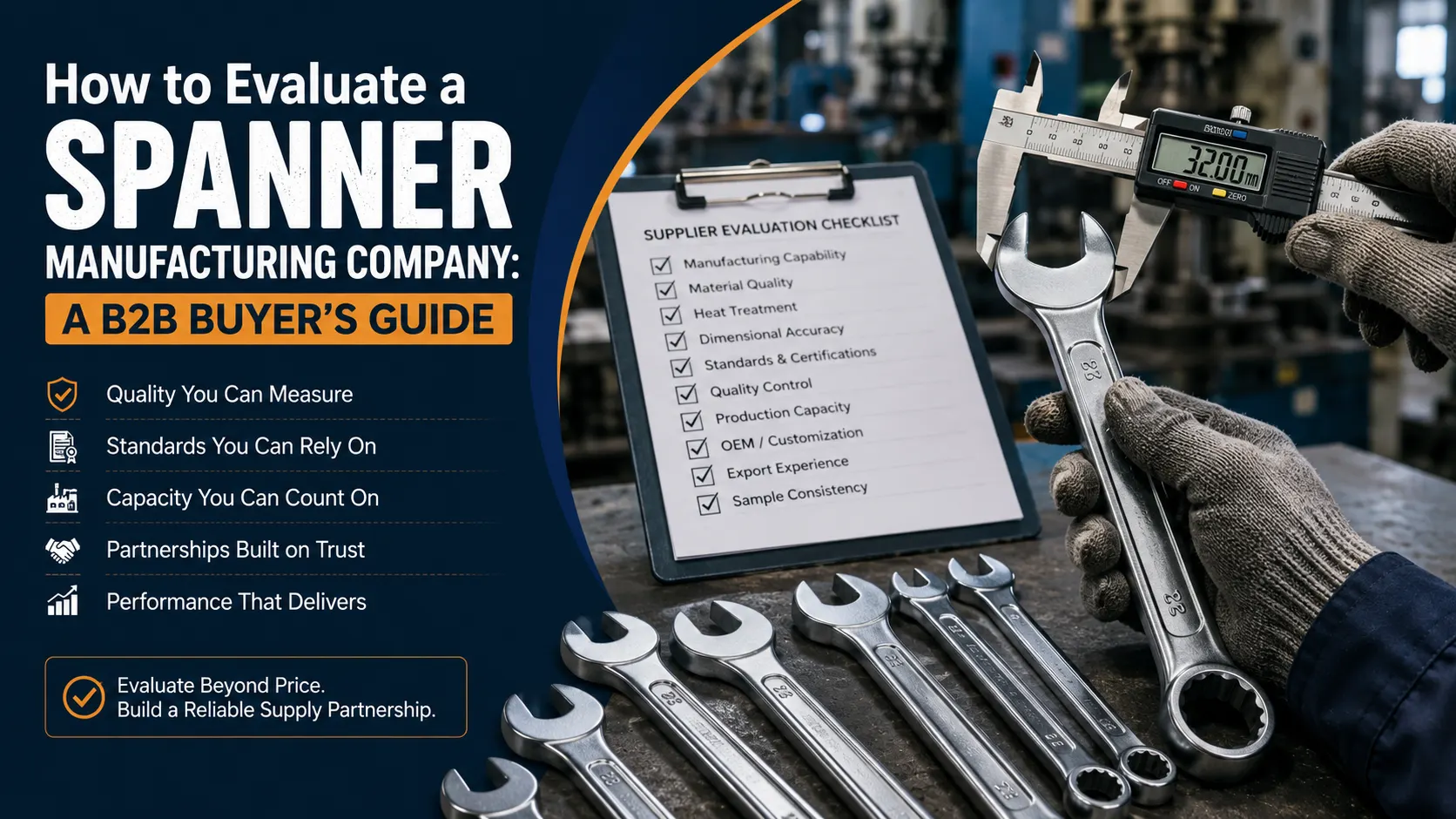
- How to Evaluate a Spanner Manufacturer in India
- JCBL Hand Tools: Spanner Manufacturing & B2B Supply Capabilities
- Why Batch-to-Batch Consistency Matters When Buying Spanners
- Comparison of Indian Spanner Manufacturers
- How to Source Spanners from India for Bulk Orders
- Sample B2B Request for Quotation (RFQ) Template
- Common Sourcing Mistakes to Avoid
- How This Guide Evaluates Manufacturers
- Conclusion: Sourcing Reliable Spanners from India
- FAQs
For international importers, wholesale distributors, hardware brands, and industrial procurement teams, sourcing spanners and wrenches from India involves technical verification across steel grades, forming methods, controlled heat treatment, dimensional tolerances, and repeat-order consistency.
India has an established hand-tool manufacturing base producing single and double open-end spanners, combination wrenches, bi-hexagonal ring spanners, adjustable wrenches, and specialized industrial patterns. Choosing the right supplier depends on the exact tool specifications, target market standards, volume requirements, and private-label customization needs.
This guide outlines how B2B buyers can evaluate Indian spanner manufacturers, verify materials and applicable standards, compare supplier capabilities, and manage bulk procurement.
What Should You Check Before Choosing a Spanner Manufacturer?
Before selecting an Indian spanner manufacturer or issuing a purchase order, audit these critical checkpoints:
- Product Range & Sizing: Confirm whether the supplier manufactures the specific spanner profiles (open-end, combination, ring, adjustable, or heavy-duty) and size ranges you need.
- Material Specification: Confirm the exact steel grade (e.g., carbon steel grades like C45/EN-8/EN-9 or alloy steels like Chrome Vanadium) specified for the product model and intended duty.
- Manufacturing Method: Determine whether the tool is drop forged, cold stamped, or formed by another method based on the product design, mechanical requirements, and applicable standard.
- Controlled Heat Treatment: Verify the hardening and tempering infrastructure used to achieve the mechanical properties and torsional strength required by applicable standards.
- Product Standards: Confirm the specific product standard applicable to the model, such as relevant DIN specifications (e.g., DIN 3110, DIN 895, DIN 894, DIN 3113) or applicable ASME standards.
- Quality & Testing Control: Check how dimensional verification, hardness, proof torque, and surface inspections are carried out and documented across production batches.
- OEM & Private-Label Support: Confirm marking capabilities, custom packaging formats, barcode integration, and finish options.
- Commercial & Export Capacity: Verify Minimum Order Quantities (MOQ), production lead times, moisture-protective export packaging, and international shipping documentation.
What Types of Spanners Do Indian Manufacturers Supply?
Indian tool manufacturers produce a broad range of standard and specialized fastening tools designed for automotive, engineering, industrial maintenance, construction, and trade applications.
Single Open-End Spanners
Single-ended open-jaw tools used where access to the fastener is restricted or where a single working size is preferred.
Double Open-End Spanners
Two different open-jaw sizes on one handle for versatile fastening and maintenance work.
Combination Spanners
An open jaw at one end and a closed ring profile at the other for general workshop use.
Bi-Hex Ring Spanners
Closed ring designs that fully engage compatible fasteners for controlled torque application.
Adjustable Wrenches
Variable-size tools with a movable jaw for mixed fastener dimensions and general maintenance.
Heavy-Duty & Striking Wrenches
Application-specific tools for heavy plant maintenance, structural work, and high-torque tasks.
Single Open-End Spanners
Designed with an angled jaw, these spanners are typically used where access to the fastener is restricted to one side or on larger machinery fasteners where single-size utility is required. Heavy-duty variants are often produced in hardened carbon steel across broad metric dimensions.
Double Open-End Spanners
Feature two open jaws of different sizes on a single handle. Standard industrial variants come in several body profiles, including drop-forged recessed-panel, elliptical-panel, and cold-stamped options, produced in carbon steel or Chrome Vanadium depending on the specific model and applicable standard.
Combination Spanners
Integrate an open jaw at one end for rapid run-down and a closed ring profile at the other for higher-torque engagement. They are standard in automotive toolkits and workshop maintenance sets.
Ring Spanners (Bi-Hexagonal / Offset)
Fully enclose the fastener head. Bi-hexagonal (12-point) broached designs distribute contact load across the fastener flats, reducing the risk of corner damage under load. Deep offset and cranked designs provide clearance around adjacent obstacles.
Adjustable Wrenches
Feature a precision-machined knurl and movable jaw to accommodate mixed fastener dimensions. They are commonly used when fixed-size tools are unavailable or for general maintenance tasks.
Heavy-Duty & Striking (Slogging) Wrenches
Manufactured for heavy plant maintenance, structural engineering, and infrastructure work, striking wrenches include a reinforced anvil end designed to withstand sledgehammer impact during high-torque loosening or tightening.
For an in-depth breakdown of tool geometry and workshop use cases, see our 11 Types of Spanners and Their Uses . For dimension and conversion details, refer to our Guide to Spanner Sizes and Conversions .
How to Evaluate a Spanner Manufacturer in India
A supplier’s catalogue illustrates what it sells; a structured B2B evaluation determines whether it can reliably deliver your required specification at volume.
Material Specification
Rather than accepting general descriptions like “high-grade tool steel,” confirm the exact metallurgical grade.
| Material | Typical Use / Advantage | Buyer Check |
|---|---|---|
|
Carbon Steel C45 / EN-8 / EN-9 |
Commonly used for standard industrial utilities, agricultural tools, and cost-sensitive commercial ranges. | Confirm the exact steel grade, heat treatment, and applicable standard. |
|
Chrome Vanadium Steel CR-V |
Commonly used in professional automotive and workshop tool ranges. | Verify alloy specification and required mechanical properties. |
| Customer-Specified Alloys | May be required for specialized industrial applications with specific mechanical or application requirements. | Define the required composition and performance requirements in the RFQ. |
There is no single steel grade that fits every commercial requirement. The suitability of a material depends on how it is paired with proper heat treatment, geometric design, and the target performance standard.
Manufacturing Method
The manufacturing method should align with the tool geometry, mechanical loads, volume, and commercial specifications:
- Closed-Die Drop Forging: The steel billet is heated to a controlled forging temperature appropriate to the steel grade and formed within precision closed dies. This aligns the grain flow along the profile of the handle and jaws, providing strength and fatigue resistance for high-load tools.
- Cold Stamping / Stamping: The tool profile is stamped or blanked from sheet or flat stock. This process is commonly used for flat utility profiles, light-duty maintenance tools, and cost-effective high-volume requirements where design parameters allow.
The suitability of forging, stamping, or other forming methods depends on the tool design, material, required loads, applicable standard, and intended application.
Heat Treatment & Mechanical Testing
Heat treatment is critical for balancing surface hardness with core toughness.
- Controlled Hardening & Tempering: Confirm that the manufacturer utilizes controlled atmosphere furnaces to prevent decarburization and ensure uniform hardness.
- Torsional Strength & Proof Load: Verify the hardness and torsional-strength requirements applicable to the specific wrench type and size under ISO 1711-1 or relevant national standards.
- In-House Testing Facilities: Inquire whether the manufacturer operates dedicated hardness testers (Rockwell/Vickers) and calibrated proof-torque test benches.
Product Standards vs. System Certifications
A common sourcing mistake is confusing quality-management certifications with product-level standards:
- Product Standards (DIN, ASME, IS): Define requirements for the individual tool, depending on the applicable standard.
- System Certifications (ISO 9001, IATF 16949): Certify the organization’s quality management and operational processes, not the dimensional compliance of a specific SKU.
- Safety Marks (e.g., GS Mark): Provide independent verification of product safety for applicable markets.
Surface Finishing and Corrosion Protection
The finish influences both appearance and corrosion resistance.
- Mirror Polish (Full Polish Chrome): Smooth, highly reflective plating that is easy to wipe clean of grease and oil.
- Satin / Matte Finish: Satin or matte finishes can reduce glare and provide a textured surface that many users prefer for handling.
- Black Phosphate / Black Oxide: Chemical conversion coatings offering a non-reflective surface for selected industrial applications.
- Zinc Plating: A practical coating option for basic corrosion protection in suitable utility applications.
Where corrosion resistance is an important requirement, specify a salt-spray test method such as ASTM B117 and define acceptance criteria appropriate to the agreed coating system and application.
JCBL Hand Tools: Spanner Manufacturing & B2B Supply Capabilities
JCBL Hand Tools represents the specialized tool manufacturing and export division of the JCBL Group (established in 1989), bringing over 35 years of industrial manufacturing experience to international procurement programs.
| Operational Area | JCBL Hand Tools Profile |
|---|---|
| Inception & Experience | Established 1989 (35+ Years Industry) |
| Manufacturing Footprint | 167,000 sqm across 5 Production Plants |
| Heat Treatment Infrastructure | Automated Hardening & Tempering Plant |
| Surface Finishing | Fully Automatic Electroplating Plant |
| R&D & Tooling | DSIR-Accredited R&D, CNC Tooling/Dies |
| Quality & Testing | German Hardness & Torque Test Benches |
| Safety & System Compliance | GS Certified Lines, DIN/ANSI Standards |
| Global Export Markets | USA, Europe, CIS, Mid-East, LatAm, South Africa |
Product Portfolio & Material Options
JCBL’s spanner and wrench range spans over 30 distinct catalogue lines, structured across Single Open-End Spanners , Double Open-End Spanners , Combination Spanners , and Ring Spanners . Depending on the model and standard, tools are available in both carbon steel and Chrome Vanadium (CR-V), with manufacturing options covering drop-forged, cold-stamped, recessed-panel, and elliptical-profile variants.
Product Standards
JCBL hand tools are manufactured in accordance with internationally recognized standards:
- Single Open-End Spanners: Produced to DIN 894 specifications in hardened/tempered carbon steel across comprehensive metric ranges.
- Double Open-End Spanners: Documented to DIN 3110 and DIN 895 standards across standard, satin, recessed-panel, and full-polished lines.
- Combination & Ring Spanners: Built to DIN 3113 and DIN 838 standards, featuring precision-broached bi-hexagonal profiles.
OEM & Private-Label Programs
JCBL specializes in large-volume supply for international importers, overseas distributors, and hardware brands. Private-label capabilities include custom roll-stamping, laser engraving, custom-dipped grips, specific surface finishes, bespoke tool roll/canvas packaging, blow-molded cases, and export-compliant retail packaging.
For detailed information on structuring contract manufacturing programs, refer to our What Is OEM Manufacturing for Hand Tool Brands . You can also download our complete product portfolio via the JCBL Hand Tools Catalogue .
Why Batch-to-Batch Consistency Matters When Buying Spanners
For a retail consumer, a minor variation in a tool’s finish or dimensions is an inconvenience. For an international importer or distributor ordering tens of thousands of units, inconsistency creates serious commercial friction:
Can lead to hardness variations and inconsistent performance under load.
Can create fastener play, poor fit, rounding, and avoidable returns.
Can affect appearance, corrosion resistance, and overall product presentation.
Can create warehouse handling, relabeling, and documentation issues.
Evaluating a manufacturer requires assessing process repeatability:
- Dimensional Accuracy: CNC-machined dies and automated broaching maintain uniform jaw and ring clearances across repeat production batches.
- Metallurgical Uniformity: Automated continuous heat-treatment furnaces help ensure consistent hardness and ductility across the entire lot.
- Plating & Marking Control: Automated electroplating lines and standardized roll-stamping/laser systems maintain visual and functional uniformity.
For repeat import programs, buyers should evaluate the supplier’s ability to reproduce the approved specification consistently across subsequent production batches.
Comparison of Indian Spanner Manufacturers
When auditing Indian hand-tool manufacturers, evaluate verified capabilities, documented product focus, and market alignment.
| Manufacturer | Documented Infrastructure & Focus | Primary Standards Alignment | Typical Sourcing Fit |
|---|---|---|---|
| JCBL Hand Tools | Automated heat treatment, automatic electroplating, DSIR-accredited R&D, documented OEM/private-label and export capabilities. | DIN-aligned products, ANSI-aligned offerings, and GS-certified product lines. | Global importers, wholesale distributors, private-label brand programs. |
| Taparia Tools Ltd | Extensive nationwide retail brand presence, broad general hand-tool catalogue. | Publicly documented product and quality standards should be verified for the required model. | Domestic retail networks, Indian wholesale distribution, and workshop trade. |
| Eastman Cast & Forge | Broad hand-tool and forging portfolio supplying automotive kits and export markets. | Product-specific standards should be confirmed for the quoted model. | Automotive toolkits, industrial suppliers, and export distribution. |
| Akar Auto Industries Ltd | Automotive component forging, leaf springs, and specialized automotive and workshop tool ranges. | Applicable certifications and product standards should be confirmed for the selected product. | Automotive component supply, vehicle assemblies, and general maintenance. |
| Ajay Industries | Established forging operations producing standard open-end, ring, and combination patterns. | Confirm the exact standards applicable to the selected range. | Commercial bulk supply and volume hardware distribution. |
| Hamco Ispat Pvt. Ltd | Focus on standard spanners, precision forming, and industrial maintenance tools. | Confirm the exact standards applicable to the selected range. | Industrial MRO, construction tools, and regional supply. |
How to Source Spanners from India for Bulk Orders
Following a disciplined procurement workflow helps international buyers prevent quality variations, shipment delays, and specification mismatches.
-
Technical RFQ Specification
Define spanner type, material grade, dimensions, applicable standard, and finish.
-
Technical Catalogue & Sample Verification
Evaluate dimensional accuracy, fastener fit, surface finish, and test reports.
-
Establish Approved Golden Sample
Retain the approved physical reference sample used to compare subsequent production.
-
Quality Control & Sampling Agreement
Agree on inspection procedures and sampling plans, such as ISO 2859-1, in the purchase order where applicable.
-
Export Packaging & Pre-Shipment Audit
Verify moisture protection, carton strength, export palletization, and final shipping documentation.
Sample B2B Request for Quotation (RFQ) Template
Using a structured, engineering-ready RFQ ensures that suppliers quote on identical technical parameters. Send this specification to shortlisted suppliers so quotations can be compared on the same technical basis.
REQUEST FOR QUOTATION – SPANNERS / WRENCHES
1. PRODUCT SPECIFICATION
- Product Type: Double Open-End Spanners / Combination Spanners
- Applicable Standard: DIN 3110 / DIN 3113 Form A (or customer specified)
- Size Range / Breakdown: 6×7 mm to 30×32 mm (Specify set or loose unit breakdown)
2. MATERIAL & MECHANICAL REQUIREMENTS
- Material Grade: Chrome Vanadium Steel (CR-V) / Carbon Steel (Specify exact grade)
- Forming Method: Closed-Die Drop Forged / Cold Stamped (As per design)
- Heat Treatment: Hardened & Tempered to meet applicable standard requirements
- Mechanical Compliance: Proof-torque test report conforming to applicable standard
3. SURFACE FINISH & BRANDING
- Finish: Satin Body with Polished Jaws / Full Mirror Chrome / Phosphate
- Corrosion Test Criteria: Salt spray test requirements as per agreed coating specification
- Marking: Roll-Stamped / Laser-Etched brand name, part number, and size markings
4. PACKAGING & PALLETIZATION
- Inner Packaging: Poly-pouch / Canvas Roll / Blister Card / Shelf Box
- Master Packaging: Export-grade corrugated carton with moisture-barrier liner
- Pallet Requirements: ISPM-15 compliant heat-treated pallets
5. COMMERCIAL TERMS
- Target Order Quantity: Initial order quantity & estimated annual volume
- Delivery Terms: FOB Port of Loading or CIF Destination
- Quality Inspection: Pre-shipment inspection terms as agreed in purchase contract
Common Sourcing Mistakes to Avoid
- Choosing Solely on Unit Price: A lower quotation may reflect differences in material specification, cross-section, heat treatment, finish, inspection, or packaging. Compare equivalent specifications before choosing on price.
- Omitting Product Standards in RFQs: Simply asking for “standard combination spanners” allows suppliers to quote different specifications. Always cite the exact standard where applicable.
- Treating System Certifications as Product Proof: An ISO 9001 certificate verifies quality management processes; it does not by itself guarantee that an individual spanner conforms to specific product-standard requirements.
- Failing to Seal a Golden Sample: Never approve mass production based on digital images alone. Inspect physical pre-production samples and retain an approved reference sample.
- Neglecting Ocean Freight Packaging: Hand tools are dense and vulnerable to maritime humidity. Specify suitable moisture-barrier protection, strong master cartons, and ISPM-15 compliant heat-treated pallets early in discussions.
How This Guide Evaluates Manufacturers
We evaluate manufacturers based on publicly documented product ranges, verified manufacturing infrastructure, applicable product standards, operational quality-control systems, OEM/customization capabilities, and global export footprint.
Specific technical requirements, material specifications, and commercial terms should always be confirmed directly with the manufacturer prior to contract finalization.
Conclusion: Sourcing Reliable Spanners from India
Selecting the right spanner manufacturer in India comes down to verifying technical capability, material integrity, and production repeatability. For international importers, distributors, and private-label brands, working with an experienced manufacturer that operates controlled heat-treatment, automated finishing, and verified product testing can support smoother long-term supply programs.
For customized B2B hand-tool programs, explore the JCBL Hand Tools Spanner Range or connect with the procurement team to request detailed technical specifications and quotation sheets.
FAQs
Key manufacturers include JCBL Hand Tools, Taparia Tools, Eastman Cast & Forge, Akar Auto Industries, Ajay Industries, and Hamco Ispat. Selection depends on whether your priority is large-volume OEM export, domestic wholesale distribution, automotive toolkits, or industrial forgings.
DIN 3110 and DIN 895 cover different double open-end wrench specifications and dimensional requirements. The exact profile, material, and performance characteristics should be checked against the applicable standard and the specific manufacturer’s model.
ISO 1711-1 includes requirements and test methods related to hardness and torsional strength for hand-operated wrenches and sockets. It provides the reference criteria for verifying that tools deliver adequate strength under operating loads without failure.
Yes. Established manufacturers like JCBL Hand Tools support comprehensive OEM and private-label programs, including customized die tooling, laser marking, specialized finishes, custom canvas pouches, blow-molded cases, and retail packaging with EAN/UPC barcoding.
Compare equivalent products against the same technical specification. Evaluate the exact steel grade, forming method, heat-treatment verification, applicable standard, surface finish, inspection documentation, MOQ, lead time, and export packaging rather than headline prices alone.
Related Readings
- Top Spanner Manufacturers & Suppliers in India for Global Buyers
- How to Choose the Right Spanner Manufacturer for Bulk Orders
- Why Importers Prefer Indian Spanner Manufacturers
- Best OEM Spanner Manufacturers for Private Label Brands
- How to Source Spanners in Bulk from India
- Wholesale Spanner Suppliers: A Complete Buyer’s Guide
- How to Evaluate a Spanner Manufacturing Company