Key Quality Certifications Required for Exporting Hand Tools Internationally
- Key Takeaways
- List of Key Certifications Required for Exporting Hand Tools
- Why Quality Certifications Are Essential for Exporting Hand Tools
- ISO 9001 Certification: Quality Management Requirement for Exporters
- Regional Product Standards: DIN, ANSI & International Compliance
- Material and Safety Certifications Required for Export Compliance
- Additional Certifications and Documentation for Global Shipments
- Export Compliance Checklist for Hand Tools
- How Certifications Influence Import Approval and Supplier Selection
- Conclusion
- FAQs
Quality certifications are a core requirement for exporting hand tools internationally, not just a regulatory formality. They verify that products meet country-specific standards, safety benchmarks, and performance criteria, which directly determines whether shipments are accepted or rejected.
For global buyers, certifications act as risk assessment tools, while for exporters, they are essential for market access, compliance, and long-term trade relationships. Understanding the right certifications is critical for successfully exporting hand tools to regions like Europe, the United States, and the Middle East.
Key Takeaways
- Exporting hand tools requires a combination of quality certifications, product standards, and compliance documents
- ISO 9001 is the most widely accepted certification for ensuring consistent manufacturing quality
- DIN standards are essential for European markets, while ANSI standards apply to the United States
- Material testing certifications (steel grade, hardness, durability) are critical for buyer approval
- CE marking may be required for certain hand tools sold in Europe
- Proper certifications help ensure faster customs clearance and reduced shipment rejection risks
- International buyers often conduct factory audits and pre-shipment inspections to verify compliance
- Certified exporters have a higher chance of supplier approval, repeat orders, and long-term contracts
List of Key Certifications Required for Exporting Hand Tools
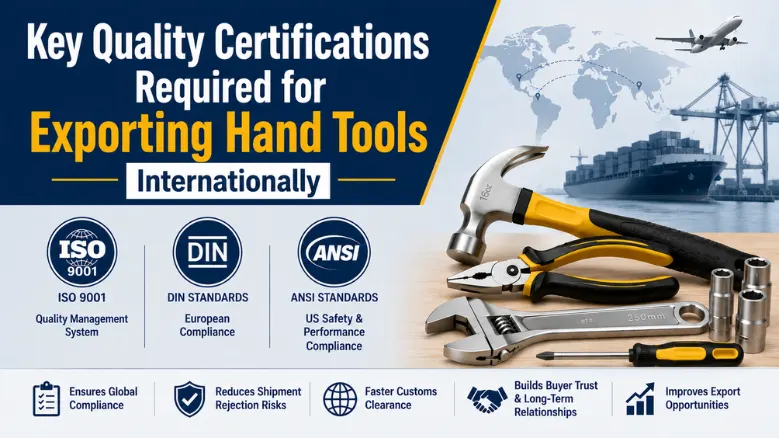
To enter international markets, hand tool exporters must comply with a combination of quality management, product standards, and testing certifications:
- ISO 9001: Quality management system certification
- DIN standards: European compliance for dimensions and technical performance
- ANSI standards: US compliance for safety and performance
- CE Marking: Required for certain categories in the European market
- Material & Test Certifications: Proof of steel grade, hardness, and durability
The key certifications required for exporting hand tools include ISO 9001, DIN or ANSI standards (depending on region), CE marking (for Europe), and material testing certifications.
Why Quality Certifications Are Essential for Exporting Hand Tools
Certifications are critical in determining whether a shipment is approved, delayed, or rejected during international trade. Regulatory authorities and buyers rely on these standards to ensure compliance.
Why they matter:
- Ensure compliance with import regulations in Europe, USA, and the Middle East
- Enable faster customs clearance
- Reduce risk of shipment rejection and penalties
- Meet the distributor and industrial buyer qualification criteria
Certifications are often a mandatory entry requirement, not an optional advantage.
ISO 9001 Certification: Quality Management Requirement for Exporters
ISO 9001 is the most widely recognized certification for hand tool exporters, ensuring that manufacturers follow a structured quality management system (QMS).
It covers:
- Standardized production processes
- Inspection and testing protocols
- Batch-level documentation and traceability
For international buyers, ISO 9001 acts as a baseline qualification requirement during supplier evaluation.
ISO 9001 certification ensures that a manufacturer consistently produces hand tools that meet defined quality standards through controlled and documented processes.
Partnering with an ISO certified hand tools manufacturer strengthens compliance and ensures consistent export-quality production.
Regional Product Standards: DIN, ANSI & International Compliance
Exporters must comply with region-specific standards that define product specifications and performance.
- DIN (Europe): Focuses on dimensional accuracy, tolerances, and durability
- ANSI (USA): Defines safety, performance, and usability benchmarks
| Standard | Region | Requirement Type |
| DIN | Europe | Dimensional & technical compliance |
| ANSI | USA | Performance & safety compliance |
| ISO | Global | Quality management systems |
Material and Safety Certifications Required for Export Compliance
Material quality and safety validation are essential for meeting global acceptance criteria.
Core requirements
- Certified raw material grades (carbon steel, chrome vanadium steel)
- Hardness testing (HRC standards)
- Mechanical strength and torque/load testing
Safety compliance ensures
- Reliable performance under industrial conditions
- Adherence to the importing country’s safety regulations
Additional Certifications and Documentation for Global Shipments
In addition to primary certifications, exporters must provide supporting documentation for customs and buyer verification.
Common documents
- Certificate of Origin
- Inspection certificates (third-party or in-house)
- Product test reports
Market-specific requirements
- CE marking (Europe)
- Buyer-specific audits and compliance checks
Proper documentation significantly improves customs clearance speed and buyer trust.
Export Compliance Checklist for Hand Tools
Before shipping internationally, ensure the following:
- ISO 9001 certification in place
- Compliance with NDI or ANSI standards
- Material and hardness test reports available
- Inspection certificates prepared
- Country-specific compliance verified
How Certifications Influence Import Approval and Supplier Selection
Certifications directly impact supplier approval and long-term business opportunities.
Impact on export success:
- Faster supplier onboarding
- Reduced compliance verification time
- Lower buyer risk perception
- Higher chances of repeat orders
International buyers often conduct factory audits and pre-shipment inspections to verify certifications. Missing or inconsistent documentation is a leading cause of shipment rejection in regulated markets.
Certified hand tool exporters are more likely to secure consistent international orders due to reduced regulatory and quality risks.
Conclusion
Exporting hand tools successfully requires strict alignment with international certifications and compliance standards. ISO 9001 ensures process quality, while DIN and ANSI standards guarantee product acceptance across regions. Combined with material testing and proper documentation, these certifications form the foundation of global trade readiness.
For exporters, meeting these requirements is not just about compliance—it is a competitive advantage that enables faster approvals, stronger buyer confidence, and sustained growth in international markets.
FAQs
ISO 9001 is widely required, along with compliance to DIN (Europe) or ANSI (USA) standards and relevant testing certifications.
They are region-specific requirements essential for meeting buyer and regulatory expectations.
Yes, buyers require proof of material quality, hardness, and performance testing.
CE marking is required for specific categories of tools sold in the European market.
While possible in limited cases, uncertified tools face significant challenges in approval and market acceptance.