India’s Growing Hand Tools Export Market: Opportunities for Global Importers
- India’s Hand Tools Export Market Size and Growth Trends
- India’s Position in the Global Hand Tools Export Market
- Why Global Importers Are Increasing Sourcing from India
- India vs China: Which Is Better for Hand Tools Sourcing?
- Key Opportunities for Global Importers
- High-Demand Export Categories
- Government Policies Accelerating Export Growth
- Challenges Global Importers Should Consider
- How to Select the Right Indian Hand Tools Exporter
- Conclusion
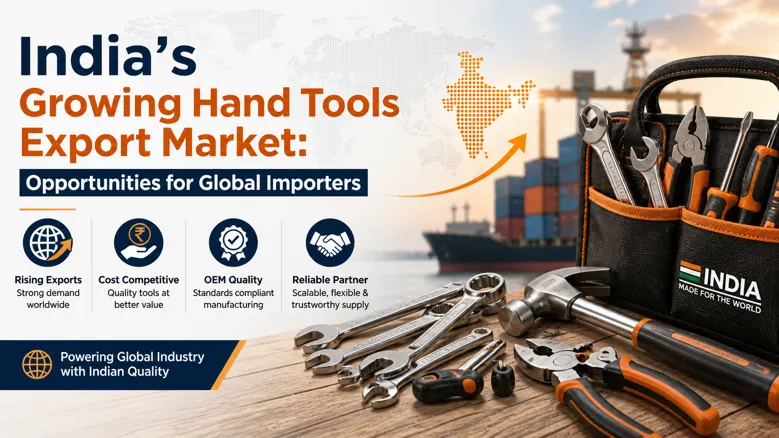
India’s hand tools export market is growing due to supply chain diversification, competitive manufacturing costs, expanding export capabilities, and strong government support for exporters.
Over the past decade, India has transitioned from a secondary sourcing option to a strategic export hub for hand tools. Export data and industry insights from the Engineering Export Promotion Council of India highlight consistent growth, particularly in demand from regulated markets like the US and Europe.
This growth is not accidental; it is driven by structural shifts in global trade and sourcing strategies.
India’s Hand Tools Export Market Size and Growth Trends
India’s hand tools exports have grown steadily, driven by rising demand in the US, Europe, and emerging markets, with increasing global share in the mid-range tools segment.
India’s exports have shown consistent YoY growth in the last decade
Strong demand from:
- USA (largest importer)
- Germany, UK (quality-driven markets)
- UAE & Africa (price-driven markets)
India is gaining share in mid-priced, OEM-spec replacement tools
India’s Position in the Global Hand Tools Export Market
India is increasingly competing with traditional manufacturing leaders by offering a balanced value proposition: cost, quality, and scalability.
Key Market Indicators
- Rising exports to North America and Europe
- Increasing demand for OEM-spec replacement tools
- Expansion of export-oriented MSME manufacturers
- Growing trust among global distributors and importers
Core Manufacturing Clusters
India’s export strength is rooted in specialized industrial clusters:
- Ludhiana: Large-scale production of industrial hand tools
- Jalandhar: Forged tools and hardware manufacturing
- Delhi NCR: Exporters, traders, and global sourcing networks
These clusters create supply chain efficiency, skilled labor availability, and production scalability, which are critical for global buyers.
Why Global Importers Are Increasing Sourcing from India
Global importers are increasingly sourcing hand tools from India to diversify supply chains, reduce costs, and ensure consistent quality. Driven by the China+1 strategy, India offers a strong mix of competitive pricing, OEM-spec products, and global compliance.
1. Supply Chain Diversification (China+1 Strategy)
Importers are sourcing from India to reduce dependence on a single country and minimize geopolitical and supply chain risks.
Global disruptions, trade tensions, and logistics uncertainties have accelerated the China+1 strategy, positioning India as a reliable alternative.
2. Cost Efficiency Without Compromising Quality
India offers high-quality replacement tools that meet OEM specifications while maintaining significantly lower production costs.
For importers, this means:
- Better margins
- Competitive retail pricing
- Sustainable sourcing strategies
3. Compliance with International Standards
Export-focused Indian manufacturers increasingly align with global compliance requirements:
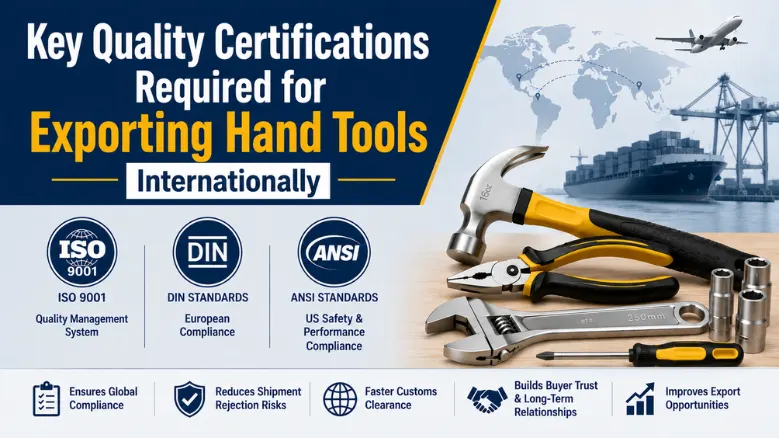
- ISO certifications
- DIN and ANSI standards
- EU regulations (REACH, RoHS where applicable)
This ensures smoother entry into regulated markets.
India vs China: Which Is Better for Hand Tools Sourcing?
India offers better flexibility, lower MOQ, and competitive pricing for replacement tools, while China dominates in scale and ultra-low-cost mass production.
| Factor | India | China |
| Pricing | Competitive | Lowest in bulk |
| MOQ | Flexible | High |
| Customization | High | Moderate |
| Quality Consistency | Improving | Strong |
| Lead Time | Moderate | Faster |
Key Opportunities for Global Importers
Global importers can benefit from India’s hand tools market through private labeling, cost optimization, scalable sourcing, and entry into emerging markets.
Private Label and Brand Building
India enables importers to:
- Launch their own brands
- Customize packaging and specifications
- Differentiate in competitive markets
This is particularly valuable for distributors targeting retail and eCommerce channels.
Cost Optimization Across the Supply Chain
Beyond product cost, importers benefit from:
- Lower manufacturing expenses
- Competitive labor costs
- Government-backed export incentives
This improves total landed cost, not just unit pricing.
Scalable and Flexible Production
Indian exporters can handle:
- Low MOQ trial orders
- Mid-scale distribution volumes
- Large bulk shipments
This flexibility supports both new market entrants and established importers.
Expansion into Emerging Markets
Indian hand tools are widely accepted in:
- Middle East
- Africa
- Southeast Asia
These regions prioritize affordability and durability, aligning well with India’s manufacturing strengths.
High-Demand Export Categories
Top exported hand tools from India include spanners, pliers, hammers, agricultural tools, and construction tools.
Core Export Products
- Spanners and wrenches
- Pliers and cutters
- Hammers and striking tools
- Agricultural hand tools
- Garage and workshop tools
Demand is driven by industries such as:
- Construction
- Agriculture
- Automotive repair
- Industrial maintenance
Government Policies Accelerating Export Growth
India’s export ecosystem is actively supported by the Ministry of Commerce and Industry under the Government of India.
Key Export Initiatives
- RoDTEP Scheme: Refund of duties and taxes on exported goods
- Make in India: Boosts manufacturing competitiveness
- Export promotion programs and trade facilitation
These initiatives reduce costs and improve global competitiveness for exporters and importers alike.
Challenges Global Importers Should Consider
Key challenges include supplier verification, quality consistency, and logistics coordination.
Common Challenges
- Variation in supplier quality
- Limited standardization across smaller manufacturers
- Shipping delays and freight cost fluctuations
Mitigation Strategies
- Conduct supplier audits
- Request pre-shipment inspections
- Start with sample orders
- Work with export-experienced suppliers
How to Select the Right Indian Hand Tools Exporter
Choosing the right supplier is critical for long-term success.
Evaluation Checklist
- Proven export experience
- Compliance with international standards
- Consistent quality control systems
- Transparent communication and documentation
Suppliers focused on export markets and replacement parts manufacturing are generally better aligned with global importer expectations than purely domestic suppliers.
Conclusion
India’s hand tools export market is becoming a strategic sourcing destination for global importers seeking cost efficiency, reliable quality, and scalable production. With growing manufacturing capabilities, strong export support, and alignment with international standards, India offers a dependable alternative in today’s shifting supply chains. For importers, this means better margins, flexible sourcing, and reduced dependency on single-country suppliers, making India a smart, future-ready choice for long-term sourcing.
FAQs
Yes, India offers a strong combination of cost competitiveness, quality manufacturing, and export readiness, making it a reliable sourcing destination.
Key advantages include lower production costs, flexible order quantities, private labeling options, and compliance with international standards.
Major importers include the USA, Germany, the UK, UAE, and several African markets.
Common challenges include supplier verification, quality consistency, and logistics management, which can be mitigated through audits and inspections.
Many export-focused manufacturers comply with ISO, DIN, ANSI, and relevant EU regulations, ensuring suitability for international markets.