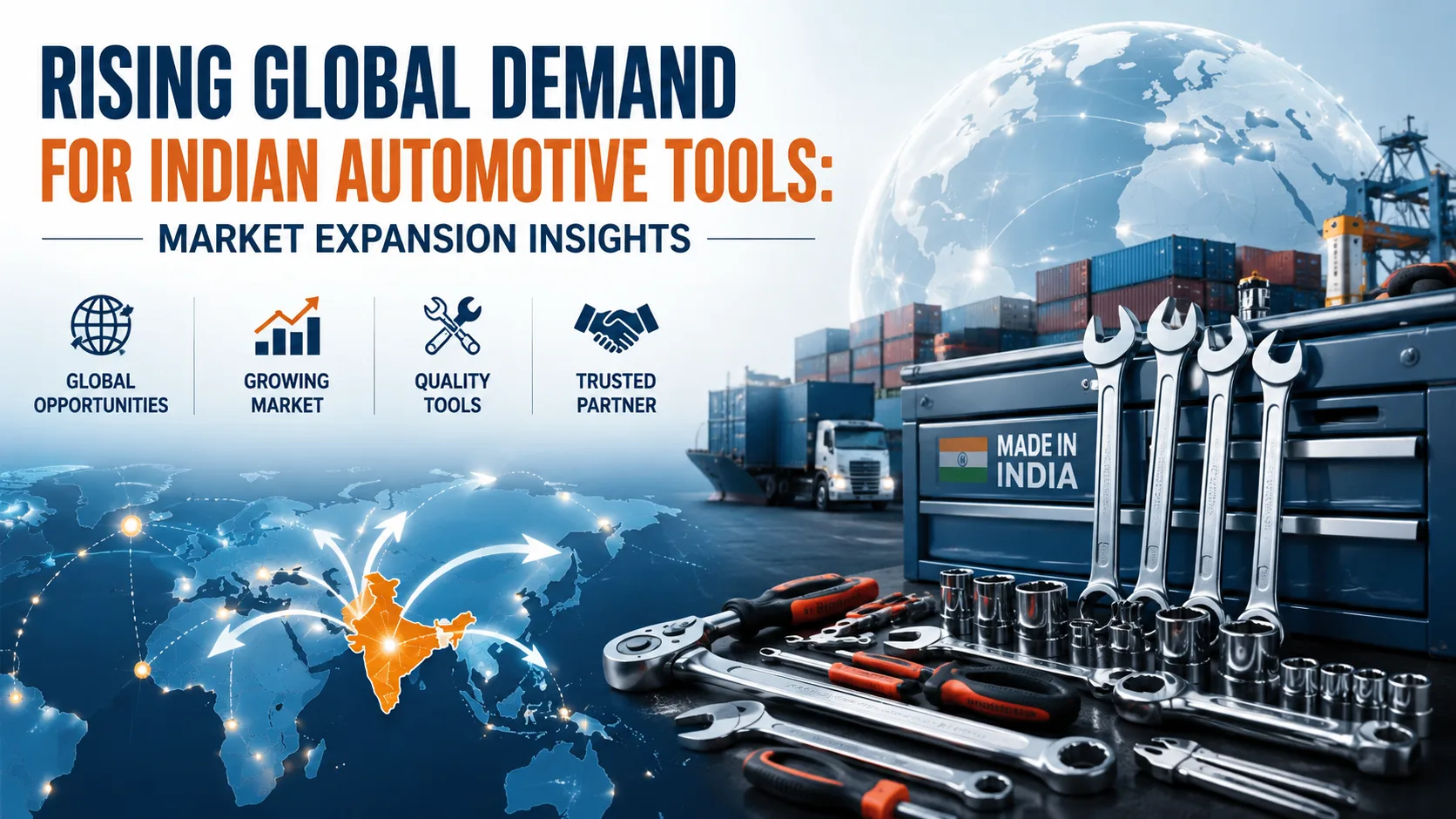
Rising Global Demand for Indian Automotive Tools: Market Expansion Insights
- Key Takeaways
- Global Automotive Tools Market: Data-Driven Growth Insights
- Why Indian Automotive Tools Are Gaining Global Traction
- Which Regions Import Automotive Tools from India the Most?
- High-Demand Automotive Tools Driving Export Growth
- What Certifications Do Global Buyers Require for Automotive Tools?
- Why Do Global Buyers Choose Indian Automotive Tool Manufacturers?
- What Challenges Do Automotive Tools Exporters Face Globally?
- Future Outlook: India’s Role in the Global Automotive Tools Market
- Conclusion
- Looking for a Reliable Automotive Tools Manufacturer in India?
- FAQs
The global automotive ecosystem is evolving rapidly, not just in vehicle technology, but in how tools and equipment are sourced worldwide. With increasing pressure to diversify supply chains, global buyers are actively shifting toward emerging manufacturing hubs like India.
According to the Automotive Tools Market Report (2026–2035), the global automotive tools market is valued at over USD 50 billion in 2025 and is projected to reach USD 86 billion by 2035, growing at a CAGR of ~5.4%.
This steady growth, combined with rising aftermarket demand, is creating a strong opportunity for automotive tools manufacturers in India to expand globally.
Key Takeaways
- Global automotive tools market to reach USD 86B by 2035 (~5.4% CAGR).
- Aftermarket drives ~62% of demand, led by repair and maintenance needs.
- India offers 15–30% lower costs with reliable quality standards.
- 94M+ vehicles produced (2024) fueling ongoing tool demand.
- Asia-Pacific holds up to 47% demand, boosting India’s export position.
- Major markets: USA, Europe, Middle East, Africa, Southeast Asia.
- Hand tools lead (~45% share); smart and diagnostic tools growing fast.
- ISO, DIN, ANSI certifications are critical for global buyers.
- Indian suppliers excel in OEM/private label and scalable production.
- Future growth driven by EV tools and smart workshop adoption.
Global Automotive Tools Market: Data-Driven Growth Insights
The automotive tools segment is closely tied to the automotive aftermarket, which is a major growth engine.
- The global automotive aftermarket is projected to exceed USD 500 billion+ in the coming years
- Over 94 million vehicles were produced globally in 2024, increasing demand for tools across manufacturing and servicing
- Around 62% of tool demand comes from maintenance and repair activities, highlighting aftermarket dominance
Additionally, more than 11 million automotive workshops globally rely on tools daily, ensuring recurring demand cycles.
Why Indian Automotive Tools Are Gaining Global Traction
India’s rise as a global sourcing hub for automotive tools is driven by a combination of cost efficiency, manufacturing strength, and export-focused growth, making it an increasingly preferred choice for international buyers. This momentum is also reflected in the growing hand tools export market in India, where global importers are actively seeking reliable manufacturing partners.
1. Cost Advantage with Proven Quality
India offers a 15–30% cost advantage compared to Western suppliers, while maintaining strong quality benchmarks, making it ideal for bulk sourcing.
2. Strong Manufacturing Ecosystem
India’s tooling industry is supported by:
- Advanced forging clusters
- CNC machining facilities
- Skilled engineering workforce
This enables consistent production for large export volumes.
3. Export Growth Momentum
India’s tools and engineering exports have been growing steadily, supported by:
- Government initiatives like Make in India
- Export incentives
- Improved logistics infrastructure
At the same time, Asia-Pacific accounts for up to 36–47% of global automotive tool demand, positioning India strategically within the largest consumption region.
Which Regions Import Automotive Tools from India the Most?
The United States, Europe (Germany, UK, France), the Middle East (UAE, Saudi Arabia), and emerging markets in Africa and Southeast Asia are the fastest-growing importers of automotive tools from India, driven by aftermarket demand, infrastructure growth, and cost-efficient sourcing needs.
United States
As per the Industry Research data, the United States accounts for ~24% of global automotive tools demand, making it one of the most important export destinations.
- Over 230,000 service centers drive continuous tool demand
- ~18% annual replacement rate ensures recurring imports
- Strong demand for aftermarket tools and private label products
High-volume demand for automotive hand tools, garage equipment, and bulk supply contracts
Europe (Germany, UK, France)
Europe emphasizes precision, safety, and regulatory compliance, making it a premium but competitive market.
- Over 60% of workshops use smart diagnostic tools
- Strong preference for ISO, DIN, and CE-certified products
- Demand for high-performance and precision-engineered tools
Premium positioning for OEM-grade and certified automotive tools from India
Middle East (UAE, Saudi Arabia)
The region contributes ~9% of global demand, driven by infrastructure and automotive expansion.
- Growing vehicle fleets and service networks
- High reliance on imported tools
- Demand for heavy-duty and durable tools due to harsh conditions
Strong demand for garage tools, workshop equipment, and heavy-duty mechanic tools
Africa & Southeast Asia
These regions are rapidly expanding due to urbanization and rising vehicle ownership.
- Increasing demand for affordable, durable tools
- A growing number of independent repair workshops
- Limited domestic manufacturing → high import dependency
Long-term growth for cost-effective automotive tools and scalable supply partnerships
High-Demand Automotive Tools Driving Export Growth
Global market data shows that demand for automotive tools is concentrated in a few high-performing product categories, each contributing differently to export growth.
- Hand tools dominate the market, accounting for approximately 45% of total share, making them the most widely used and consistently demanded category across workshops and service centers.
- Electric and smart tools are gaining rapid adoption, with nearly 42% of workshops integrating advanced tools, reflecting a shift toward efficiency and precision in automotive servicing.
- Diagnostic and test equipment is another fast-growing segment, expanding at a CAGR of around 5.5%, driven by increasing vehicle complexity and the rise of electronic systems.
What this means for exporters:
These trends highlight strong and sustained export opportunities in:
- High-volume automotive hand tools
- Garage and workshop equipment for daily operations
- Advanced diagnostic and EV-compatible tools for future-ready markets
What Certifications Do Global Buyers Require for Automotive Tools?
Global buyers, especially in the USA, Europe, and the Middle East, prioritize suppliers who meet strict quality and compliance standards.
Key certification requirements include the following:
- ISO 9001 certification for quality management systems
- DIN and ANSI standards for product performance and safety
- Product testing and durability validation to ensure long-term reliability
This growing focus on compliance is a key reason why automotive tools exporters from India are gaining trust in regulated international markets.
Why Do Global Buyers Choose Indian Automotive Tool Manufacturers?
Indian exporters offer a strong combination of cost efficiency, manufacturing flexibility, and global compliance, making them highly competitive across international markets.
1. Strong Cost-to-Quality Ratio
Indian manufacturers deliver high-quality automotive tools at competitive pricing, offering better value compared to many Western suppliers.
Ideal for buyers in price-sensitive markets like Africa and Southeast Asia, as well as bulk importers in the USA and Middle East.
2. Private Label & OEM Capabilities
Many Indian exporters support:
- Private label automotive tools manufacturing
- Custom branding and packaging solutions
- Product customization based on regional requirements
This is especially beneficial for distributors and brands in North America and Europe looking to build their own product lines.
3. Scalable Production Capacity
India’s manufacturing ecosystem enables:
- High-volume production for global distribution
- Flexible Minimum Order Quantities (MOQs)
- Reliable long-term supply partnerships
This makes Indian suppliers suitable for both large-scale importers and growing distributors worldwide.
What Challenges Do Automotive Tools Exporters Face Globally?
Despite strong growth, exporters must navigate several key challenges:
- Logistics and freight volatility, impacting delivery timelines and costs
- Region-specific regulatory compliance, especially in Europe and North America
- Rising competition from other low-cost manufacturing countries
However, improvements in India’s logistics infrastructure, export policies, and manufacturing standards are helping exporters overcome these barriers and expand globally.
Future Outlook: India’s Role in the Global Automotive Tools Market
The automotive tools market is evolving rapidly, driven by technology and changing vehicle ecosystems.
Key future trends include:
- Rising demand for EV-specific automotive tools, growing up to ~45% in emerging segments
- Increasing adoption of smart and connected tools, with ~70% trend adoption in advanced workshops
- Expansion of global automotive service networks, especially in developing regions
With the global market projected to exceed USD 86 billion by 2035, India is well-positioned to become a key global sourcing hub for automotive tools.
Conclusion
The growing global demand for Indian automotive tools reflects a clear shift in how international buyers approach sourcing. Today, decisions are driven not just by cost, but by the need for consistent quality, certified manufacturing, and reliable supply chains.
India is steadily positioning itself as a trusted global sourcing hub, offering the right balance of competitive pricing, scalable production, and export-ready compliance. For importers, distributors, and automotive brands, this creates an opportunity to build long-term partnerships with manufacturers that can support both current demand and future market expansion.
Looking for a Reliable Automotive Tools Manufacturer in India?
Partner with a supplier that delivers:
- OEM-grade quality and consistent performance
- Export-ready certifications for global markets
- Private label and customization capabilities
- Scalable production for bulk and long-term supply
FAQs
The market is valued at over USD 50 billion in 2025 and is projected to reach USD 86 billion by 2035.
Due to cost competitiveness, improving quality standards, and global supply chain diversification.
Major markets include the USA, Europe, Middle East, Africa, and Southeast Asia.
Hand tools, garage equipment, diagnostic tools, and EV-specific tools.
Yes, many manufacturers like JCBL Hand Tools meet ISO, DIN, and ANSI certifications required for international trade.