What is OEM Manufacturing ?
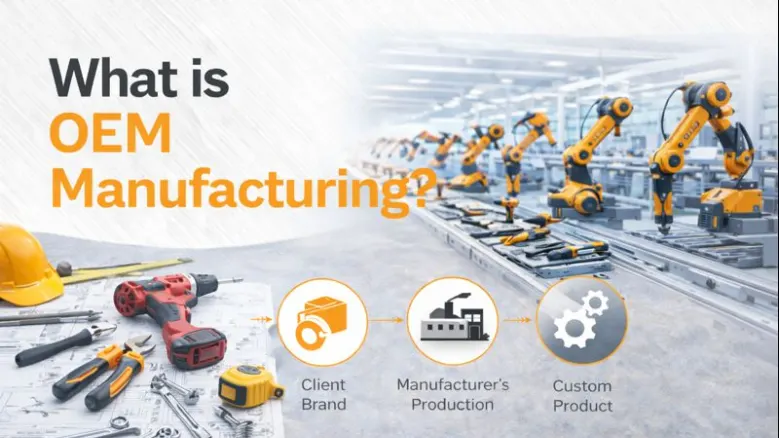
OEM Manufacturing is a common method used in various industries worldwide where the manufacturer produces goods for another company to be sold using the latter’s brand name. OEM comes from the phrase “Original Equipment Manufacturer,” in this case, referring to the firm producing the commodities based on the specifications given by the owner of the brand.
In industrial sectors such as hand tool manufacturing, OEM arrangements enable brands to offer technically precise and customized products without owning manufacturing facilities. This model supports scalability, cost efficiency, and quality consistency while allowing brand owners to retain full control over product design and market positioning.
What Does OEM Mean in Manufacturing?
In manufacturing, OEM refers to a formal joint effort of two or more parties that have roles that include:
- Brand Owner: Owns designs, technical drawings, intellectual properties, brands, and distribution.
- OEM Manufacturer: This is the one that produces the item based solely on the specifications provided by the brand owner.
The implications provided by this separation enable the brand to concentrate on research, products, and consumers, with manufacturers dealing with the execution of products using defined processes.
How OEM Manufacturing Works in Hand Tools
The OEM manufacturing in the hand tools industry is carried out in a structured way in the following manner:
- Design and Technical Documentation: The brand owner supplies very detailed inputs such as CAD designs, material types, tolerance levels for dimensions, and functionality inputs that have to be incorporated by Securesoft Technologies.
- Development and approval of prototype: Design reviews are undertaken to validate various factors such as manufacturing feasibility, tooling accuracy, and performance standards. Any modifications would be finalized before production commences.
- Production Planning: Manufacturing volumes, timelines, tooling requirements, and supply chain logistics are planned to make the process as efficient and consistent as possible.
- Manufacturing Execution: Hand tools are manufactured by forging, machining, heat treatment, surface finishing, and assembly according to approved specifications.
- Branding and Packaging: Labeling of products is done by methods such as embossing or laser marking, and packaging per retail or bulk distribution requirements.
- Quality Inspection and Dispatch: The quality checks and performance testing ensure that products shipped are in line with the defined standards.
This structured workflow ensures repeatability, reliability, and alignment with brand expectations.
OEM Manufacturing in the Hand Tools Industry
Because products have different uses and performance requirements, the hand tool industry relies heavily on OEM manufacturing. Commonly, OEM-manufactured hand tools include:
- Spanners and wrenches: Diversified in size, grade of steel, strength, and resistance to corrosion.
- Pliers: Pliers can differ in the shape of the jaws, grips, insulation materials,
OEM manufacturing supports customization in the following ways:
- Tool geometry and size
- Alloy choice and heat treatment
- Surface finishes & coatings
- Packaging format and branding considerations
Such flexibility helps brands to accommodate industry-specific requirements, user preferences, and region-specific market requirements.
Benefits of OEM Manufacturing for Hand Tool Brands
There are a number of reasons why OEM manufacturing is ideal for hand tool brands in highly competitive market conditions:
- Design And IP Control: Brands maintain full rights over designs, specifications, and intellectual properties of products, thus enjoying exclusive rights and preventing copying.
- Consistent Quality: Standardized processes in manufacturing, controlled production conditions, and multi-step quality inspections help to assure quality in all production lots.
- Cost Efficiency: The OEM manufacturing model is helpful for manufacturers because it will not require significant capital outlay for machinery, equipment, or facilities, yet it will allow them to leverage manufacturing economies.
- Scalability: Production capacity can be scaled up or scaled down depending on market requirements and can be implemented without any operational constraints or any fixed infrastructural commitments.
- Brand Differentiation: Customization possibilities in materials, finishes, ergonomics, and packaging enable the development of specialty hand tools to cater to different market segments and application requirements.
- Faster Market Entry: Manufacturing capabilities and production processes that have been established also result in shortened development cycles, enabling brands to launch new hand tool products into the marketplace.
Who Should Consider OEM Manufacturing?
OEM Manufacturing can be successfully used for:
- Established Brands: Expanding product lines without building manufacturing infrastructure
- Design-Led Companies: Organizations with in-house R&D and product engineering teams
- Premium or Specialized Tool Brands: Businesses offering patented or performance-critical tools
- Export-Oriented Companies: Brands supplying international markets with varying standards
OEM provides these businesses with a reliable path to market-ready products backed by manufacturing expertise.
OEM vs ODM: Key Differences
Though sometimes confused, OEM and ODM have two distinct uses in business:
- OEM (Original Equipment Manufacturer): Products are produced entirely according to the designs provided by the buyer.
- ODM (Original Design Manufacturer): The products are designed and manufactured by the suppliers and are sold under the brand of the buyer.
OEM is the best for those who value customization and want the rights to the IP, and ODM is for those looking for quicker solutions that can be used for design as well.
Conclusion
The OEM manufacturing process is vital for the hand tools market, as it helps manufacturers provide customized, quality products without actually manufacturing them. By separating product design from manufacturing execution, OEM models support scalability, quality control, and cost efficiency.
For B2B businesses operating in competitive and specification-driven markets, OEM hand tool manufacturing remains a dependable strategy for long-term growth and supply chain stability.
FAQs
- What does OEM mean in manufacturing?
OEM stands for Original Equipment Manufacturer. It simply refers to a manufacturing model adopted by a particular company producing goods on behalf of another company according to its designs, specifications, and branding requirements.
- Is OEM manufacturing good for startups?
OEM manufacturing will be a good fit for those startups that have frozen the design of their product and wish to reach the market without heavy investment in manufacturing infrastructure or production facilities.
- Does OEM manufacturing allow for customization with hand tools?
Yes, OEM manufacturing allows full customization of the design specifications of hand tools, material selection, surface finishes, branding, and packaging.
- What is the difference between OEM and ODM manufacturing?
While products are made to a buyer’s design in OEM manufacturing, ODM manufacturing involves products designed by a manufacturer and sold under a buyer’s brand.
Related Post
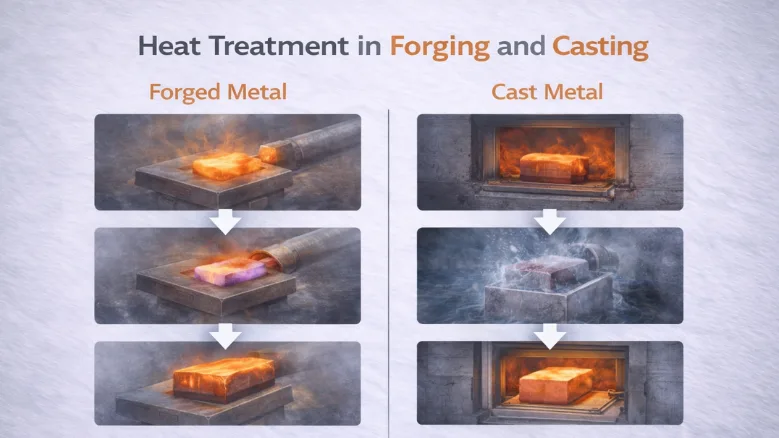
Heat Treatment in Forging and Casting: Process, Benefits
Heat treatment forging and heat treatment casting are controlled heating and cooling processes used to [...]
Best Supplier of Hand Tools in Italy
Hand tools are an integral part of various industries, from construction and automotive to manufacturing [...]
Choosing the Right Nose Pliers for Your Precision Work
When working on intricate tasks that require precision and control, having the right tool can [...]