What Is Cold Forging? Process, Benefits, Cost & Industrial Applications
- What Is Cold Forging in Manufacturing?
- How Does Cold Forging Work? (Step-by-Step Process)
- Types of Cold Forging Processes
- Advantages of Cold Forging
- Limitations of Cold Forging
- Cold Forging vs Hot Forging vs CNC Machining
- Applications of Cold Forging in Industry
- When Should You Choose Cold Forging?
- Is Cold Forging Cost-Effective for Manufacturers?
- How to Choose the Right Cold Forging Supplier
- Common Mistakes to Avoid in Cold Forging
- Conclusion
- FAQs
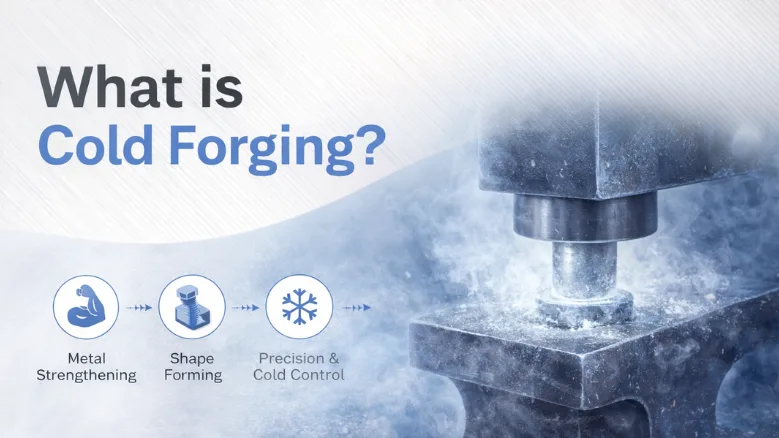
Cold forging is a metal forming process in which metal is shaped at or near room temperature using high compressive force. It is widely used to manufacture high-precision components such as fasteners, automotive parts, and electrical connectors due to its superior dimensional accuracy, excellent surface finish, and cost efficiency in high-volume production.
What Is Cold Forging in Manufacturing?
Cold forging is a manufacturing process where metal is plastically deformed without applying heat. It falls under cold working techniques, where compressive force is used to shape metal into precise forms using dies and presses.
Unlike machining, which removes material, cold forging reshapes the material. This results in:
- Better material utilization
- Stronger parts due to grain flow alignment
- Minimal waste generation
Because no heat is involved, cold forging avoids thermal distortion and oxidation, making it ideal for components requiring tight tolerances and consistent quality.
How Does Cold Forging Work? (Step-by-Step Process)
Cold forging follows a controlled process to ensure precision and repeatability:
- Material Selection: Ductile metals such as low-carbon steel, aluminum, and copper are selected for their ability to deform without cracking.
- Die and Tooling Preparation: Custom dies are designed based on the final component shape. Lubrication is applied to reduce friction and improve tool life.
- Application of High Pressure: Mechanical or hydraulic presses apply high compressive force, often ranging from several tons to hundreds of tons.
- Metal Deformation: The material flows into the die cavity, taking the desired shape without heating.
- Ejection and Minimal Finishing: The finished part is removed, often requiring little to no secondary machining due to its smooth surface.
Types of Cold Forging Processes
Different cold forging methods are used depending on the application:
- Cold Heading: Commonly used for bolts, screws, and rivets
- Cold Extrusion: Produces parts with uniform cross-sections
- Coining: Creates highly detailed and precise shapes
- Thread Rolling: Forms threads without cutting, improving strength
These processes allow manufacturers to produce complex shapes with high repeatability.
Advantages of Cold Forging
Cold forging offers significant benefits, especially in high-volume manufacturing:
- High Dimensional Accuracy: Parts are produced with tight tolerances, often eliminating the need for secondary machining.
- Excellent Surface Finish: Smooth finishes reduce or eliminate polishing and finishing operations.
- Material Efficiency: Cold forging can reduce material waste by up to 20–30% compared to machining, depending on the component design.
- Improved Strength and Durability: The process enhances mechanical properties through strain hardening and grain flow alignment.
- High Production Efficiency: Faster cycle times make it ideal for mass production environments.
Limitations of Cold Forging
Despite its advantages, cold forging has certain limitations that manufacturers must consider:
- High Equipment Force Requirements: Significant pressure is required, leading to investment in high-capacity machinery.
- Limited to Ductile Materials: Brittle materials cannot be effectively cold forged.
- Design Constraints: Complex geometries and thick sections can be challenging to produce.
- High Initial Tooling Cost: Tooling investment is high but it becomes cost-effective in large production runs.
Cold Forging vs Hot Forging vs CNC Machining
| Factor | Cold Forging | Hot Forging | CNC Machining |
| Temperature | Room temperature | High temperature | Not applicable |
| Material Waste | Low | Moderate | High |
| Accuracy | High | Moderate | Very high |
| Surface Finish | Excellent | Rough | Excellent |
| Strength | High (work hardened) | Very high | Depends on material |
| Cost (High Volume) | Lowest | Medium | Highest |
Key Insight: Cold forging is the most cost-effective solution for high-volume, precision components, while CNC machining is better suited for low-volume, highly complex parts.
Applications of Cold Forging in Industry
Cold forging is widely used across industries where precision, consistency, and scalability are critical.
- Automotive Industry: Used for shafts, gears, and fasteners that require high strength and consistency.
- Fastener Manufacturing: Bolts, nuts, screws, and rivets are produced with excellent thread quality and durability.
- Electrical and Electronics: Connectors, terminals, and pins require clean surfaces and precise dimensions for reliable conductivity.
- Industrial Equipment: Bushings, fittings, and precision components benefit from durability and repeatability.
- Consumer Goods and Appliances: Used in producing cost-effective and durable metal parts at scale.
Learn about forging in manufacturing to better understand how cold forging fits into the bigger production landscape.
When Should You Choose Cold Forging?
Cold forging is the best choice when:
- You need high-volume production
- Tight tolerances are required
- Surface finish must be smooth
- Material waste needs to be minimized
- Long-term production cost matters
It is especially suitable for manufacturers looking to scale production efficiently while maintaining consistent quality.
Is Cold Forging Cost-Effective for Manufacturers?
Yes, cold forging is highly cost-effective when used in the right applications.
Key Cost Benefits:
- Reduces material waste significantly
- Minimizes machining and finishing costs
- Enables faster production cycles
- Improves tool life in long production runs
Although tooling costs are higher initially, the total cost of ownership decreases significantly in large-scale production.
How to Choose the Right Cold Forging Supplier
Selecting the right supplier is critical for achieving consistent quality and cost efficiency.
Key Factors to Consider:
- Technical Expertise: Experience in similar components
- Tooling Capabilities: In-house die design and development
- Production Capacity: Ability to handle large volumes
- Quality Standards: Certifications such as ISO
- Material Knowledge: Expertise in working with different metals
Asking the right questions before sourcing can reduce defects, delays, and long-term costs.
Common Mistakes to Avoid in Cold Forging
- Choosing cold forging for highly complex geometries
- Ignoring material limitations
- Underestimating tooling costs
- Not optimizing design for manufacturability
Avoiding these mistakes improves both performance and cost efficiency.
Conclusion
Cold forging is one of the most efficient and reliable manufacturing processes for producing high-precision metal components at scale. It offers excellent dimensional accuracy, superior surface finish, and significant cost savings in high-volume production.
While it may not be suitable for heavy-duty or highly complex parts, it remains a preferred choice across industries such as automotive, electronics, and industrial manufacturing. By understanding its capabilities and limitations, businesses can make informed decisions and optimize their production processes.
FAQs
Cold forging is a manufacturing process where metal is shaped at or near room temperature using high pressure to create precise and durable components.
Common materials include low-carbon steel, aluminum, copper, and other ductile metals.
Yes, cold forging often produces stronger parts due to improved grain structure and strain hardening.
Automotive, electronics, fastener manufacturing, and industrial machinery industries widely use cold forging.
It reduces material waste, minimizes machining, and increases production speed, making it highly cost-effective for mass production.
Related Readings
- What Is Forging?
- What Is Hot Forging?
- What Is Warm Forging?
- Hot vs Cold vs Warm Forging: Key Differences Explained
- Closed-Die vs Open-Die Forging: Process & Key Differences
- Types of Forging Processes Explained
- Grain Structure in Forged vs Cast Metal
- Heat Treatment in Forging and Casting
- Casting Defects vs Forging Defects
- Forging vs Casting Cost Comparison
- What Is Casting?