How to Select a Reliable Hand Tools Manufacturer: Why Consider JCBL Hand Tools?
Choosing a reliable hand tools manufacturer is essential for importers, wholesalers, distributors, and industrial buyers looking for consistent product quality and dependable supply. The right manufacturing partner should offer suitable production capabilities, quality control processes, relevant certifications, customisation options, and the capacity to fulfil bulk orders.
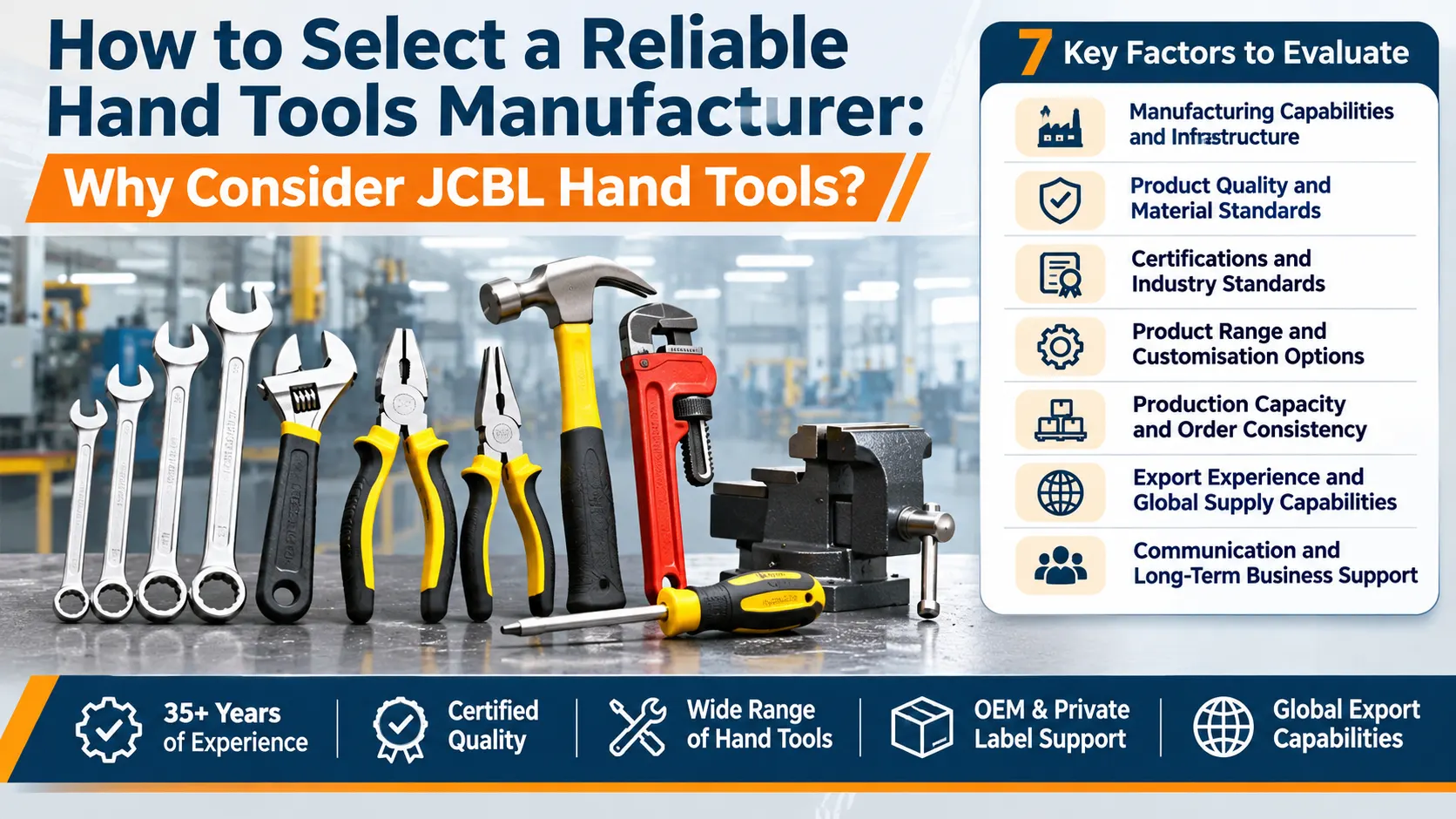
However, evaluating manufacturers requires more than comparing product prices. Buyers must assess their manufacturing infrastructure, technical capabilities, product range, and experience in serving international markets. Here are seven important factors to consider when selecting a hand tools manufacturer and why JCBL Hand Tools is worth evaluating.
What Makes a Reliable Hand Tool Manufacturer?
A reliable hand tools manufacturer demonstrates consistent product quality, controlled manufacturing processes, adequate production capacity, relevant quality certifications, and dependable order fulfilment. It should also offer clear communication, technical support, and the flexibility to meet specific product and bulk supply requirements.
7 Factors to Consider When Selecting a Hand Tool Manufacturer
1. Evaluate Manufacturing Capabilities and Infrastructure
Start by assessing the manufacturer’s production facilities, machinery, and engineering capabilities. A well-equipped manufacturing setup should support precision production, consistent output, and efficient order execution.
Check whether the manufacturer has:
- Suitable forging, machining, and finishing facilities.
- Modern machinery and tooling capabilities.
- In-house or controlled heat treatment processes.
- Adequate infrastructure for bulk production.
These capabilities help determine whether the manufacturer can meet your technical specifications and order volumes.
2. Check Product Quality and Material Standards
The quality of hand tools depends on material selection, manufacturing processes, and quality checks. Buyers should evaluate the steel grade, heat treatment, hardness, dimensional accuracy, and surface finish relevant to the tools being sourced.
Ask manufacturers about their material specifications, testing procedures, and batch-level quality controls. For tools such as spanners and wrenches, hardness and torque testing can help assess whether products meet the required performance specifications.
3. Verify Certifications and Industry Standards
Certifications and product standards provide important reference points when evaluating a manufacturer’s quality systems and product compliance.
Look for:
- ISO 9001: Quality management system certification.
- DIN standards: Technical specifications applicable to particular hand tool categories.
- ANSI standards: Relevant American standards for specified tools.
- GS certification: Independent product safety certification for applicable products.
Do not assume that every product from a manufacturer carries the same certification. Verify the certificate, its scope, validity, and applicability to the specific product before placing an order.
4. Assess Product Range and Customisation Options
A manufacturer with a suitable product portfolio can simplify procurement across multiple hand tool categories. Evaluate whether its range covers your business requirements, including spanners, adjustable wrenches, pipe wrenches, pliers, pincers, hammers, vices and lubrication tools.
For businesses selling under their own brands, also check OEM and private label capabilities. Confirm whether the manufacturer can accommodate custom specifications, product finishes, branding, labelling and packaging requirements.
5. Confirm Production Capacity and Order Consistency
Production capacity directly affects a manufacturer’s ability to handle bulk procurement and repeat orders. Before finalising a supplier, evaluate its manufacturing capacity, production planning, and ability to maintain consistent specifications across batches.
Discuss:
- Minimum order quantities (MOQs).
- Monthly or annual production capacity.
- Sample approval and production timelines.
- Lead times for repeat orders.
- Capacity to accommodate increased demand.
A manufacturer should be able to provide realistic production commitments rather than making unsupported delivery promises.
6. Evaluate Export Experience and Global Supply Capabilities
International buyers should prioritise manufacturers familiar with export procedures and destination-market requirements. Export experience can help simplify documentation, packaging, and shipment coordination.
Check whether the manufacturer can support:
- Export documentation and shipping coordination.
- Protective and export-ready packaging.
- Product labelling requirements.
- Bulk shipment planning.
- Communication regarding order and dispatch schedules.
Also verify its experience supplying your target market and the standards applicable to your products.
7. Consider Communication and Long-Term Business Support
Reliable communication is important throughout the procurement process, from initial quotations to repeat orders. Evaluate how effectively the manufacturer handles technical enquiries, shares product information, provides order updates, and addresses quality-related concerns.
For B2B buyers, responsive communication and consistent order coordination can make a significant difference to long-term sourcing relationships.
Why Consider JCBL Hand Tools as Your Manufacturing Partner?
Established in 1989, JCBL Group brings over 35 years of manufacturing experience to its international hand tools division, JCBL Hand Tools. With modern manufacturing infrastructure, quality-focused processes, and global export experience, JCBL serves the sourcing requirements of importers, wholesalers, distributors, and industrial buyers.
1. Advanced Manufacturing Infrastructure
JCBL combines modern manufacturing facilities with CNC-developed dies and fixtures, automated hardening and tempering processes, and in-house electroplating capabilities. Its quality evaluation infrastructure includes hardness and torque testing machines to assess relevant product specifications and consistency.
2. Quality Standards and Certifications
JCBL manufactures its spanners and wrenches in accordance with applicable DIN and ANSI standards and offers GS-certified products. The company also holds ISO 9001:2015 and ISO 14001:2015 certifications for quality and environmental management systems.
3. Comprehensive Hand Tools Portfolio
JCBL offers hand tools for automotive, workshop, professional, and industrial applications across multiple categories:
- Spanners and Wrenches: Combination spanners, adjustable wrenches and pipe wrenches.
- Pliers and Pincers: Tools for gripping, holding and cutting.
- Striking and Carpenter Tools: Hammers, hacksaws and related tools.
- Lubrication Tools: Grease guns and oil cans.
- Vices and Fasteners: Workshop holding and fastening products.
- Automotive and Garage Tools: Tools for vehicle servicing and maintenance.
This portfolio enables buyers to source multiple hand tool categories through one manufacturing partner.
4. OEM, Customisation and Bulk Supply
JCBL supports OEM and private-label requirements, including product specifications, finishes, branding, labelling and packaging. Its manufacturing capabilities also cater to bulk procurement requirements from international importers, wholesalers and distributors.
5. Established International Export Presence
JCBL Hand Tools serves international markets across Europe, the USA, Latin America, the Middle East, Africa and Australia. Its export operations support bulk shipments, export-oriented packaging and shipping documentation, catering to the requirements of global B2B buyers.
What Should Buyers Check Before Placing an Order?
Before finalising a hand tools manufacturer, use this checklist:
- Review the product catalogue, specifications, and material details.
- Verify relevant certifications and product standards.
- Assess manufacturing infrastructure and quality control processes.
- Confirm production capacity, MOQ, and delivery timelines.
- Request samples and evaluate product quality where appropriate.
- Finalise customisation, branding and packaging requirements.
- Confirm pricing, payment terms, and export documentation.
These checks help buyers assess whether a manufacturer can meet their technical, commercial, and supply requirements before committing to a bulk order.
Choose the Right Hand Tools Manufacturing Partner
Selecting a reliable hand tools manufacturer requires careful evaluation of product quality, manufacturing infrastructure, certifications, production capacity, and export capabilities. For importers, distributors and wholesalers, these factors are essential to building a consistent and dependable supply chain.
With its manufacturing experience, diverse product range, quality-focused processes, OEM capabilities, and international export presence, JCBL Hand Tools is worth considering for bulk hand tool sourcing and long-term B2B supply requirements.
Looking for a hand tools manufacturer for bulk orders or OEM requirements?
Explore the JCBL Hand Tools product range or contact the team to discuss your specifications and sourcing needs.
FAQs
1. How do I choose a reliable hand tools manufacturer?
Evaluate the manufacturer’s infrastructure, material standards, quality control processes, certifications, production capacity and export experience. Also verify its ability to maintain consistent product specifications and fulfil repeat orders.
2. What certifications should a hand tools manufacturer have?
Relevant credentials may include ISO 9001 for quality management, applicable DIN or ANSI product standards, and GS certification for products covered by it. Requirements depend on the tool category and destination market.
3. Why are DIN and ANSI standards important for hand tools?
DIN and ANSI standards establish technical requirements for applicable tools, helping buyers evaluate dimensions, specifications and performance characteristics. Always check the specific standard relevant to the product being purchased.
4. Can hand-tool manufacturers provide OEM and private-label solutions?
Yes. Many manufacturers offer OEM and private-label services, allowing buyers to specify product designs, finishes, branding, labelling and packaging. Capabilities and minimum order quantities vary by manufacturer.
5. Why should importers consider production capacity?
Production capacity determines whether a manufacturer can fulfil initial bulk orders, maintain repeat supply and accommodate changing procurement volumes. It is an important factor in avoiding supply disruptions.
6. Why consider JCBL Hand Tools for bulk sourcing?
JCBL Hand Tools offers a diverse product portfolio, manufacturing infrastructure, DIN- and ANSI-aligned spanners and wrenches, GS-certified products, OEM and private-label capabilities, and international export experience. Buyers can discuss product-specific requirements and bulk supply arrangements with its team.