The Future of the Global Hand Tool Industry (2025–2030)
- Key Trends Shaping the Hand Tool Industry (2025–2030)
- Market Drivers and Restraints
- Regional Outlook: Where Growth Will Come From
- Competitive Landscape of the Global Hand Tool Industry
- Technological Advancements in Hand Tools
- Opportunities in the Hand Tool Industry (2025–2030)
- Future Outlook: What to Expect by 2030
- Conclusion
- FAQs
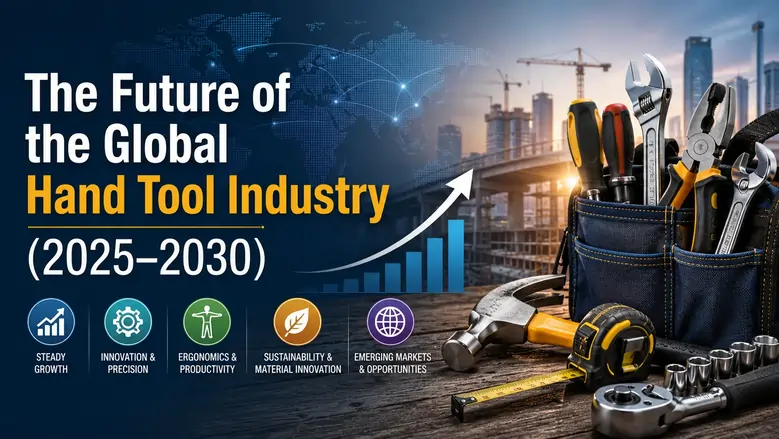
The global hand tool industry is projected to grow at a CAGR of 5.20% from 2025 to 2030, reaching approximately USD 46.24 billion by 2030. Growth is driven by infrastructure expansion, industrial maintenance demand, and rising DIY adoption, with the Asia-Pacific emerging as the fastest-growing region and innovation focused on ergonomics, durability, and precision.
Key drivers shaping the future:
- Expansion of global construction and infrastructure projects
- Stable demand from automotive and industrial maintenance sectors
- Rising DIY and prosumer adoption worldwide
- Growth in emerging economies, especially India and Southeast Asia
- Shift toward ergonomic, durable, and application-specific tools
Key Trends Shaping the Hand Tool Industry (2025–2030)
The key trends shaping the global hand tool industry from 2025 to 2030 include ergonomic tool design, smart and precision-enabled tools, rising DIY demand, manufacturing shifts to emerging economies, and increasing focus on sustainability and material innovation.
1. Ergonomic and Productivity-Focused Tools
Ergonomic design is becoming a standard feature, with manufacturers improving grip, weight balance, and comfort to reduce fatigue and increase efficiency, especially for professional users.
2. Smart and Precision-Enabled Hand Tools
Tools with torque control, calibration features, and integrated measurement capabilities are gaining adoption in industrial sectors where accuracy and compliance are critical.
3. Expansion of DIY and Prosumer Demand
The rise of DIY culture, supported by e-commerce and digital content, is increasing demand for high-quality tools among non-professional users.
4. Manufacturing Shift Toward Emerging Economies
Production is expanding in countries like India, Vietnam, and Indonesia due to lower costs and favorable policies, while China continues to lead global exports.
5. Sustainability and Material Innovation
Hand Tools Manufacturers are adopting recyclable materials, reducing chemical usage, and improving energy efficiency to meet environmental standards and strengthen brand positioning.
Market Drivers and Restraints
Key Growth Drivers
- Infrastructure boom: Large-scale projects across Asia, the Middle East, and Africa
- Industrial maintenance demand: Continuous need for repair and assembly tools
- E-commerce penetration: Easier global access to tools for both B2B and B2C buyers
- Affordability advantage: Lower cost compared to power tools
Key Challenges
- Competition from power tools: Especially in high-speed industrial applications
- Raw material price volatility: Steel and alloy costs impacting margins
- Market commoditization: Basic tools facing intense price competition
- Counterfeit products: Particularly in developing markets
Regional Outlook: Where Growth Will Come From
1. Asia-Pacific (Fastest-Growing Region)
Asia-Pacific will lead global growth through 2030.
- India: Infrastructure push and “Make in India” manufacturing expansion
- China: Continued dominance in production and exports
- Southeast Asia: Emerging consumption and production base
2. North America (Stable, High-Value Market)
A mature market driven by:
- Replacement demand
- Professional usage
- Strong DIY culture in the U.S.
Premium and branded tools dominate this region.
3. Europe (Innovation and Sustainability Focus)
Europe emphasizes:
- High-quality engineering
- Regulatory compliance
- Sustainable manufacturing practices
Demand is driven by industrial applications and precision tools.
Competitive Landscape of the Global Hand Tool Industry
The market is moderately fragmented, with global brands competing alongside regional manufacturers.
Key competitive factors:
- Product durability and quality
- Pricing competitiveness
- Brand trust and recognition
- Distribution network strength
- Innovation and design
Critical industry shift: Mid-tier manufacturers are increasingly moving toward OEM and private-label production, supplying global brands and retailers to maintain margins in competitive markets.
Technological Advancements in Hand Tools
Innovation in hand tools is focused on performance enhancement rather than automation.
Key advancements include:
- Advanced alloys: Improved strength and corrosion resistance
- Precision engineering: Tighter tolerances for industrial use
- Hybrid functionality: Tools integrating measurement or calibration
- Industrial compatibility: Tools designed for modern manufacturing ecosystems
These advancements are particularly relevant in automotive, aerospace, and precision engineering sectors.
Opportunities in the Hand Tool Industry (2025–2030)
- Emerging market expansion: Strong demand in Asia and Africa
- Private label and OEM manufacturing: A growing global sourcing trend
- E-commerce and B2B platforms: Direct-to-market access
- Specialized tools: Electrical, plumbing, and precision segments
- Aftermarket demand: Replacement tools and maintenance kits
E-commerce is reducing reliance on traditional distributors, allowing manufacturers to directly access global buyers, especially in price-sensitive markets.
Future Outlook: What to Expect by 2030
The hand tool industry will remain resilient and essential, complementing rather than competing with power tools.
By 2030, the industry will see:
- Continued steady global growth
- Greater emphasis on ergonomics and user efficiency
- Increased adoption of sustainable materials
- Expansion of organized and branded players in emerging markets
- Stronger integration into industrial and digital ecosystems
Basic tools will become increasingly commoditized, while value will shift toward design, quality, and application-specific innovation.
Conclusion
The global hand tool industry is set for stable, long-term growth through 2030, supported by its essential role across industries and households. While competition and commoditization will intensify, opportunities remain strong in emerging markets, specialized tools, and direct-to-market distribution models.
Businesses that focus on quality, cost efficiency, and strategic market expansion, particularly in high-growth regions, will be best positioned to capture the next phase of industry growth.
FAQs
Yes, the hand tool industry is growing steadily in 2025, supported by infrastructure development, industrial demand, and expanding DIY usage worldwide.
Hand tools remain essential due to their affordability, portability, precision, and independence from power sources, making them ideal for a wide range of applications.
Asia-Pacific dominates the market, driven by strong manufacturing capabilities, infrastructure growth, and rising domestic consumption in countries like China and India.
China is the largest producer and exporter of hand tools globally, though countries like India and Vietnam are rapidly increasing their manufacturing share.
Demand is driven by urbanization, infrastructure projects, industrialization, and increasing access to affordable tools through e-commerce platforms.