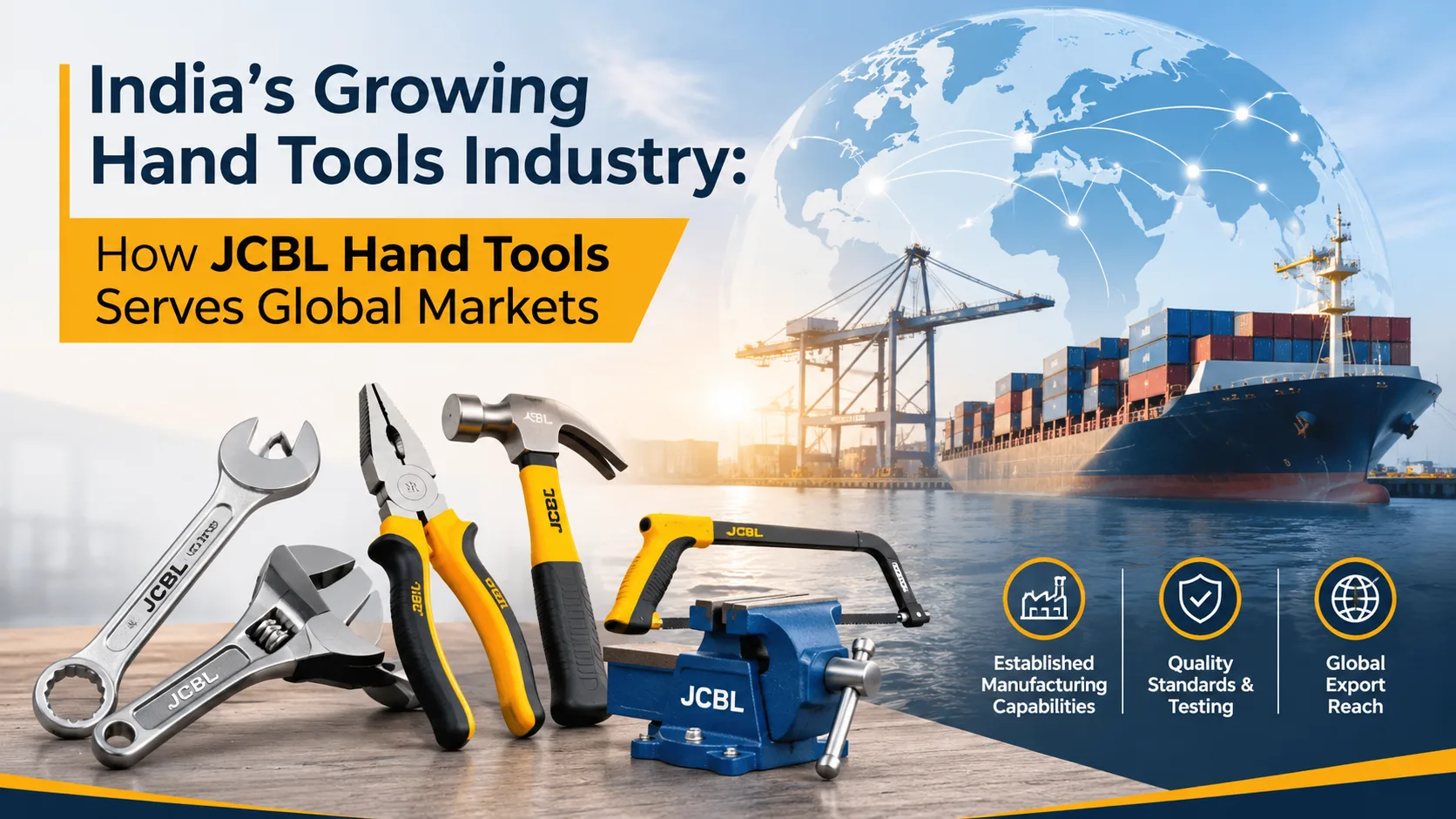
India’s Growing Hand Tools Industry: How JCBL Hand Tools Serves Global Markets
- How Is India’s Hand Tool Industry Growing?
- What Is Driving Global Demand for Indian Hand Tools?
- Which Hand Tools Does India Manufacture for Global Markets?
- How JCBL Hand Tools Serves Global Markets
- What Should International Buyers Check When Sourcing Hand Tools from India?
- What Is the Future of India’s Hand Tool Industry?
- Conclusion
- FAQs
India’s hand tools industry is strengthening its position in global markets through established manufacturing clusters, diverse product capabilities, and expanding export opportunities. According to NITI Aayog’s April 2025 report , India’s hand tool exports were valued at approximately $600 million, representing 1.8% of global exports. Manufacturers such as JCBL Hand Tools contribute to this export ecosystem by serving international buyers with a diverse product range, engineering capabilities, and quality-focused manufacturing.
How Is India’s Hand Tool Industry Growing?
India has an established hand tools manufacturing ecosystem supported by specialised industrial clusters, skilled workers, and engineering infrastructure. Jalandhar and Ludhiana in Punjab are key production centres, with Punjab accounting for about 80% of India’s hand tool exports, according to NITI Aayog.
The industry also has considerable export potential. NITI Aayog estimates the global hand tools market at $34 billion in 2022 and projects it could reach $60 billion by 2035. Its roadmap identifies an opportunity for India to increase hand tool exports to $15 billion by 2035.
However, expanding India’s global market share will require addressing existing competitiveness challenges. The report identifies a 14–17% cost disadvantage compared with China, driven by factors including raw material costs, labour productivity, financing, and logistics. Improving production efficiency, manufacturing scale, and supply-chain infrastructure will be important for Indian manufacturers seeking to strengthen their international position.
What Is Driving Global Demand for Indian Hand Tools?
International buyers consider manufacturing capabilities, product specifications, quality, and supply reliability when evaluating hand tools suppliers. India’s established manufacturing ecosystem offers opportunities across several areas:
- Established Manufacturing Clusters: Industrial centres such as Jalandhar and Ludhiana provide specialised production capabilities and supporting supplier networks.
- Product Diversity: Indian manufacturers produce tools for automotive, construction, engineering, maintenance, and workshop applications.
- Export Sourcing Opportunities : Importers and distributors can evaluate Indian suppliers for recurring procurement, product-specific requirements, and bulk orders.
- Quality Standardisation: Manufacturing in accordance with applicable DIN, ANSI, and other relevant standards helps suppliers address international product requirements.
- Production Development: Investment in manufacturing technology, testing equipment, and infrastructure can improve product consistency and export competitiveness.
India already has an established position in specific product categories. NITI Aayog’s analysis indicates that Indian manufacturers account for approximately 4.6% of global spanner and wrench exports and 2.7% of exports in the files, rasps, and pliers category.
Which Hand Tools Does India Manufacture for Global Markets?
Indian manufacturers supply hand tools used across industrial, automotive, construction, and professional applications. Major product categories include:
- Spanners and wrenches : Used to tighten and loosen fasteners in mechanical and automotive applications.
- Pliers and pincers : Used for gripping, bending, cutting, and handling materials.
- Hammers and striking tools : Designed for assembly, fitting, repair, and construction work.
- Automotive and garage tools : Used in vehicle servicing and workshop maintenance.
- Carpenter tools : Support woodworking, installation, and related professional tasks.
- Vices and clamps : Secure workpieces during machining, assembly, and repair.
This manufacturing diversity allows Indian suppliers to serve different product requirements across international distribution and industrial supply chains.
How JCBL Hand Tools Serves Global Markets
JCBL Hand Tools combines a diverse product range, established manufacturing capabilities, quality testing, and international export experience to serve global B2B buyers.
1. Comprehensive Hand Tools Product Range
JCBL offers spanners, adjustable and pipe wrenches, pliers, pincers, hammers, hacksaws, vices, and automotive tools for professional, workshop, and industrial applications. This range allows international distributors and wholesalers to source multiple hand tool categories from one manufacturer.
2. Engineering and Manufacturing Capabilities
Over 35 years JCBL Group manufacturing experience
Five plants Manufacturing plants across Chandigarh and Chennai
167,000 square metres Facilities spanning the stated manufacturing infrastructure
DSIR-accredited Research and Development centre
Its stated capabilities include high-grade steel selection, CNC-developed dies and fixtures, automated hardening and tempering , precision machining, and mechanical testing. German-made hardness and torque testing equipment supports product evaluation, while automatic electroplating facilities provide finishes such as mirror-polished, satin, matte, zinc, and black.
3. Quality Standards and Product Testing
JCBL manufactures applicable spanners and wrenches to DIN and ANSI standards and identifies GS certification for these products. The company also lists ISO 9001:2015 and ISO 14001:2015 management system certifications. Hardness and torque testing further support the evaluation of product quality and performance.
4. Customized Manufacturing and Bulk Supply
JCBL’s manufacturing capabilities provide a basis for discussing customized specifications and bulk supply requirements. Buyers considering OEM or private-label orders should confirm product availability, customisation scope, minimum order quantities, and packaging options directly with the company.
5. International Export Reach
JCBL serves markets across the USA, Europe and CIS, Latin America, the Middle East, South Africa, and Australia. Its export experience supports engagement with international importers, distributors, and industrial buyers sourcing hand tools from India.
What Should International Buyers Check When Sourcing Hand Tools from India?
Selecting a hand tools manufacturer involves more than comparing product availability and quoted prices. International buyers should evaluate:
- Manufacturing capabilities: Review production infrastructure, manufacturing processes, and the ability to fulfil recurring orders.
- Material and product quality : Check steel specifications, heat treatment, surface finishing, workmanship, and functional testing.
- Applicable standards : Verify relevant DIN, ANSI, GS, or other product-specific certifications and supporting documentation.
- Customization requirements: Confirm technical specifications, branding, packaging, and private-label capabilities.
- Export and supply reliability: Assess international supply experience, order management, shipment coordination, and communication.
Evaluating these factors helps procurement teams identify suppliers that can meet their technical specifications and long-term sourcing requirements.
What Is the Future of India’s Hand Tool Industry?
India’s hand tools industry has significant potential to expand its international presence, but achieving NITI Aayog’s proposed $15 billion export target by 2035 will require improvements in manufacturing competitiveness.
Key priorities include:
- Adopting advanced production technologies
- Improving labour productivity
- Strengthening quality-testing infrastructure
- Reducing supply-chain costs
Greater manufacturing efficiency and stronger relationships with international distributors can also help Indian suppliers compete in established export markets.
Manufacturers with established engineering capabilities, product-specific quality processes, and experience serving international buyers will play an important role in this expansion.
Conclusion
India’s hand tools industry offers international buyers access to an established manufacturing ecosystem and a diverse range of products. As export opportunities grow, manufacturers must demonstrate technical capabilities, consistent product quality, and the ability to meet international procurement requirements.
With its broad product portfolio, engineering infrastructure, quality-focused manufacturing processes, and international export presence, JCBL Hand Tools serves global distributors, importers, wholesalers, and industrial buyers looking to source hand tools from India.
Looking for a hand tools manufacturer and exporter from India?
Explore JCBL Hand Tools’ product range and connect with the team to discuss product specifications, customised manufacturing, and bulk supply requirements.
FAQs
1. Is India a major manufacturer of hand tools?
Yes. India has an established hand tool manufacturing ecosystem, with major production clusters in Jalandhar and Ludhiana. According to NITI Aayog, India accounted for approximately 1.8% of global hand tool exports in its 2025 sector assessment.
2. Which hand tools are manufactured in India?
India manufactures spanners, wrenches, pliers, pincers, hammers, hacksaws, vices, automotive tools, and other equipment used in construction, engineering, maintenance, and workshop applications.
3. Why do international buyers source hand tools from India?
International buyers consider Indian manufacturers for their product diversity, established manufacturing clusters, engineering capabilities, and export opportunities. Supplier selection should also account for product specifications, quality processes, certifications, and supply reliability.
4. What should importers look for in an Indian hand tools manufacturer?
Importers should evaluate manufacturing infrastructure, material quality, product testing, applicable certifications, customisation capabilities, export experience, and the supplier’s ability to fulfil bulk and recurring orders.
5. Does JCBL Hand Tools serve international markets?
Yes. JCBL identifies export markets across the USA, Europe and CIS, Latin America, the Middle East, South Africa, and Australia. Its product portfolio and manufacturing capabilities serve international B2B sourcing requirements.