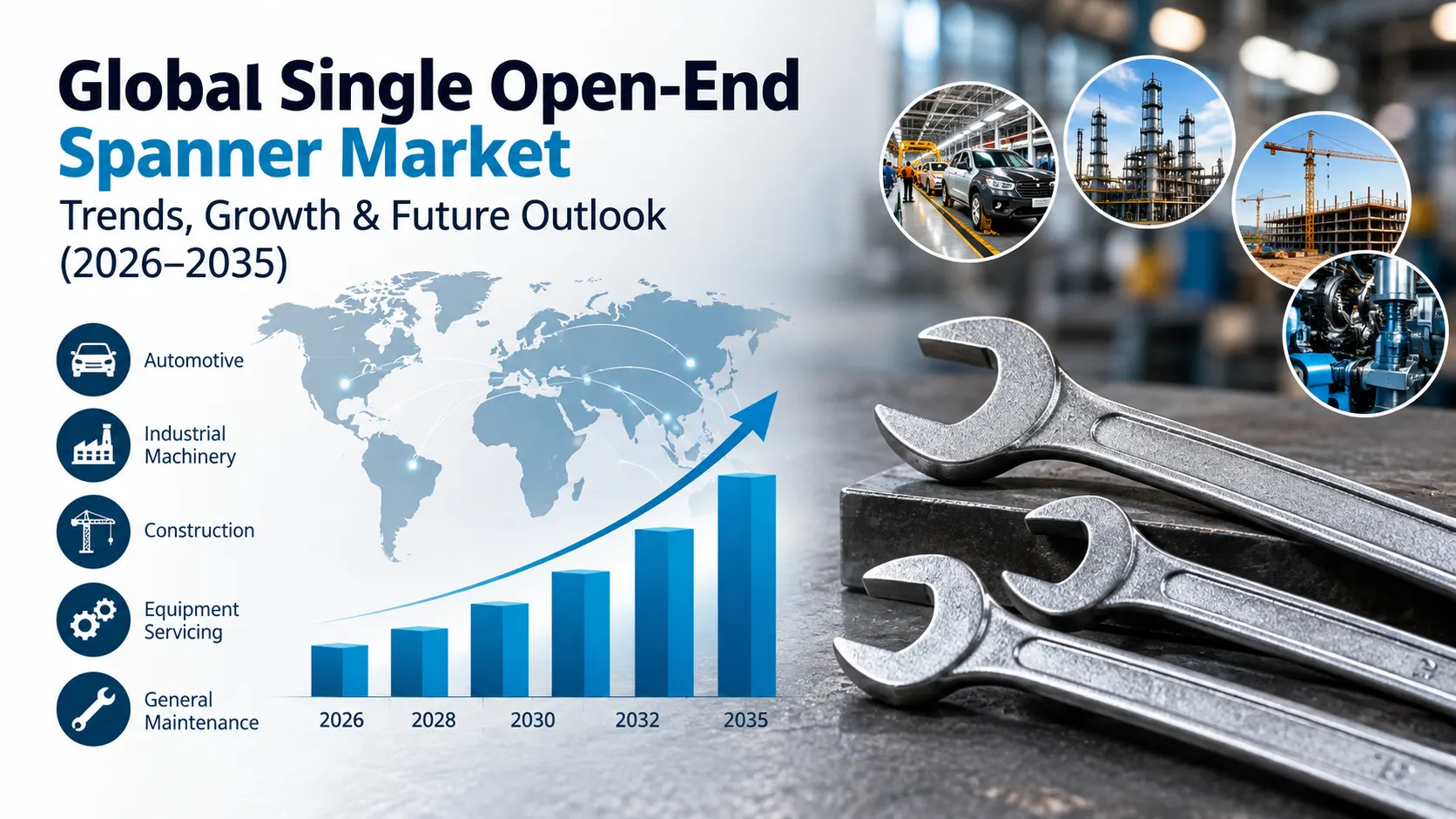
Global Single Open-End Spanner Market Trends, Growth & Future Outlook (2026–2035)
- Single Open-End Spanner Market: Key Facts
- What Is a Single Open-End Spanner?
- Common applications
- What Is Driving the Single Open-End Spanner Market?
- Key Trends in Single Open-End Spanners
- India’s Role in the Global Spanner Supply Chain
- Why Source Single Open-End Spanners From India?
- What Should B2B Buyers Check Before Ordering?
- Future Outlook: 2026–2035
- Conclusion
- FAQs
The global single open-end spanner market was valued at approximately USD 156.37 million in 2025 and is estimated to reach USD 167.47 million in 2026, according to data published in Research and Markets. The market is projected to reach USD 240.21 million by 2032, representing a 6.32% CAGR during the forecast period.
Demand for single open-end spanners is closely linked to automotive maintenance, industrial machinery, construction, fabrication, equipment servicing, and general mechanical applications. For B2B buyers, the market is increasingly shaped by manufacturing consistency, material quality, supply-chain reliability, and OEM capabilities.
Single Open-End Spanner Market: Key Facts
| Market indicator | Figure |
| Global market, 2025 | USD 156.37 million |
| Global market, 2026 | USD 167.47 million |
| Projected market, 2032 | USD 240.21 million |
| CAGR, 2026–2032 | 6.32% |
| Global tools market, 2022 | ~USD 100 billion |
| Global tools market projection, 2035 | ~USD 190 billion |
| India’s hand-tool exports | ~USD 600 million |
| India’s spanner & wrench export share | ~4.6% |
| India’s HS 820411 exports, 2024 | USD 148.56 million |
The single open-end spanner market figures are market-research estimates. The broader tools and trade figures come from NITI Aayog and UN Comtrade/WITS and cover wider product categories.
What Is a Single Open-End Spanner?
A single open-end spanner, also called a single-ended spanner or wrench, is a hand tool with one open jaw designed to grip and turn hexagonal nuts and bolts.
Unlike a combination spanner, which has an open end and a closed ring end, a single open-end spanner has one open jaw. Its straightforward design allows quick access to fasteners and makes it suitable for maintenance and assembly work.
Common applications
- Automotive repair and servicing
- Industrial machinery maintenance
- Equipment assembly
- Construction and fabrication
- Mechanical workshops
- General maintenance
What Is Driving the Single Open-End Spanner Market?
1. Continued manufacturing activity
Single open-end spanners are essential maintenance and assembly tools across manufacturing environments. As industrial production and equipment servicing continue, demand for basic mechanical tools remains steady.
UNIDO reported that global manufacturing production increased 1.2% quarter-on-quarter in Q1 2026, while global manufacturing exports increased 3.5%. Asia and the Pacific recorded the strongest regional manufacturing production growth during the quarter.
2. Automotive production and maintenance
Automotive manufacturing and aftermarket servicing are important demand areas for hand tools. Spanners are used for assembly, repair, and routine vehicle maintenance.
This creates both OEM demand and recurring aftermarket demand, supporting the need for reliable standard and customized spanners.
3. Growth of the wider tools industry
NITI Aayog estimates that the global tools market was worth approximately USD 100 billion in 2022 and could reach around USD 190 billion by 2035. The global hand-tools segment was estimated at approximately USD 34 billion.
These figures cover the broader tools industry, not single open-end spanners specifically, but they provide context for the market’s wider growth environment.
Key Trends in Single Open-End Spanners
1. Precision and quality consistency
B2B buyers increasingly require consistent performance across large production batches.
Manufacturers therefore need tighter control over:
- Steel grade and material composition
- Forging dimensions
- Jaw accuracy
- Heat treatment and hardness
- Surface finish
- Dimensional inspection
- Mechanical testing
For bulk procurement, batch-to-batch consistency can directly affect product rejection, customer complaints, and long-term sourcing costs.
2. Steel remains the primary material
Steel remains the preferred material for professional spanners because of its strength, durability, hardness, and cost efficiency.
Common choices include carbon steel and alloy steels such as chrome vanadium, depending on the required specification and application.
3. OEM and private-label sourcing
International distributors and tool brands increasingly require manufacturers to provide more than standard catalogue products.
B2B requirements may include:
- Custom sizes and profiles
- Brand marking
- Custom packaging
- Surface finishes
- Tool sets
- Product documentation
This makes manufacturing flexibility an important factor in supplier selection.
4. Supply-chain diversification
Global buyers are increasingly evaluating alternative sourcing locations to improve supply continuity and reduce dependence on a single production base.
For spanner procurement, this places greater emphasis on production capacity, quality consistency, lead-time reliability, and export experience alongside price.
India’s Role in the Global Spanner Supply Chain
India has an established position in hand-tool manufacturing, particularly in forged tools and products such as wrenches and spanners.
NITI Aayog’s 2025 report estimates India’s hand-tool exports at approximately USD 600 million and identifies spanners and wrenches among the country’s key exported tools. It also highlights major manufacturing clusters in Jalandhar and Ludhiana in Punjab, Mumbai and Nagpur in Maharashtra, and Nagaur in Rajasthan.
Punjab is particularly significant, accounting for approximately 80% of India’s hand-tool exports, according to the report.
India’s spanner and wrench trade data
HS 820411 covers hand-operated wrenches with non-adjustable jaws. India exported approximately USD 148.56 million, equivalent to 36.38 million kg, under this classification in 2024.
The leading destinations were
| Destination | 2024 India exports |
| United States | USD 41.94M |
| Russia | USD 13.31M |
| Germany | USD 12.06M |
| Brazil | USD 10.43M |
| UAE | USD 8.58M |
Important: HS 820411 is broader than single open-end spanners. These figures should therefore be treated as a trade proxy, not as the market size of single open-end spanners.
Why Source Single Open-End Spanners From India?
India offers international buyers an established manufacturing ecosystem supported by:
- Forging and machining capabilities
- Established hand-tool clusters
- Experienced export manufacturers
- Automotive and engineering supply chains
- OEM and private-label production
- Competitive manufacturing economics
NITI Aayog identifies India’s manufacturing base, labor-cost advantages, and established supply chains as opportunities for expanding its position in the global tools industry. At the same time, the report highlights competitiveness challenges that manufacturers must address through greater scale, productivity, and process efficiency.
For buyers, supplier evaluation should therefore focus on quality systems and manufacturing capability rather than price alone.
What Should B2B Buyers Check Before Ordering?
Before placing a bulk order, evaluate:
- Material: Confirm steel grade and material specifications.
- Forging: Check forging quality and dimensional consistency.
- Heat treatment: Verify hardness and required mechanical properties.
- Jaw accuracy: Ensure the jaw opening meets the specified dimensions.
- Surface finish: Confirm plating, polishing, or coating requirements.
- Quality control: Ask about dimensional, hardness, visual, and mechanical testing.
- Production capacity: Confirm the supplier can maintain quality at the required volume.
- Customization: Check OEM marking, packaging, and custom-size capabilities.
- Export readiness: Review documentation, packaging, and experience in the target market.
Future Outlook: 2026–2035
The single open-end spanner market is projected to grow steadily through 2032, with the market estimated to rise from USD 156.37 million in 2025 to USD 240.21 million by 2032 at a CAGR of 6.32%.
The wider manufacturing environment also remains supportive. UNIDO’s Q1 2026 data shows continued growth in global manufacturing production and exports, while India’s established hand-tool industry provides opportunities for manufacturers serving international buyers.
Over the longer term, competitive advantage is likely to depend on consistent quality, scalable production, customization, export compliance, and supply-chain reliability.
Conclusion
The global single open-end spanner market is projected to grow from approximately USD 156.37 million in 2025 to USD 240.21 million by 2032, supported by demand from automotive, industrial maintenance, manufacturing, construction and mechanical applications.
For B2B buyers, the market opportunity goes beyond product availability. Material quality, dimensional accuracy, consistent manufacturing, customization, production capacity, and export reliability are critical when selecting a long-term supplier.
With established manufacturing clusters and growing export capabilities, India is well positioned to serve international buyers seeking scalable and reliable single open-end spanner manufacturing partners.
FAQs
A single open-end spanner is a hand tool with one open jaw used to grip and turn hexagonal nuts and bolts.
A single open-end spanner has one open jaw, while a combination spanner has an open jaw on one end and a closed ring end on the other.
According to the market reports, the global market was valued at USD 156.37 million in 2025 and is projected to reach USD 240.21 million by 2032, growing at a CAGR of 6.32%.
HS 820411 covers hand-operated wrenches with non-adjustable jaws. It is useful for analyzing international spanner and wrench trade but does not exclusively represent single open-end spanners.
India exported approximately USD 148.56 million worth of products under HS 820411 in 2024.
India has established hand-tool manufacturing clusters and a significant export base. NITI Aayog identifies India as having opportunities to expand its global position in hand tools, supported by its manufacturing ecosystem and established supply chains.