What Is Hot Forging?
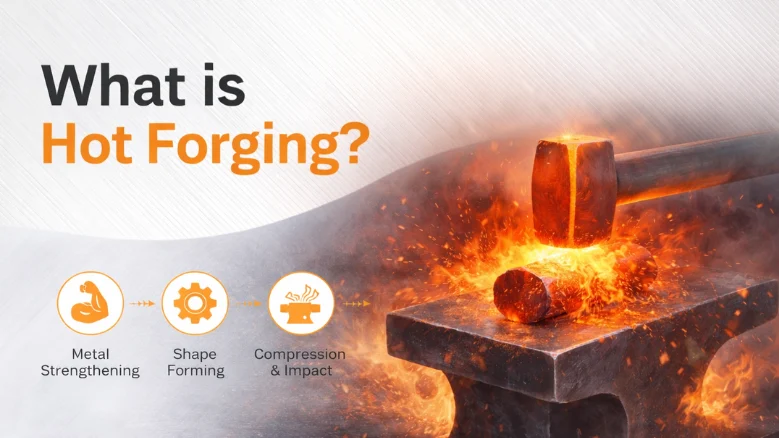
In the world of industrial tool-making, strength and dependability are not optional items; they are necessities. For example, in the world of heavy loads, impacts, and harsh working conditions, tools need to have strength and dependability in large quantities. For this very purpose, the importance and value of hot forging lie in the fact that it is a dependable technique for making robust and high-performance tools.
Due to its potential to improve strength, hardness, and structural uniformity, hot forging is commonly used for the manufacture of heavy-duty handheld equipment and auto parts.
What Is Hot Forging?
Hot forging is a manufacturing process in which the metal is forged while the metal is kept above the recrystallization temperature. This stage makes the metal more malleable, as the metal can be altered at this time without breaking.
This process enables manufacturers to produce strong and dense components with a solid structure internally. Hot forging is mainly applicable in industrial activities that involve equipment exposed to stress and impact.
How the Hot Forging Process Works
Hot forging is accomplished in a straightforward manner. First, the metal is heated until the desired level is achieved. The metal is easier to mold when hot. Secondly, the metal is forged to take the desired shape. Forging the metal enables the desired compact structure to be achieved. Lastly, the forged metal is cooled. By doing this, the metal is able to attain stability.
This process of hot working, that is to say, of heating, working or shaping to a desired form and then cooling, guarantees.
Advantages of Hot Forging
Hot forging has several significant advantages in the manufacturing industry. These advantages are particularly significant in the manufacturing of tools that are required to perform under heavy loads, impacts, and harsh operating conditions. These advantages have made hot forging a very effective manufacturing method.
Improved Strength
The hot forging process gives the metal a compact and coherent internal structure. This enables the tools to resist high-stress, high-pressure, and high-load exposure during their operation. Therefore, hot forged tools are not likely to crack or bend when used for heavy-duty activities.
Enhanced Toughness
Hot forged parts are developed in such a manner that shock absorption takes place in the case of impact and breaking of the tool. This is particularly vital in the case of tools where impact continues to be regular. This ability of the tool enhances its security of the tool.
Reduced Internal Defects
In hot forging, the forming process creates fewer spaces and vulnerabilities inside the tool. It ensures that the tool functions well by creating fewer flaws inside it. Additionally, it leads to the production of long-lasting and functioning tools with their service life assured.
- This process creates a few spaces inside the tool.
- This imparts long-term functionality to the tool.
- This process imparts reliability to the tool.
Because of these hot forging benefits, it is an excellent choice for manufacturing industrial and professional tools that require strength and reliability.
Why Hot Forging Is Used for Heavy-Duty Tools
Heavy-duty tools must perform reliably under extreme working conditions. Hot forging produces tools that maintain strength, shape, and performance even after repeated impact and long-term use.
Tools such as hammers, spanners, and striking tools rely on hot forging because the process delivers durability and structural integrity. To better understand the fundamentals of metal shaping, you can explore “what is forging.”
For a clearer comparison of manufacturing methods, the “difference between cast and forged” explains why forged tools perform better in demanding environments.
Applications of Hot Forging
Hot forging in manufacturing is widely used across industries where tool strength, reliability, and long-term performance are essential. The approach can prove particularly significant for tools and components that are subjected to high levels of loading, stress, and extreme working conditions.
Tourist Tools
Automotive parts and tools need to withstand high torque values as well as continuous use during vehicle assembly and maintenance activities. Since hot forging ensures maintaining tool properties in such cases, hot forging tools have application in activities such as fastening operations/tightening activities.
Tools Used in Industrial Maintenance
Tools used for maintenance as well as for upkeep in plants, factories, or workshops are needed to withstand heavy impacts instead. Durable hot forged tools are available that withstand breaking or cracking while providing long-term performance along with the desired functionality.
Construction and Infrastructure Tools
Construction tools are frequently subjected to rough handling, heavy impact, and harsh job-site conditions. Hot forging is used to manufacture tools that can handle these challenges while maintaining structural integrity. The process ensures that the tools can be relied on, even when used in harsh outdoor and/or high-load situations.
Heavy Engineering and Fabrication Tools
When carrying out heavy engineering or fabrication jobs, tools have to withstand a lot of force as well as endure constant mechanical stress. Hot forging is a technique commonly used to manufacture tools that can offer the desired consistency in performance while maintaining their integrity in the long run.
Agricultural Tools
Agricultural tools have to function in harsh environments involving surfaces, moisture content, and mechanical endurance. Hot forged tools offer the strength and endurance required in agricultural work and equipment servicing to minimize wear and maximize tool lifespan.
Conclusion
Hot forging plays a vital role in manufacturing tools that must perform reliably under heavy loads and demanding working conditions. By shaping metal at elevated temperatures, the process delivers improved strength, toughness, and structural consistency that many industrial applications require.
From automotive and industrial maintenance tools to construction and agricultural equipment, hot forging ensures durability, resistance to impact, and long service life. Its ability to reduce internal defects and maintain performance over time makes it a preferred manufacturing method for heavy-duty and professional tools.
Understanding what hot forging is and where it is used helps manufacturers and users choose tools that offer dependable performance, safety, and long-term value in real working environments.
Frequently Asked Questions (FAQs)
Hot forging is a manufacturing process where heated metal is shaped to produce strong and durable industrial components.
Hot forging creates a dense and uniform internal structure that improves strength and resistance to impact.
Common hot forged tools include hammers, spanners, striking tools, and heavy-duty hand tools.
Yes, hot forging is widely used in hand tools to ensure durability, strength, and long service life.
Yes, hot forging improves toughness, reduces internal defects, and increases overall tool durability.
Related Post
Why Choose Chromium Vanadium (CRV) Steel Tools?
Imagine working on an important project or fixing your car. Your tool slips out of [...]
Leading Hand Tools Supplier in Sweden
Sweden is a hub of innovation and precision craftsmanship, where high-quality hand tools are essential [...]
Key Factors to Consider When Importing Hand Tools for Your Business
In today’s highly competitive global market, businesses must source high-quality tools at the best prices [...]