What Is Warm Forging?
- Why Warm Forging Matters in Modern Manufacturing
- What Is Warm Forging?
- Warm Forging vs Cold Forging vs Hot Forging
- Warm Forging Process: Step-by-Step (How It Works)
- Key Advantages of Warm Forging
- When to Choose Warm Forging
- Applications of Warm Forging
- Materials Used in Warm Forging
- Challenges & Limitations of Warm Forging
- Quality Control in Warm Forging
- Why Manufacturers Prefer Warm Forging
- Conclusion
- FAQs
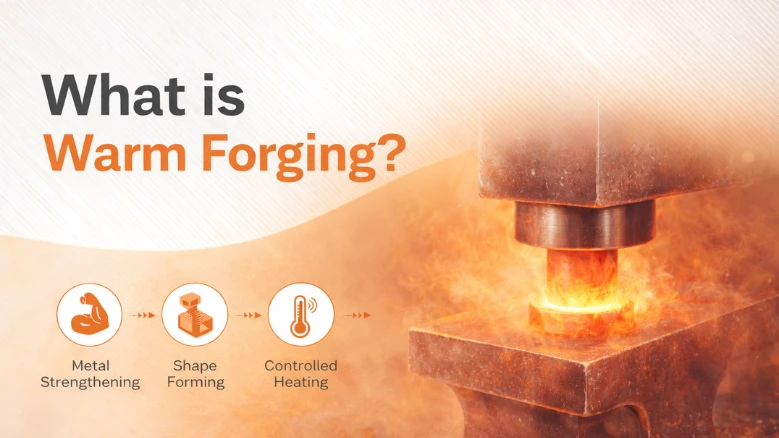
Warm forging is a precision metal-forming process performed at intermediate temperatures (typically 600°C to 900°C), in which metals are deformed under controlled conditions to achieve a balance of high strength, a refined grain structure, and tight dimensional tolerances. It is widely used in automotive, industrial tooling, and heavy engineering applications.
Why Warm Forging Matters in Modern Manufacturing
Manufacturers today face a constant trade-off between precision, strength, and production cost.
- Cold forging offers excellent accuracy but requires very high forming forces, which can lead to tool wear and limit the ability to form complex geometries.
- Hot forging allows easy deformation but results in oxidation, scale formation, and lower dimensional accuracy.
Warm forging solves this by operating in a controlled thermal window where:
- Material flow improves without excessive grain growth
- Forming forces are reduced by 30–50% compared to cold forging
- Dimensional tolerances improve significantly compared to hot forging
This makes it a strategic manufacturing choice for high-volume, performance-critical components.
What Is Warm Forging?
Warm forging is performed below the recrystallization temperature but above ambient conditions, typically within 0.3 to 0.6 of the material’s melting temperature (in Kelvin).
Key Metallurgical Characteristics
- Controlled plastic deformation improves grain alignment
- Reduced strain hardening compared to cold forging
- Limited oxidation due to lower temperatures than hot forging
- Improved ductility, enabling complex shapes
The result is warm-forged components with:
- High fatigue resistance
- Consistent mechanical properties
- Near-net shape accuracy
Warm Forging vs Cold Forging vs Hot Forging
| Parameter | Warm Forging | Cold Forging | Hot Forging |
| Temperature | 600–900°C | Room Temp | 1000–1250°C |
| Forming Force | Medium | Very High | Low |
| Dimensional Tolerance | ±0.05–0.3 mm | ±0.01–0.05 mm | ±0.5–1.5 mm |
| Surface Finish | Good (Ra ~3.2–6.3 µm) | Excellent (Ra ~0.8–3.2 µm) | Poor (Scaling present) |
| Oxidation | Minimal | None | High |
| Tool Life | 20–40% higher than cold forging | Low | High |
| Machining Requirement | Low | Very Low | High |
Insight: Warm forging delivers the best balance between tool life, cost efficiency, and dimensional control, making it ideal for B2B manufacturing environments.
Warm Forging Process: Step-by-Step (How It Works)
Warm forging follows a controlled, step-by-step process to ensure consistent material flow, precise shaping, and high-quality output in industrial manufacturing.
1. Material Heating
The metal (billets) is heated to a temperature between 600°C and 900°C using induction heaters or furnaces.
- The temperature must be controlled very carefully (within about ±10°C)
- This ensures the metal softens evenly and deforms properly
If heating is not controlled properly:
- The metal may not flow uniformly
- Surface defects and inconsistencies can occur
2. Lubrication & Die Preparation
Before forging, special lubricants (usually graphite or glass-based) are applied to the dies and material.
- This reduces friction between the metal and the die
- Friction can be reduced by up to 40%
Benefits:
- Longer die life
- Better surface finish on the component
- Lower energy is required during forging
3. Forging Operation
The heated metal is placed inside a die and pressed into shape using mechanical or hydraulic presses.
- Pressure typically ranges between 300–800 MPa, depending on the material
During this step:
- The metal flows into the desired shape
- The internal grain structure aligns with the component design
- Defects like voids or gaps inside the material are reduced
4. Controlled Cooling
After forging, the component is cooled in a controlled way (usually air cooling or regulated cooling conditions).
Proper cooling helps:
- Prevent internal stress
- Avoid distortion or warping
- Maintain desired mechanical properties
Cooling speed affects:
- Hardness of the material
- Stability of the internal structure
5. Finishing & Inspection
Since warm forging produces near-net-shape parts, only minimal finishing is required.
- Small machining operations may be done if needed
- Components are checked using gauges or precision measuring tools (like CMM)
Key advantage:
- Machining requirements can be reduced by 20–30% compared to hot forging, saving time and cost
Key Advantages of Warm Forging
A. Technical Advantages
- Optimized grain flow → improves fatigue life by up to 25–40%
- Higher dimensional accuracy than hot forging
- Lower internal stress compared to cold forging
- Ability to produce complex geometries with consistent quality
B. Commercial Advantages
- Reduced machining cost due to near-net shape
- Tool life improvement by 20–40% vs cold forging
- Lower rejection rates in mass production
- Reduced material waste (up to 15% savings)
- Energy savings compared to hot forging
Business Outcome: Lower cost per component with higher production efficiency.
When to Choose Warm Forging
Choose warm forging when:
- Components require tight tolerances, but not ultra-precision cold-forging levels
- Complex geometries cannot be achieved with cold forging
- Cold forging causes excessive tool wear or cracking
- Hot forging leads to unacceptable machining costs
- Production volumes demand repeatability and consistency
Ideal for OEMs and bulk manufacturing suppliers.
Applications of Warm Forging
Warm forging is widely used in industries that require high-strength, precision-engineered components capable of performing reliably under continuous stress, load, and demanding operating conditions.
Automotive Industry Applications of Warm Forging
Warm forging is extensively used in automotive manufacturing to produce transmission gears, shafts, axle components, and synchronizer hubs that require high fatigue strength, dimensional accuracy, and long service life.
Industrial Tools & Hand Tools Applications
Warm forging is ideal for manufacturing spanners, wrenches, sockets, and impact tool bodies that must withstand repeated torque, mechanical stress, and heavy-duty industrial usage without deformation or failure.
Warm Forging in Heavy Engineering Applications
In heavy engineering, warm forging is used to produce couplings, connectors, fasteners, and structural components that require superior strength, durability, and consistent performance under continuous cyclic loading conditions.
Warm forging applications are critical in industries where component reliability, strength, and precision directly impact performance, making it a preferred manufacturing process for high-volume, quality-driven production.
Materials Used in Warm Forging
Warm forging supports a wide range of engineering materials:
- Carbon steels (C20, C45) → General engineering
- Alloy steels (4140, 4340) → High-strength applications
- Stainless steels (304, 316) → Corrosion resistance
- Aluminum alloys → Lightweight components
Material selection depends on:
- Load conditions
- Wear resistance requirements
- Environmental exposure
Challenges & Limitations of Warm Forging
Despite its advantages, warm forging requires strict process control:
- Narrow temperature window (process-sensitive)
- Initial tooling investment can be moderate
- Requires skilled process optimization
- Not suitable for extremely large or heavy components
However, these are manageable with modern process control systems and expertise.
Quality Control in Warm Forging
Quality control in warm forging ensures consistent strength, precision, and defect-free components for demanding industrial applications.
- Process Control: Real-time temperature monitoring and controlled heating cycles ensure uniform material deformation and consistent mechanical properties.
- Tooling Optimization: Precision die design and regular maintenance improve component accuracy, surface finish, and extend tooling life.
- Inspection and Testing of Warm Forged Components: Dimensional inspection, hardness testing, tensile testing, and microstructure analysis ensure components meet strict quality standards.
Strong quality control practices help deliver reliable, high-performance components suitable for large-scale industrial production.
Why Manufacturers Prefer Warm Forging
Warm forging is widely adopted because it offers:
- Best cost-to-performance ratio among forging methods
- High repeatability in large-scale production
- Reduced dependency on secondary machining
- Improved product lifespan and reliability
For manufacturers, this translates into:
- Lower operational costs
- Higher throughput
- Better product consistency
Conclusion
Warm forging is a highly efficient and technically advanced process that bridges the gap between cold and hot forging. By combining controlled deformation, improved mechanical properties, and dimensional accuracy, it enables the production of high-performance components at scale.
For industries where strength, precision, and cost efficiency are critical, warm forging provides a clear competitive advantage.
At JCBL Hand Tools, advanced forging processes are backed by engineering expertise, process control, and strict quality standards, ensuring consistent delivery of durable, high-performance tools for industrial applications.
FAQs
Warm forging is typically performed between 600°C and 900°C, depending on the material and application requirements.
Warm forging offers better dimensional accuracy, lower oxidation, and reduced machining compared to hot forging, making it ideal for precision components.
Warm forging is preferred when cold forging requires excessive force or when components have complex shapes that are difficult to form at room temperature.
Key advantages include improved strength, reduced machining, better tool life, lower material waste, and consistent quality in mass production.
Warm forging is widely used in automotive, industrial tooling, and heavy engineering industries.
Yes, warm forging is cost-effective due to reduced machining, improved tool life, and efficient material usage, especially in high-volume production.
Related Readings
- What Is Forging?
- What Is Hot Forging?
- What Is Cold Forging?
- Hot vs Cold vs Warm Forging: Key Differences Explained
- Closed-Die vs Open-Die Forging: Process & Key Differences
- Types of Forging Processes Explained
- Grain Structure in Forged vs Cast Metal
- Heat Treatment in Forging and Casting
- Casting Defects vs Forging Defects
- Forging vs Casting Cost Comparison
- What Is Casting?