What Is Open Die Forging? Process, Advantages & Uses
- What Is Open Die Forging?
- How Does Open Die Forging Work?
- Common Open Die Forging Operations
- What Are the Advantages of Open Die Forging?
- What Are the Uses of Open Die Forging?
- What Are the Limitations of Open Die Forging?
- Open Die Forging vs. Closed Die Forging
- When Should You Choose Open Die Forging?
- Conclusion
- FAQs
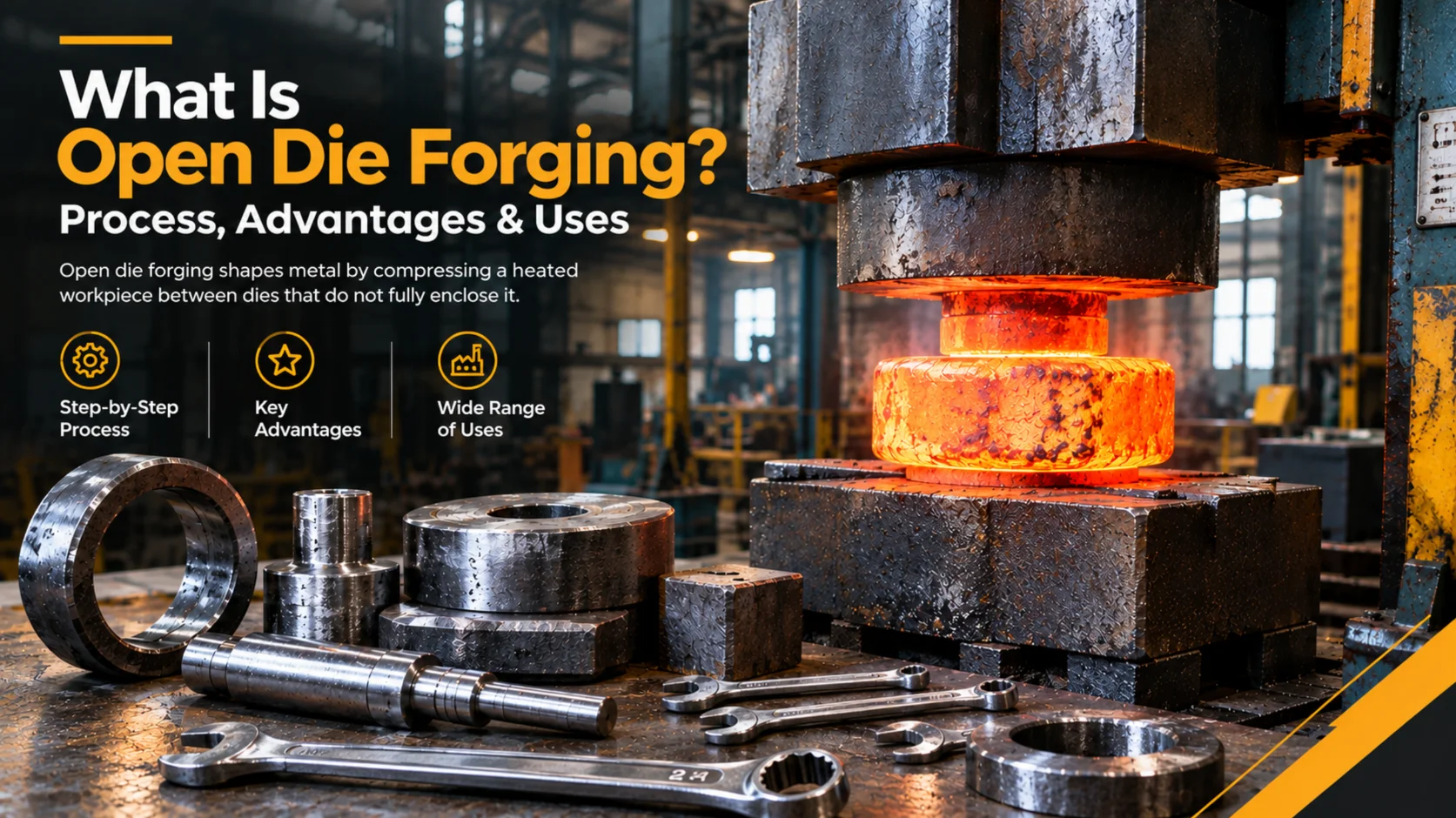
Open die forging is a metal forming process in which a heated workpiece is compressed between dies that do not completely enclose it. The workpiece is progressively shaped through repeated press strokes or hammer blows, with rotation or repositioning between operations. It is commonly used to manufacture large, heavy, and customized components such as shafts, discs, rings, blocks, and cylinders.
What Is Open Die Forging?
In open die forging, a heated metal workpiece is placed between an upper and lower die and subjected to compressive force. Unlike closed die forging, the dies do not contain the material within a shaped cavity. This allows the metal to flow outward as it deforms.
The workpiece can be rotated, moved, or repositioned between successive press strokes or hammer blows. By controlling these movements and the amount of deformation, manufacturers progressively achieve the required shape and dimensions.
Open die forging is particularly useful for components that are too large, heavy, customized, or low-volume for conventional closed die production. Typical products include large shafts, discs, rings, blocks, cylinders, and sleeves.
How Does Open Die Forging Work?
The open die forging process generally involves these steps:
1. Material Selection
The forging material is selected according to the component’s required strength, toughness, temperature resistance, corrosion resistance, and service conditions. Common materials include carbon steels, alloy steels, stainless steels, and selected non-ferrous alloys.
2. Heating
The workpiece is heated to an appropriate forging temperature. Heating increases the material’s ductility and reduces its resistance to deformation, allowing it to be shaped under compressive force.
Temperature control is important because unsuitable temperatures can affect deformation behavior, surface condition, and final material properties.
3. Positioning Between Dies
The heated workpiece is positioned between the upper and lower dies of a forging press or hammer. The dies provide the surfaces needed to apply force but do not fully surround the workpiece.
4. Applying Compressive Force
The forging equipment applies controlled force through repeated press strokes or hammer blows. The metal undergoes plastic deformation, changing its length, thickness, diameter, or cross-sectional shape.
5. Repositioning and Manipulation
The workpiece is progressively rotated, moved, or repositioned between strokes. This allows the operator to control material flow and gradually develop the required geometry.
6. Final Sizing and Finishing
After the required forged shape is achieved, the component may undergo heat treatment, machining, surface finishing, dimensional inspection, or other specified processes.
Common Open Die Forging Operations
Different deformation operations can be combined depending on the required component geometry.
- Upsetting: Increases the cross-sectional area while reducing the workpiece’s length.
- Drawing out: Reduces the cross-section while increasing the length.
- Cogging: Uses successive reductions to break down and reshape large sections of metal, often from ingots.
- Piercing: Creates a hole or cavity in the workpiece.
- Hollow forging: Produces hollow cylindrical components, often using a mandrel.
- Ring forging: Forms and enlarges ring-shaped components through controlled deformation.
The exact operation sequence depends on the starting material, workpiece dimensions, component design, and required properties.
What Are the Advantages of Open Die Forging?
1. Suitable for Large and Heavy Components
Open die forging is particularly well suited to producing large and heavy forgings that may not be practical for conventional closed die processes. It is commonly used for large shafts, discs, rings, blocks, and similar components.
2. Flexible for Custom Components
Because the workpiece is not confined to a fixed die cavity, manufacturers can produce a wide range of shapes and dimensions. This flexibility is useful for specialized components, prototypes, repairs, and lower-volume production.
3. Lower Dedicated Tooling Requirements
Open die forging generally requires less dedicated, part-specific tooling than closed die forging. This can make it more practical when producing customized components or when production volumes do not justify complex impression dies.
4. Supports Controlled Grain Flow
Properly designed forging operations can develop grain flow that follows the general geometry of the component. This controlled deformation can contribute to the required mechanical performance of the finished forging.
5. Suitable for Demanding Industrial Applications
The ability to control deformation, component dimensions, and forging sequence makes open die forging suitable for components that must meet demanding mechanical and operating requirements.
What Are the Uses of Open Die Forging?
Open die forging is used across industries where large dimensions, customized geometry, and reliable mechanical performance are important.
Power Generation
Representative components include:
- Turbine shafts
- Generator shafts
- Rotor components
- Large discs
- Heavy-duty rings
Oil and Gas
Open die forging can be used for:
- Shafts
- Rings
- Flanges
- Cylindrical components
- Other heavy-duty equipment components
Heavy Equipment and Mining
Applications include:
- Large shafts
- Hubs
- Blocks
- Pins
- Heavy-duty machinery components
Industrial Machinery
Common components include:
- Drive shafts
- Discs
- Rings
- Sleeves
- Cylinders
- Custom forged parts
Aerospace
Open die forging is also used for selected aerospace components where material properties, structural integrity, component size, and dimensional requirements are critical.
What Are the Limitations of Open Die Forging?
Open die forging offers significant flexibility, but it is not the ideal process for every component.
- It generally provides less geometric detail than closed die forging.
- Dimensional tolerances may require subsequent machining.
- It may not be the most economical option for high-volume production of small, highly repeatable components.
- Complex geometries can require multiple forging operations and careful workpiece manipulation.
- Final suitability depends on the material, component design, required tolerances, and production volume.
These factors should be evaluated during process selection rather than assuming that one forging method is universally better.
Open Die Forging vs. Closed Die Forging
The main difference is how the dies control the workpiece.
| Feature | Open Die Forging | Closed Die Forging |
| Die configuration | Does not fully enclose the workpiece | Uses shaped die cavities |
| Material flow | Relatively unrestricted | More strongly controlled by the die cavity |
| Component size | Well suited to large components | Commonly used for smaller, defined geometries |
| Tooling | Generally lower dedicated tooling requirement | Requires part-specific impression dies |
| Shape flexibility | High | More restricted by die design |
| Production suitability | Custom and lower-volume work | Often preferred for repetitive, higher-volume production |
Therefore, open die forging is generally preferred for large, heavy, customized, or lower-volume components, while closed die forging is often more suitable for complex, repeatable components produced in higher volumes.
When Should You Choose Open Die Forging?
Open die forging may be a suitable choice when:
- The component is large or heavy.
- Custom dimensions are required.
- Production volume is relatively low or moderate.
- The component has a shaft, disc, ring, block, cylinder, or similar geometry.
- Dedicated closed-die tooling would not be economical.
- Controlled metal deformation and the resulting mechanical properties are important.
Before selecting the process, manufacturers should evaluate the alloy, starting stock, forging temperature, deformation sequence, dimensional tolerances, heat treatment, machining allowance, and inspection requirements.
Conclusion
Open die forging is a flexible metal forming process particularly suited to large, heavy, and customized components. By progressively compressing and manipulating a workpiece between dies that do not fully enclose it, reliable manufacturers can produce shafts, discs, rings, blocks, cylinders, and other industrial forgings.
The right forging method depends on the component size, material, geometry, production volume, tolerances, and required mechanical properties. For large or specialized components where process flexibility and controlled deformation are important, open die forging can be an effective manufacturing solution.
FAQs
Open die forging is a process in which heated metal is compressed between dies that do not completely enclose the workpiece. The material is repeatedly pressed or hammered and repositioned until the required shape and dimensions are achieved.
It is commonly used to manufacture large or customized components such as shafts, discs, rings, blocks, cylinders, sleeves, and heavy machinery parts.
Open die forging is commonly performed at elevated temperatures because heating increases material ductility and reduces deformation resistance. The appropriate temperature depends on the material and process requirements.
Common materials include carbon steels, alloy steels, stainless steels, and selected non-ferrous alloys. The suitability of a material depends on its composition and forgeability.
Its main advantage is flexibility. It can produce large, heavy, and customized components without requiring the workpiece to conform to a fully enclosed die cavity.
Not universally. Open die forging is generally advantageous for large, customized, and lower-volume components, while closed die forging can be more suitable for complex, repeatable components produced in higher volumes.