What Is Closed Die Forging? Process, Benefits & Applications
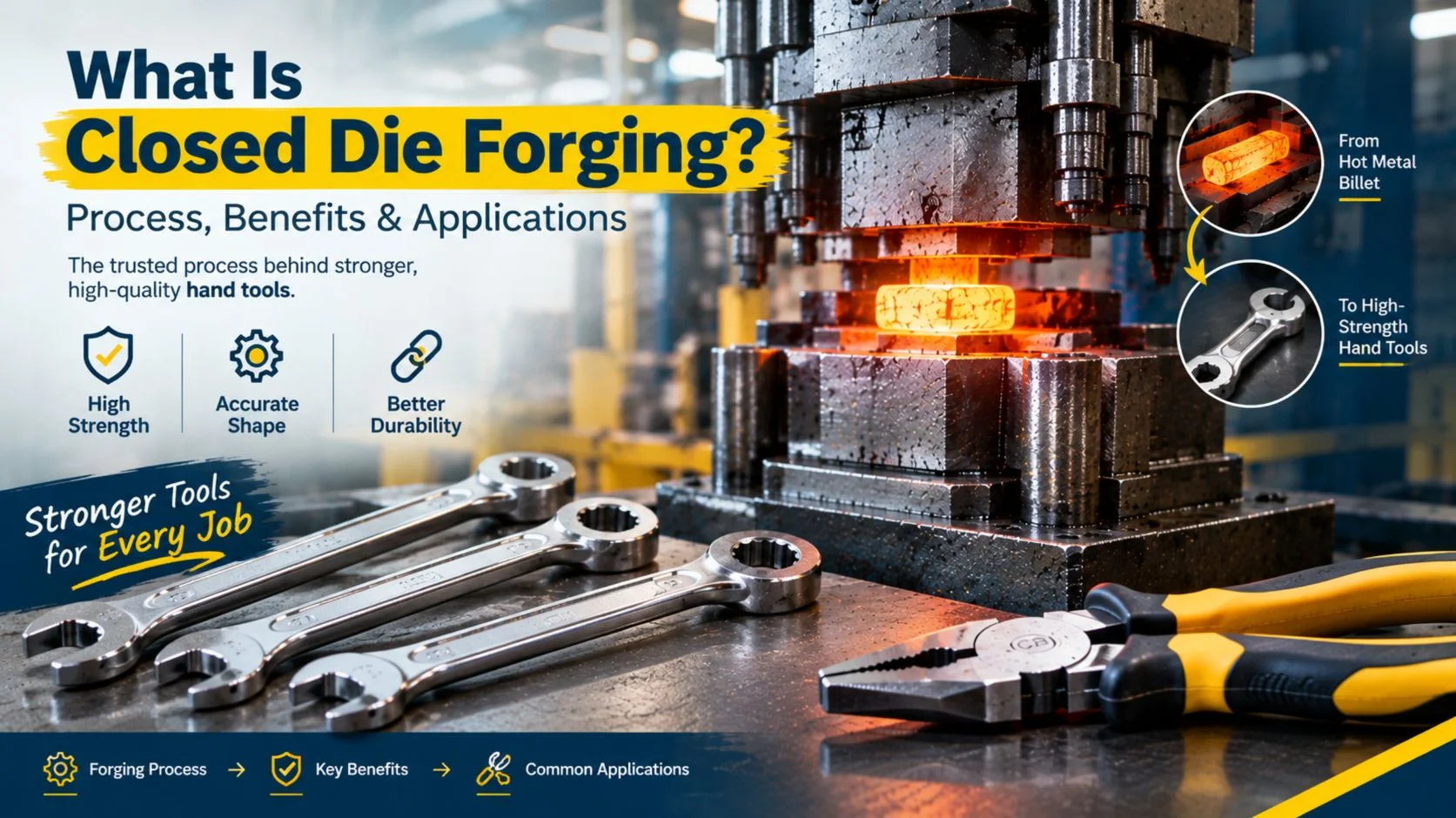
- What Is Closed Die Forging?
- How Does Closed Die Forging Work?
- What Are the Benefits of Closed Die Forging?
- What Materials Can Be Used for Closed Die Forging?
- What Are the Applications of Closed Die Forging?
- What Are the Limitations of Closed Die Forging?
- When Should You Choose Closed Die Forging?
- Conclusion
- FAQs
Closed die forging is a metal-forming process in which a metal billet is compressed between dies containing the required component shape. As the dies close under high force, the material plastically deforms and flows into the die cavity. Also called impression die forging, the process is widely used to manufacture repeatable, high-integrity components for automotive, aerospace, construction equipment, and industrial applications.
What Is Closed Die Forging?
Closed die forging is a manufacturing process that shapes metal by forcing a billet into a die cavity under compressive force. The dies contain impressions corresponding to the required component geometry, which restricts metal flow and forms the part.
In conventional impression-die forging, excess material can flow outside the die impression and form flash at the parting line. The flash is subsequently trimmed. Flashless or true closed-die forging is a related process in which the die fully encloses the workpiece, requiring very accurate control of billet volume and process conditions.
Closed Die Forging vs Open Die Forging
The main difference is how the workpiece is constrained during deformation.
| Feature | Closed Die Forging | Open Die Forging |
| Die configuration | Shaped impressions | Generally simpler die surfaces |
| Metal flow | Restricted by die cavity | Less laterally constrained |
| Part geometry | Suitable for complex shapes | Generally suited to simpler or larger shapes |
| Production | Well suited to repeat production | Often preferred for smaller quantities and large components |
| Tooling | Higher die investment | Lower part-specific tooling investment |
How Does Closed Die Forging Work?
The closed die forging process typically involves several controlled stages. The exact sequence depends on the material, component geometry, equipment, and production requirements.
1. Billet Preparation
The selected metal is cut into billets of an appropriate size and weight. Billet dimensions are calculated according to the component geometry and the amount of material required to fill the forging impressions and, where applicable, form flash.
2. Billet Heating
For hot closed die forging, the billet is heated to a temperature suitable for the material being forged. Heating makes the material more ductile and reduces the force required for deformation. Induction and furnace heating are commonly used, depending on the application and production setup.
3. Preforming or Blocking
Complex components may require one or more preforming stages. The billet is progressively shaped so that material is distributed appropriately before it enters the final impression.
This step helps control metal flow and reduces the risk of defects caused by trying to form a complex geometry in a single operation.
4. Finish Forging
The preform is positioned in the finishing die, and the dies close under a press or hammer. The applied force causes the metal to flow into the impression until the required geometry is formed.
For conventional impression-die forging, excess material can move through the parting line into the flash area. This controlled resistance to outward flow also helps promote filling of the die cavity.
5. Flash Trimming
Where flash is produced, the excess material is removed using a trimming operation. Flashless forging does not require this step, but it demands much tighter control of billet volume and process conditions.
6. Finishing and Inspection
Depending on the component, post-forging operations may include heat treatment, descaling, machining, surface finishing, and dimensional inspection. Non-destructive testing may also be specified for components with particular quality requirements.
What Are the Benefits of Closed Die Forging?
Closed die forging is selected when component geometry, production volume, mechanical requirements, and repeatability justify the required tooling and process controls.
1. Controlled and Repeatable Geometry
Because the dies contain the required component profile, the process can produce repeatable shapes across production batches. This makes it suitable for components manufactured in significant quantities.
2. Good Mechanical Properties
Plastic deformation during forging can produce a refined, continuous grain structure and favorable grain flow relative to many cast structures. These characteristics can contribute to strength and structural integrity when the process is properly designed and controlled.
3. Complex Component Shapes
Multiple impressions and preforming operations allow manufacturers to produce components with features such as ribs, bosses, flanges, bends, and other non-symmetrical profiles that would be difficult to achieve with simpler forging methods.
4. Reduced Machining Compared With Producing the Part Entirely From Stock
Closed die forging can produce a component relatively close to its final geometry. As a result, some applications require less material removal during subsequent machining than manufacturing the same component entirely from bar or billet stock.
The actual machining allowance depends on the component design, forging capability, tolerances, and finishing requirements.
5. Efficient for Production Runs
Custom dies require an initial tooling investment, but the cost can be distributed across a larger number of components. This makes closed die forging particularly attractive for medium- to high-volume production where repeatability and cycle efficiency are important.
What Materials Can Be Used for Closed Die Forging?
A wide range of engineering metals and alloys can be processed using impression-die forging, although the appropriate process depends on material properties and component requirements.
Common materials include:
- Carbon and alloy steels
- Stainless steels
- Aluminum alloys
- Copper alloys
- Titanium alloys
- Selected nickel-based and other high-performance alloys
Forging temperature, deformation behavior, die design, equipment capacity, and required properties all influence whether a particular alloy is suitable for a given closed die forging application.
What Are the Applications of Closed Die Forging?
Closed die forging is commonly used for components where controlled geometry, mechanical performance, and production repeatability are important.
- Automotive: Typical applications include connecting rods, steering and suspension components, yokes, shafts, gears, and other drivetrain or chassis components.
- Aerospace: Forged aluminum, titanium, and nickel-based alloy components are used in applications where weight, strength, and structural performance are important. Component requirements vary considerably by aircraft system and specification.
- Construction and Heavy Equipment: Closed die forging can produce pins, levers, links, shafts, and other load-bearing components used in construction and heavy machinery.
- Industrial Machinery: Common applications include gears, flanges, shafts, couplings, and other mechanical components that require controlled geometry and suitable mechanical properties.
What Are the Limitations of Closed Die Forging?
Closed die forging is not the right choice for every component.
The main considerations include:
- Higher tooling cost: Custom dies require significant design and manufacturing investment.
- Production-volume requirements: Low-volume projects may not justify dedicated die costs.
- Geometry constraints: Component size, section thickness, draft, radii, and metal-flow requirements affect forgeability.
- Secondary operations: Machining, trimming, heat treatment, or finishing may still be necessary.
- Process control: Complex parts may require multiple impressions, accurate billet positioning, and carefully controlled forging parameters.
Therefore, process selection should consider the component’s material, geometry, tolerances, production quantity, and total manufacturing cost rather than focusing on forging alone.
When Should You Choose Closed Die Forging?
Closed die forging is generally worth considering when a project requires:
- Repeat production of the same component
- Complex or contoured metal geometries
- Controlled and consistent dimensions
- Favorable mechanical properties
- Reduced machining compared with manufacturing entirely from solid stock
- Production volumes that can justify custom tooling
For large, simple components or low-volume production, open die forging or another manufacturing process may be more appropriate. The best option depends on the component’s design and production requirements.
Conclusion
Closed die forging is a controlled metal-forming process used to produce repeatable components with complex geometries and suitable mechanical properties. By shaping a billet within engineered die impressions, manufacturers can produce parts efficiently for automotive, aerospace, construction, and industrial applications. However, tooling investment and component geometry make process selection important. For B2B manufacturing, the right forging method should be evaluated against material, part design, production volume, tolerances, secondary machining, and total cost.
FAQs
In common manufacturing terminology, closed die forging and impression die forging are often used interchangeably. Conventional impression-die forging can produce flash, while true flashless closed-die forging completely encloses the workpiece.
No. Conventional impression-die forging commonly produces flash that is later trimmed, while flashless forging is specifically designed to prevent excess material from escaping the die cavity.
Forging can provide advantageous grain flow and a forged microstructure, which may improve mechanical performance for suitable designs and materials. However, the performance of a finished component depends on its alloy, design, forging process, heat treatment, and quality controls.
Yes. The process is particularly suitable for repeat production because dedicated dies can produce consistent component geometries. The tooling investment is easier to justify when production quantities are sufficiently high.
Carbon and alloy steels, stainless steels, aluminum alloys, copper alloys, and selected titanium and high-performance alloys can be closed-die forged, depending on their forging characteristics and the required component design.