Closed-Die vs Open-Die Forging: Process & Key Differences
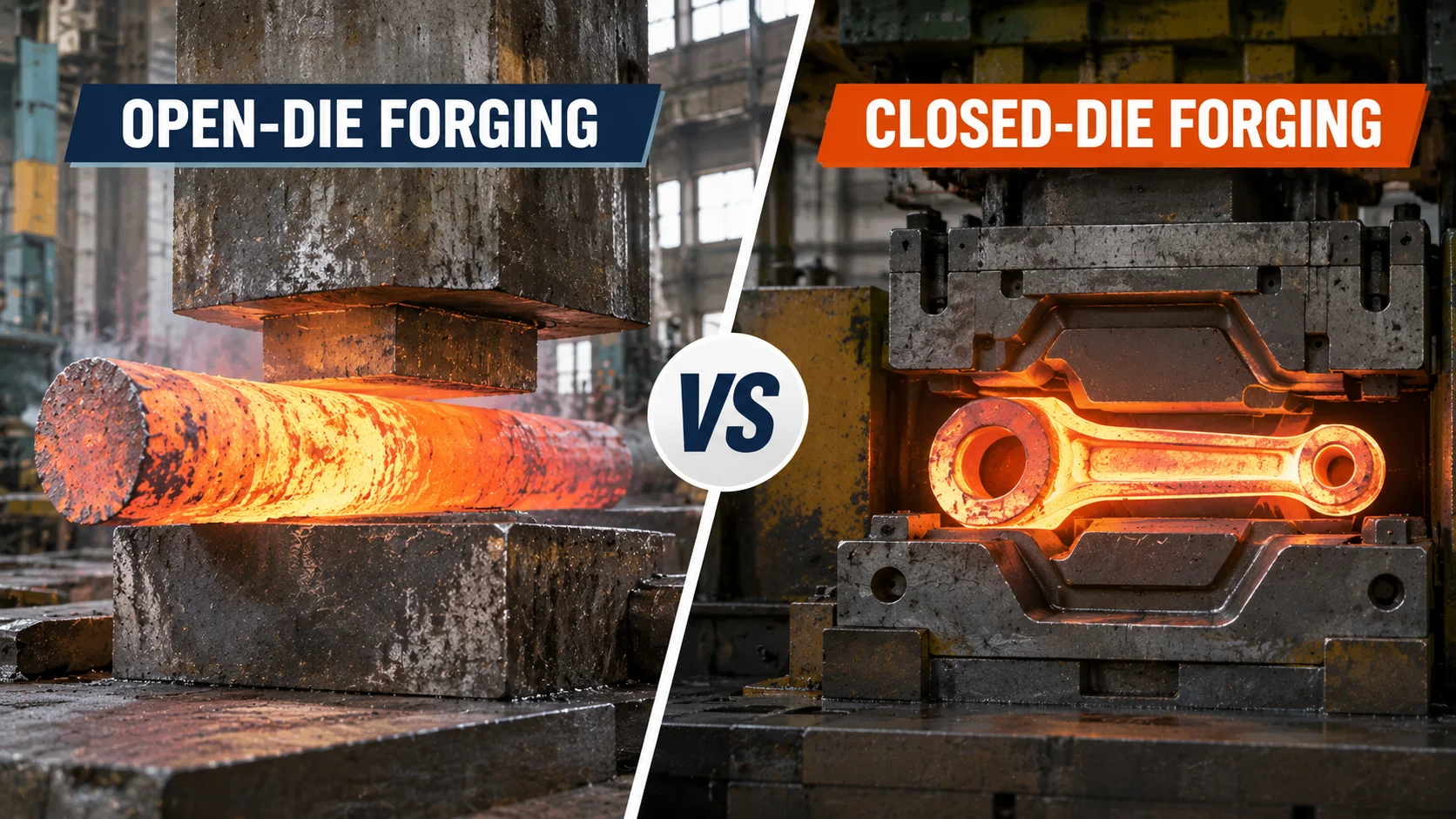
Open-die and closed-die forging differ mainly in how the metal is constrained during forming. Open-die forging shapes a workpiece between dies that do not fully enclose it, making it suitable for large, heavy, or customized components. Closed-die forging forms heated metal inside shaped die cavities, making it suitable for repeatable geometries, complex components, and production runs where dedicated tooling can be justified.
The right process depends on component size, geometry, required tolerances, production volume, tooling investment, material utilization, and machining requirements.
What Is Open-Die Forging?
Open-die forging is a metal-forming process in which a heated workpiece is compressed between dies that do not completely enclose it. The workpiece is progressively shaped through repeated pressing or hammering, often with rotation and repositioning between operations.
Because the dies are not machined to the complete geometry of the finished component, the process provides flexibility in producing different sizes and shapes without dedicated cavity tooling. It is particularly suited to large forgings such as shafts, rings, discs, blocks, and other heavy industrial components.
Open-Die Forging Process
The typical process involves:
- Heating: The workpiece is heated to the required forging temperature.
- Positioning: The heated material is placed between the forging dies.
- Compression: A press or hammer applies force to deform the metal.
- Repositioning: The workpiece is rotated, moved, or manipulated between forging operations.
- Progressive forming: Operations such as upsetting, drawing, or piercing are performed as required.
- Finishing: The forging may undergo heat treatment, machining, surface finishing, and inspection.
Open-die forging therefore relies more heavily on controlled deformation and subsequent machining to achieve the final geometry.
Advantages of Open-Die Forging
- Suitable for large and heavy components
- Lower dedicated tooling investment
- Flexible for custom dimensions and shapes
- Practical for low-volume or specialized production
- Allows substantial deformation and controlled grain flow
- Suitable when significant machining will follow forging
Limitations of Open-Die Forging
- Lower dimensional control than cavity-based forging
- Limited ability to produce intricate geometries directly
- Often requires greater machining allowance
- Production may involve more handling and repositioning
What Is Closed-Die Forging?
Closed-die forging, also known as impression-die forging, forms heated metal inside shaped die cavities. When the dies close under high compressive force, the material flows into the cavity and takes its defined geometry. Excess material can form flash at the die parting line and is subsequently trimmed.
The die cavity provides greater control over material flow and part geometry, making closed-die forging suitable for repeat production of components with defined and relatively complex shapes.
Closed-Die Forging Process
The process generally follows these steps:
- Billet preparation: Metal stock is cut to the required size and weight.
- Heating: The billet is heated to its appropriate forging temperature.
- Die placement: The heated billet or preform is positioned in the die.
- Die closing: The dies apply high compressive force.
- Cavity filling: The material flows into the die impression to form the component.
- Flash trimming: Excess material is removed where flash is produced.
- Finishing: Heat treatment, sizing, machining, surface treatment, and inspection may follow.
Because the die defines much of the final geometry, closed-die forging can reduce machining requirements for suitable components and provide high repeatability across production runs.
Advantages of Closed-Die Forging
- Suitable for defined and complex geometries
- Higher dimensional consistency
- High repeatability across production runs
- Can reduce machining for near-net-shape designs
- Suitable for medium- to high-volume production
- Enables controlled material flow around component features
Limitations of Closed-Die Forging
- Requires dedicated die tooling
- Higher initial tooling investment
- Die design becomes more demanding for complex components
- Economic suitability depends heavily on production quantity
- Component size is constrained by die and equipment capacity
Closed-Die vs Open-Die Forging: Key Differences
The fundamental distinction is material confinement: open-die forging allows the material to move beyond the die surfaces, while closed-die forging directs material flow into a predetermined cavity. That difference affects geometry, tooling, production economics, and machining requirements.
| Factor | Open-Die Forging | Closed-Die Forging |
| Die design | Flat or simple contoured dies | Shaped cavities matched to the component |
| Material flow | Relatively unrestricted | Controlled by the die cavity |
| Component size | Well suited to large/heavy parts | Limited by die and equipment capacity |
| Geometry | Simple to moderately complex | More complex and defined geometries |
| Dimensional control | Generally lower | Generally higher |
| Tooling investment | Lower | Higher |
| Production volume | Often suitable for low-to-medium volumes | Often suitable for medium-to-high volumes |
| Machining | Usually requires more finishing | Can require less machining for suitable designs |
| Material utilization | Depends strongly on machining allowance | Can improve material utilization through near-net shaping |
| Flexibility | High | More dependent on die design |
| Typical components | Shafts, rings, blocks, large discs | Connecting rods, gears, brackets, and other repeat-production parts |
Neither process is inherently better. The appropriate method depends on the component and production requirements.
Open-Die vs Closed-Die Forging: Cost Differences
Cost should be evaluated as total manufacturing cost, not simply the price of the forging operation.
Open-die forging generally requires less dedicated tooling, which can make it attractive for one-off, prototype, custom, or lower-volume components. However, the resulting part may require more machining to reach its final dimensions.
Closed-die forging requires a higher initial investment because the dies must be designed and manufactured for the component. For suitable production volumes, that investment can be distributed across many parts, while the controlled geometry can reduce machining and improve repeatability.
Therefore, the cost comparison should consider:
- Die and tooling cost
- Material yield
- Machining allowance
- Machining time
- Production quantity
- Setup and lead time
- Inspection requirements
Which Forging Process Should You Choose?
The choice between open-die and closed-die forging should start with the component specification rather than the process name.
Open-Die Forging Is Generally Suitable When:
- The component is very large or heavy.
- Production quantities are relatively low.
- The geometry is simple or can be machined after forging.
- Flexible dimensions are required.
- Dedicated cavity tooling is not economically justified.
Closed-Die Forging Is Generally Suitable When:
- The component has a defined, repeatable geometry.
- More complex features need to be formed.
- Consistent dimensions are important.
- Production quantities justify dedicated tooling.
- Reducing machining is commercially valuable.
For a B2B forging project, manufacturers should provide the component drawing, material grade, dimensions, tolerances, expected quantity, heat-treatment requirements, inspection standards, and machining requirements when discussing process selection with a forging supplier.
Applications of Open-Die and Closed-Die Forging
Open-die forging is commonly used for large shafts, rings, discs, blocks, hubs, and heavy industrial components where flexibility and component size are important.
Closed-die forging is commonly used for repeat-production components such as connecting rods, gears, brackets, clevises, and other automotive, industrial, and engineering parts requiring controlled geometry.
Conclusion
Open-die and closed-die forging solve different manufacturing problems. Open-die forging offers flexibility for large, heavy, customized, or lower-volume components, while closed-die forging provides controlled geometry and repeatability for suitable complex and repeat-production parts. The right choice ultimately depends on component size, geometry, material, tolerances, production volume, tooling investment, material utilization, and machining requirements. Evaluating these factors together gives manufacturers a more reliable basis for selecting the appropriate forging process.
FAQs
Open-die forging shapes metal between dies that do not fully enclose the workpiece, while closed-die forging forms metal inside shaped die cavities. This makes open-die forging more flexible for large components and closed-die forging more suitable for defined, repeatable geometries.
Open-die forging generally has lower dedicated tooling costs. Closed-die forging has higher initial die costs but can become more economical for suitable production volumes because tooling is spread across multiple parts and machining requirements may be reduced.
Open-die forging is generally more suitable for very large and heavy components because it is not dependent on a dedicated die cavity surrounding the entire workpiece. Actual size limits depend on the available forging equipment and material.
Closed-die forging generally provides greater dimensional consistency because the die cavity controls the material’s shape during deformation. Final tolerances still depend on the material, die design, equipment, process control, and finishing operations.
Neither process automatically produces superior mechanical properties. Performance depends on the material, amount and direction of deformation, grain flow, heat treatment, component design, and process control. Both open-die and closed-die forging can produce high-integrity components.
Yes. Both processes can require machining, heat treatment, trimming, sizing, or other finishing operations. Closed-die forging can reduce machining when the component is designed for near-net-shape production, while open-die forgings commonly require more material removal to achieve final dimensions.
Related Readings
- What Is Forging?
- What Is Hot Forging?
- What Is Cold Forging?
- What Is Warm Forging?
- Hot vs Cold vs Warm Forging: Key Differences Explained
- Closed-Die vs Open-Die Forging: Process & Key Differences
- Types of Forging Processes Explained
- Grain Structure in Forged vs Cast Metal
- Heat Treatment in Forging and Casting
- Casting Defects vs Forging Defects
- Forging vs Casting Cost Comparison
- What Is Casting?