Drop Forging vs Press Forging: What’s the Difference?
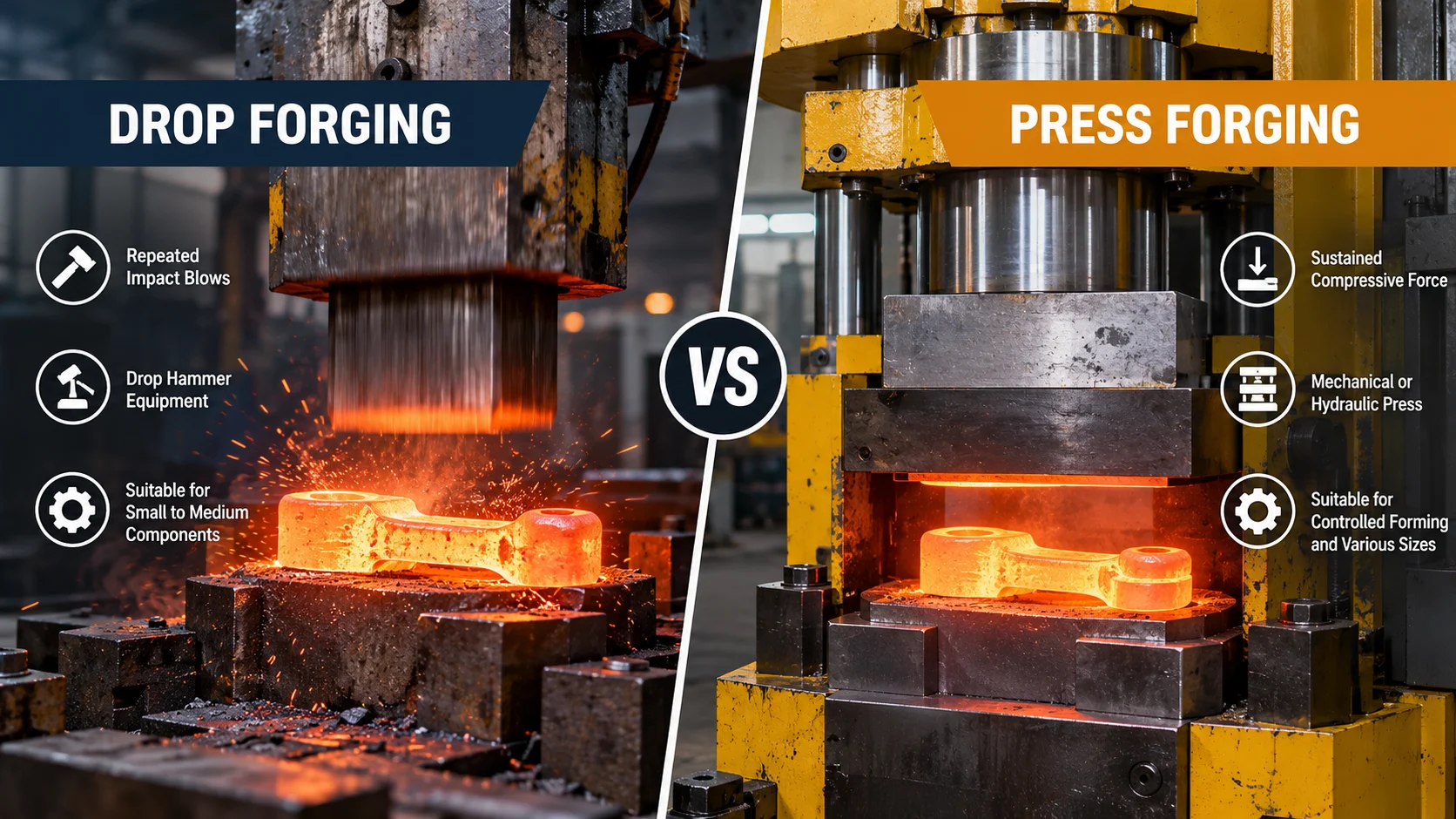
Drop forging and press forging are metal-forming processes used to manufacture components for automotive, construction, tooling, and heavy engineering applications. The main difference is how force is applied: drop forging uses repeated hammer impacts, while press forging applies compressive force through a controlled stroke. The right process depends on component geometry, material, dimensional requirements, production volume, and manufacturing cost.
Drop Forging vs Press Forging: Key Differences
Drop forging and press forging differ primarily in their force application, deformation behavior, and equipment requirements. Both can produce durable components, but their suitability varies with the part design and production conditions.
| Comparison factor | Drop forging | Press forging |
| Force application | Repeated impact blows | Sustained compressive force |
| Equipment | Drop hammer or forging hammer | Mechanical or hydraulic press |
| Deformation | Metal deforms through successive impacts | Metal deforms under pressure during the press stroke |
| Process control | Depends on impact energy, blow sequence, and die design | Force, stroke, and pressing conditions can be controlled |
| Production suitability | Suitable for repetitive production with appropriate tooling | Suitable for controlled forming and automated production, depending on setup |
| Component considerations | Often used for small to medium-sized die-forged parts | Can accommodate a range of component sizes, depending on press capacity |
| Cost considerations | Depends on hammer capacity, tooling, cycle time, and finishing | Depends on press investment, tooling, energy use, and production volume |
Important distinction: Drop forging and press forging describe how force is applied. They are not necessarily separate die categories. Closed-die forging, for example, can be performed using either hammers or presses.
What Is Drop Forging?
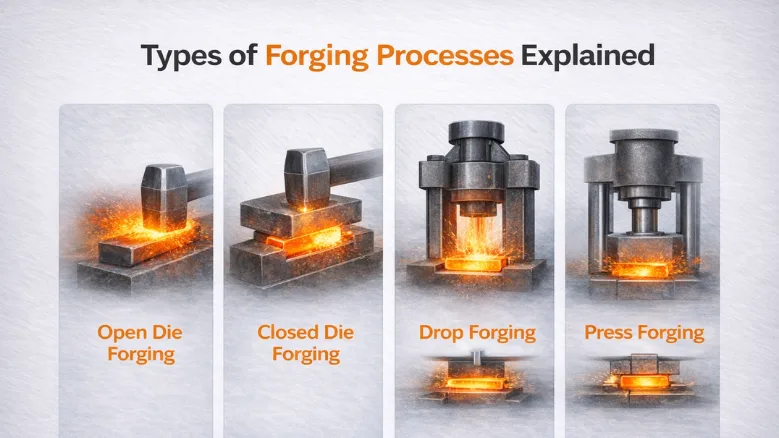
Drop forging is a metal-forming process in which a hammer delivers repeated blows to shape a workpiece using dies. The metal is commonly heated before forging to improve its ability to deform without cracking.
How Does Drop Forging Work?
The process generally involves four stages:
- Workpiece preparation: Metal stock is cut to the required size and heated when hot forging is used.
- Die placement: The workpiece is positioned between the forging dies.
- Impact forming: A hammer delivers successive blows, forcing the metal to flow into the die cavity.
- Finishing and inspection: Excess material is trimmed when necessary. The component may then undergo heat treatment, machining, and dimensional inspection.
The number of blows and forming stages depends on the component’s shape, material, and die design.
Advantages and Limitations of Drop Forging
Advantages
- Supports repeat production of components with established tooling and process parameters.
- Can produce favorable grain flow that follows the component’s geometry.
- Is suitable for a range of industrial tools, automotive parts, and hardware.
Limitations
- Impact operations generate noise and vibration, requiring appropriate workplace controls.
- Complex shapes may need multiple blows or performing stages.
- Die costs and setup requirements can make the process less economical for small production runs.
- Critical dimensions and surface finishes may require additional machining.
Drop forging is commonly considered for components such as spanners, wrenches, and selected automotive and industrial parts.
What Is Press Forging?
Press forging shapes metal by applying compressive force through a mechanical or hydraulic press. Rather than relying on successive hammer impacts, the press deforms the workpiece over a controlled stroke.
Press forging is commonly performed on heated metal, although cold and warm forging processes are also used where the material and component design permit them.
How Does Press Forging Work?
The process generally follows these stages:
- Workpiece preparation: The billet is cut to size and heated if required.
- Positioning: The workpiece is placed in the press tooling.
- Press deformation: The press applies compressive force, shaping the metal according to the die geometry.
- Finishing and inspection: The component is trimmed if necessary, heat-treated or machined as specified, and inspected against its engineering requirements.
Advantages and Limitations of Press Forging
Advantages
- Provides controlled application of force and deformation over the press stroke.
- Can produce substantial deformation through the workpiece, depending on material and process conditions.
- Supports repeatable production when tooling and machine parameters are properly controlled.
- Can be integrated into automated manufacturing lines.
Limitations
- Press equipment and dedicated tooling can require significant capital investment.
- Longer die-contact times in some hot-forging operations make temperature management important.
- Component size and geometry must suit the press capacity and tooling.
- Machining may still be needed to achieve tight tolerances or specified surface finishes.
Press forging is used for automotive components, machinery parts, and larger or more demanding forgings, depending on equipment capacity and design requirements.
Which Is Better: Drop Forging or Press Forging?
Neither process is universally better. Drop forging may suit components that can be formed efficiently through impact loading, while press forging may be preferable when controlled compression and deformation are important. The final decision should be based on the component specification rather than the process name alone.
Manufacturers should evaluate five factors:
- Component geometry: Consider the size, shape, cross-section, and complexity of the part.
- Material and properties: Check forgeability, required processing temperature, grain flow, and mechanical-property requirements.
- Dimensional accuracy: Determine whether the as-forged component can meet tolerances or needs machining.
- Production volume: Compare cycle time, tooling costs, equipment utilization, and expected cost per component.
- Quality requirements: Establish the required inspection methods, heat treatment, dimensional checks, and material testing.
For example, a manufacturer producing a large quantity of spanners may evaluate drop forging for its suitability to the component and production setup. A manufacturer producing a component that needs controlled deformation through its cross-section may evaluate press forging. These are starting points for process selection, not universal rules.
A forging supplier can assess the component drawing, material grade, tolerances, and order quantity to recommend a suitable process.
Applications of Drop Forging and Press Forging
Both methods are used across industrial manufacturing, although the appropriate process depends on the component and production requirements.
Typical drop forging applications
- Spanners, wrenches, and other forged hand tools
- Selected automotive and chassis components
- Industrial hardware and load-bearing parts
Typical press forging applications
- Large or heavy-engineering forgings within press capacity
- Automotive and machinery components
- Components requiring controlled deformation or integration into automated press lines
These applications can overlap. The same general component category may be manufactured using different forging methods depending on its dimensions, material, tooling, and required properties.
Conclusion
The key difference between drop forging and press forging is force application: drop forging uses repeated impacts, while press forging relies on sustained compression. Both can manufacture durable industrial components, but the right choice depends on geometry, material, tolerances, production volume, and cost.
For industrial manufacturers and buyers, evaluating these requirements against the component drawing and quality specifications is the most reliable way to select the appropriate forging process.
FAQs
Drop forging uses repeated hammer blows to shape metal, whereas press forging applies compressive force over a controlled stroke. This difference influences deformation behavior, equipment selection, and process suitability.
Not necessarily. Both methods can produce strong components with favorable grain flow. Final mechanical properties depend on the material, forging conditions, grain orientation, heat treatment, and component design.
Both can support mass production. The most suitable option depends on cycle time, tooling costs, automation, equipment capacity, and component geometry. Manufacturers should compare total production costs for the intended volume.
Neither process is always cheaper. Drop forging may be economical for suitable repeat-production applications, while press forging may offer advantages in controlled forming or automation. Tooling, operating costs, finishing requirements, and order quantity determine the overall economics.