Chrome Vanadium vs. Carbon Steel Spanners: Which Is Better?
- Chrome Vanadium vs Carbon Steel Spanners: Key Differences
- What Is Chrome Vanadium Steel?
- What Is Carbon Steel?
- Chrome Vanadium vs Carbon Steel: Performance Comparison
- Which Is Better: Chrome Vanadium or Carbon Steel Spanners?
- What Standards Should B2B Buyers Check?
- Chrome Vanadium vs Carbon Steel Spanners for B2B Buyers
- Sourcing Chrome Vanadium and Carbon Steel Spanners from India
- Which Steel Is Best for Spanners?
- Conclusion
- FAQs
Chrome vanadium (Cr-V) spanners are generally the better choice for professional and heavy-duty applications because properly specified Cr-V steel can provide a strong combination of strength, hardness, and toughness. Carbon steel spanners can be a more economical option for general-purpose applications. However, actual performance depends on the steel grade, heat treatment, forging quality, and manufacturing controls, not the material name alone.
For wholesalers, importers, and industrial buyers, this distinction is important when sourcing spanners in bulk from India or other manufacturing markets.
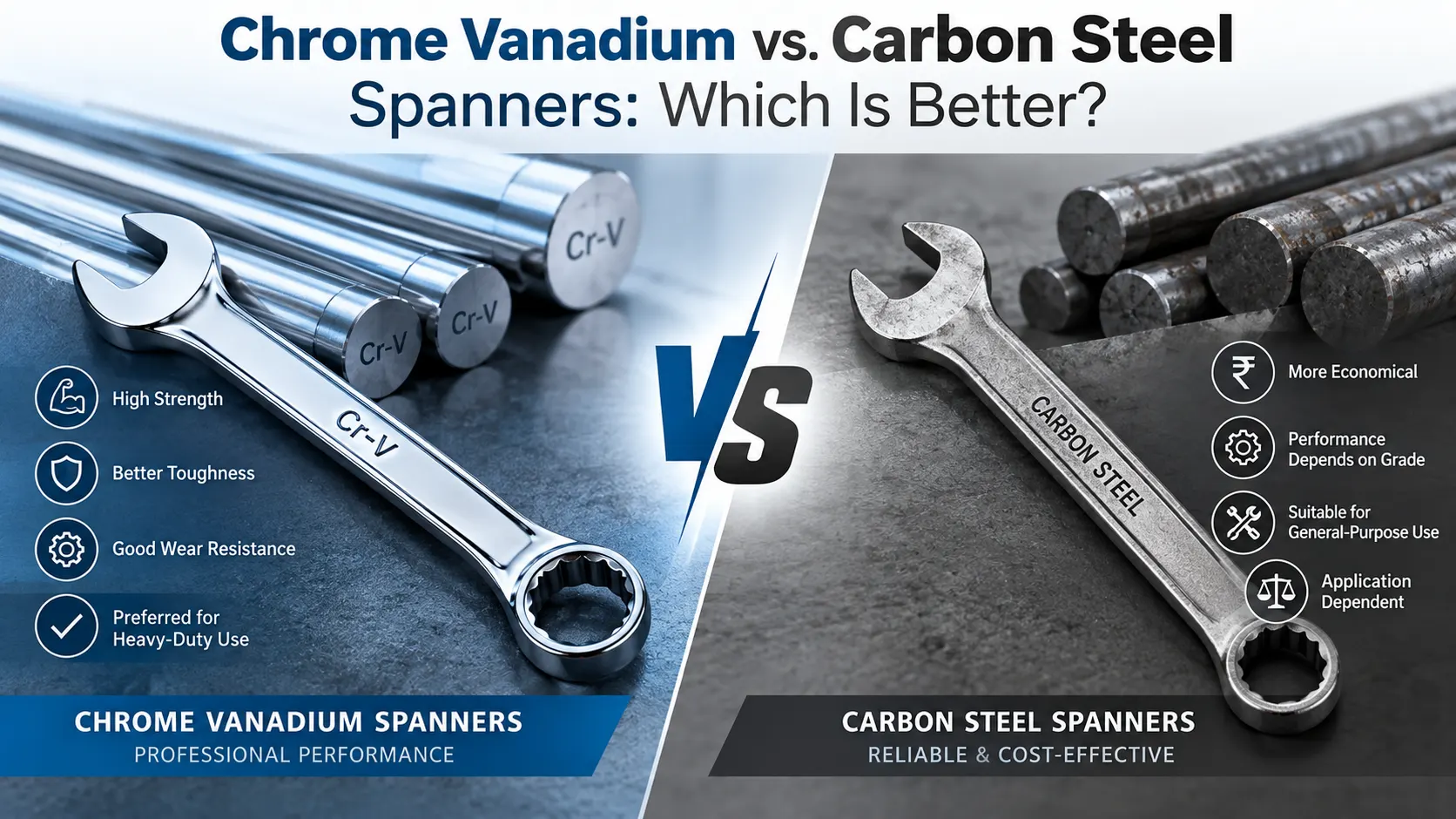
Chrome Vanadium vs Carbon Steel Spanners: Key Differences
| Factor | Chrome Vanadium Steel | Carbon Steel |
| Strength | Generally high | Depends on grade and treatment |
| Toughness | Generally high when properly treated | Depends on grade and treatment |
| Wear resistance | Generally good | Depends on hardness and grade |
| Corrosion resistance | Depends on surface finish | Depends on surface finish |
| Heavy-duty suitability | Generally preferred | Application-dependent |
| Cost | Usually higher | Generally more economical |
| Typical positioning | Professional/premium tools | General-purpose/cost-sensitive tools |
Key takeaway: The CR-V is commonly preferred for demanding hand-tool applications, but a properly specified and heat-treated carbon steel can also produce a reliable spanner. Buyers should compare complete specifications rather than steel names alone.
What Is Chrome Vanadium Steel?
Chrome vanadium is an alloy steel containing chromium and vanadium along with iron and carbon. These alloying elements can improve properties such as hardenability, strength, and toughness when the steel is appropriately processed.
This makes Cr-V suitable for applications where hand tools must withstand repeated mechanical loading. The final properties of a Cr-V spanner, however, depend on the specific steel grade and manufacturing process.
Cr-V does not mean stainless steel. Chromium in the alloy does not make a spanner rustproof. Corrosion protection also depends on the surface treatment, coating, and storage conditions.
What Is Carbon Steel?
Carbon steel is a broad category of steel in which carbon is the principal alloying element. Its properties can vary substantially according to carbon content, grade, and heat treatment.
A carbon steel spanner can provide adequate strength and durability for many general-purpose applications when the material is correctly selected and processed. Because “carbon steel” covers many different grades, the term by itself is not sufficient to assess spanner quality.
For B2B procurement, buyers should request the actual steel grade or material specification rather than accepting a generic “carbon steel” description.
Chrome Vanadium vs Carbon Steel: Performance Comparison
1. Strength and Load Resistance
A properly specified Cr-V steel can provide high strength and resistance to deformation, making it suitable for demanding hand-tool applications.
Carbon steel performance varies by grade. A suitable carbon steel can also provide sufficient strength, but buyers should verify the specified grade, heat treatment, and intended load requirements.
2. Hardness and Wear Resistance
Spanner jaws experience repeated contact and pressure against nuts and bolts. Adequate hardness helps reduce jaw deformation and wear.
Cr-V is commonly selected where manufacturers require a combination of hardness and toughness. Carbon steel can also achieve appropriate hardness through heat treatment, so the final hardness and material specification are more meaningful than the generic steel category alone.
3. Toughness and Impact Resistance
A quality spanner needs more than high hardness. It also needs adequate toughness to withstand mechanical loading without becoming excessively brittle.
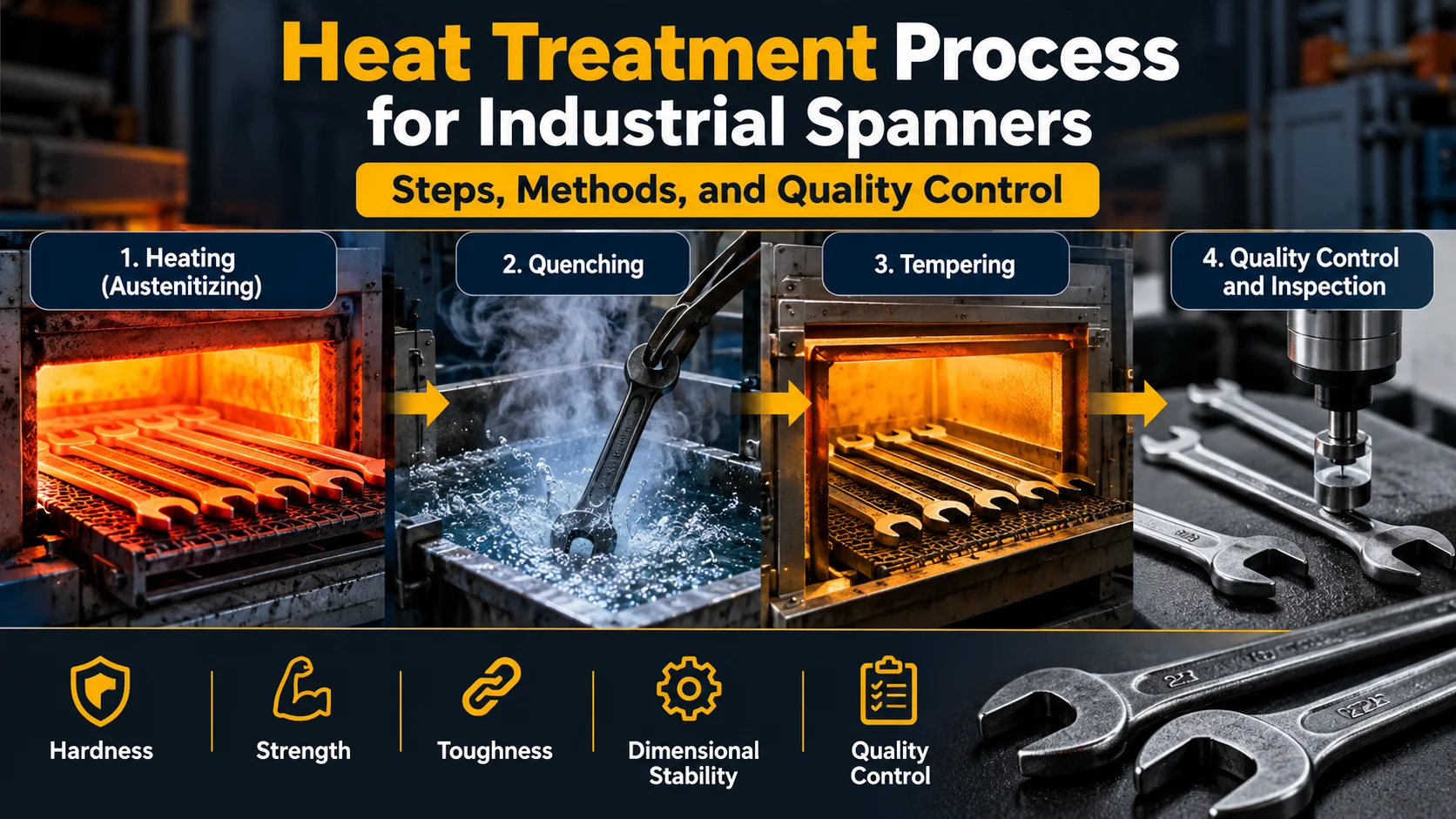
Heat treatment is therefore critical. The objective is to establish an appropriate balance between hardness, strength, and toughness for the intended application.
4. Corrosion Resistance
Neither ordinary Cr-V nor carbon steel should automatically be considered corrosion-proof.
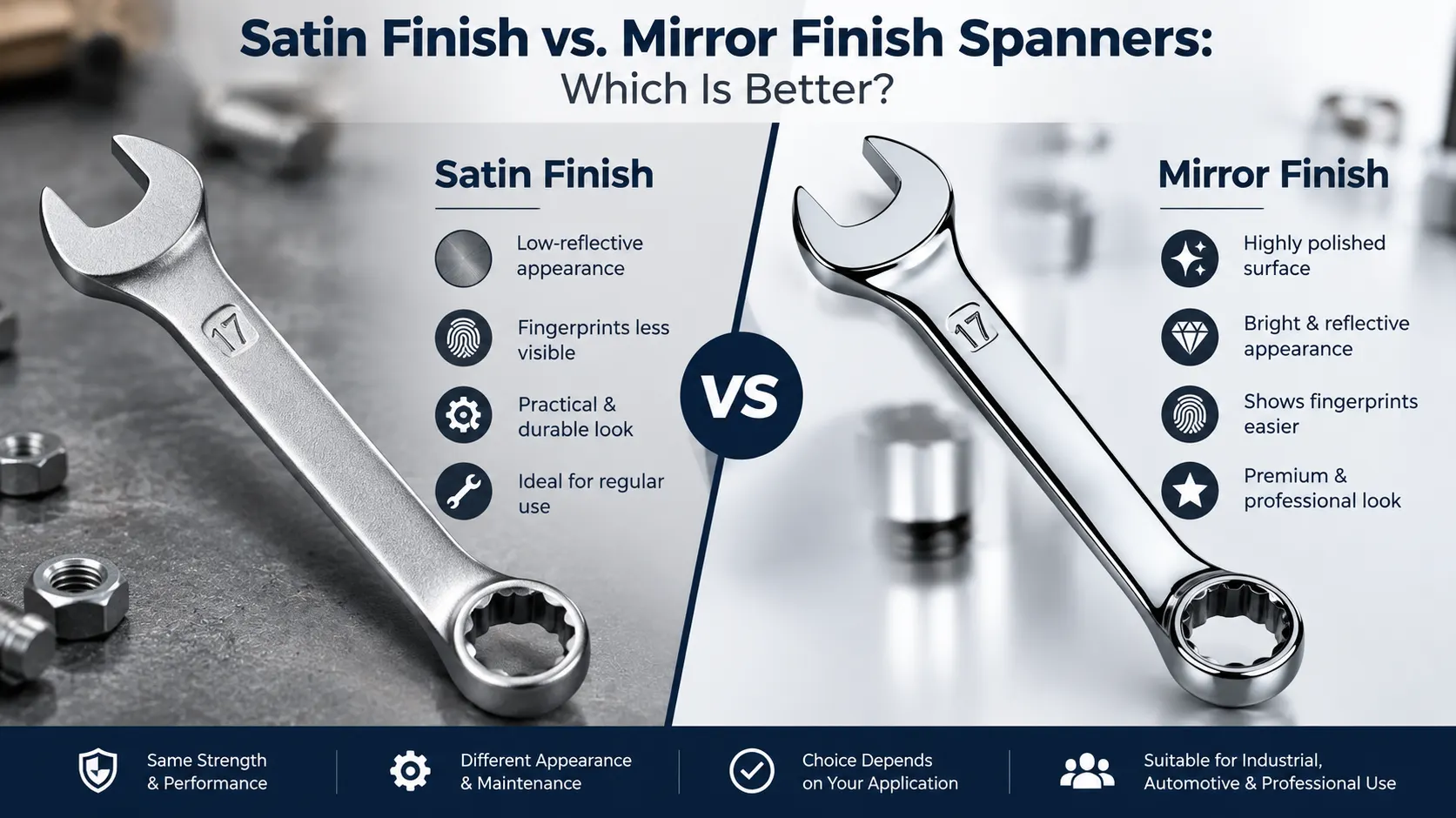
Spanners may use finishes such as chrome plating or other protective treatments to improve surface protection. Buyers should evaluate the base material and surface finish separately when corrosion resistance is an important requirement.
5. Service Life
A properly manufactured Cr-V spanner will generally be well suited to frequent and demanding use. However, service life depends on more than steel composition.
Important factors include:
- Steel grade
- Forging quality
- Heat treatment
- Hardness and toughness
- Jaw geometry
- Dimensional accuracy
- Surface finish
- Actual application and loading
This is why a well-manufactured spanner with a verified specification is more important than a material label alone.
Which Is Better: Chrome Vanadium or Carbon Steel Spanners?
Chrome vanadium is generally the better choice for professional, heavy-duty, and frequent-use applications. Carbon steel can be the better cost-performance choice for general-purpose applications when the selected grade and heat treatment meet the required specifications.
Choose the CR-V when your priority is
- Heavy-duty use
- Frequent professional use
- Higher wear resistance
- Premium tool positioning
- Long-term service requirements
Consider carbon steel when your priority is
- Cost-sensitive product ranges
- General-purpose applications
- Moderate usage requirements
- A suitable specified grade with controlled heat treatment
There is no universal “best” material. The appropriate choice depends on the required performance, product positioning, and target price.
What Standards Should B2B Buyers Check?
For bulk procurement, buyers should identify the specific standard applicable to the spanner type. Common standards used for hand-tool specifications include:
- DIN 3113: Combination wrenches
- DIN 895: Double open-ended wrenches
- DIN 838: Double-ended ring wrenches
The relevant standard depends on the product design and market requirement. Buyers should confirm whether a manufacturer is actually producing and testing the product to the specified standard rather than relying only on a standard being mentioned in a catalog.
Other requirements may apply depending on the destination market, customer specification, and product category.
Chrome Vanadium vs Carbon Steel Spanners for B2B Buyers
For importers, distributors, wholesalers, and OEM buyers, the steel name should be only one part of the supplier evaluation.
Before placing a bulk order, verify:
- Steel grade and material specification
- Forging capability and process control
- Heat-treatment process
- Hardness and mechanical-property requirements
- Dimensional tolerances
- Applicable product standard
- Surface finishing and corrosion protection
- Inspection and testing procedures
- Batch-to-batch consistency
- Sample approval before mass production
- MOQ, production capacity and lead time
- OEM, private-label, and export packaging capability
A lower-priced Cr-V spanner is not automatically better value than a properly manufactured carbon-steel spanner. B2B buyers should compare equivalent specifications, quality requirements, and total procurement value.
Sourcing Chrome Vanadium and Carbon Steel Spanners from India
India is an established manufacturing base for forged hand tools, serving both domestic and international markets. For overseas buyers sourcing chrome vanadium or carbon steel spanners from India, supplier capability should be evaluated beyond the quotation.
Ask potential manufacturers:
- Which steel grades do you use?
- Is forging performed in-house?
- How is heat treatment controlled?
- What hardness and dimensional checks are performed?
- Which standards can you manufacture to?
- Can you provide production samples?
- What is your monthly production capacity?
- Do you support OEM or private-label spanners?
- Can you provide export-ready packaging and documentation?
For international B2B procurement, choosing an Indian manufacturer with controlled processes for forging, heat treatment, finishing, and inspection can help improve consistency across bulk orders.
Which Steel Is Best for Spanners?
| Application or Priority | Recommended Consideration |
| Heavy-duty professional use | Properly specified Cr-V |
| Frequent workshop use | Cr-V or suitable alloy steel |
| Premium tool range | Cr-V or specified alloy steel |
| General-purpose use | Suitable carbon or alloy steel |
| Cost-sensitive range | Compare suitable carbon steel grades |
| OEM/private-label production | Evaluate complete material and manufacturing specifications |
The best steel is ultimately the one that meets the application’s strength, toughness, durability, quality, and cost requirements.
Conclusion
Chrome vanadium spanners are generally preferred for professional and heavy-duty applications, while carbon steel spanners can offer a cost-effective solution for suitable general-purpose requirements. The better choice depends on the complete product specification rather than the material label alone.
For buyers sourcing spanners in bulk from India, evaluate the steel grade, forging, heat treatment, dimensional accuracy, applicable standards, surface finish, and quality-control systems before comparing prices. This approach provides a more reliable basis for selecting a manufacturer and achieving consistent B2B quality.
FAQs
For professional and heavy-duty applications, properly specified Cr-V is generally preferred because it can provide a strong combination of strength, hardness, and toughness. However, a suitable carbon steel grade can also perform effectively when correctly heat treated and manufactured.
Not necessarily in every case. Cr-V can provide excellent mechanical properties, but actual spanner strength depends on the specific steel grade, heat treatment, geometry, and manufacturing quality.
Cr-V means chrome vanadium, an alloy steel containing chromium and vanadium. It is commonly used in hand tools because the alloy can provide suitable strength, toughness, and hardenability when properly processed.
Yes. A carbon steel spanner can be durable and reliable when the appropriate grade, heat treatment, dimensions, and manufacturing controls are used. “Carbon steel” alone, however, does not define the tool’s performance.
Yes. Properly specified and heat-treated Cr-V spanners are commonly suited to professional and demanding applications because they can provide a useful balance of strength, hardness, and toughness.