Manufacturing Process of Drop-Forged Spanners: Step-by-Step Guide
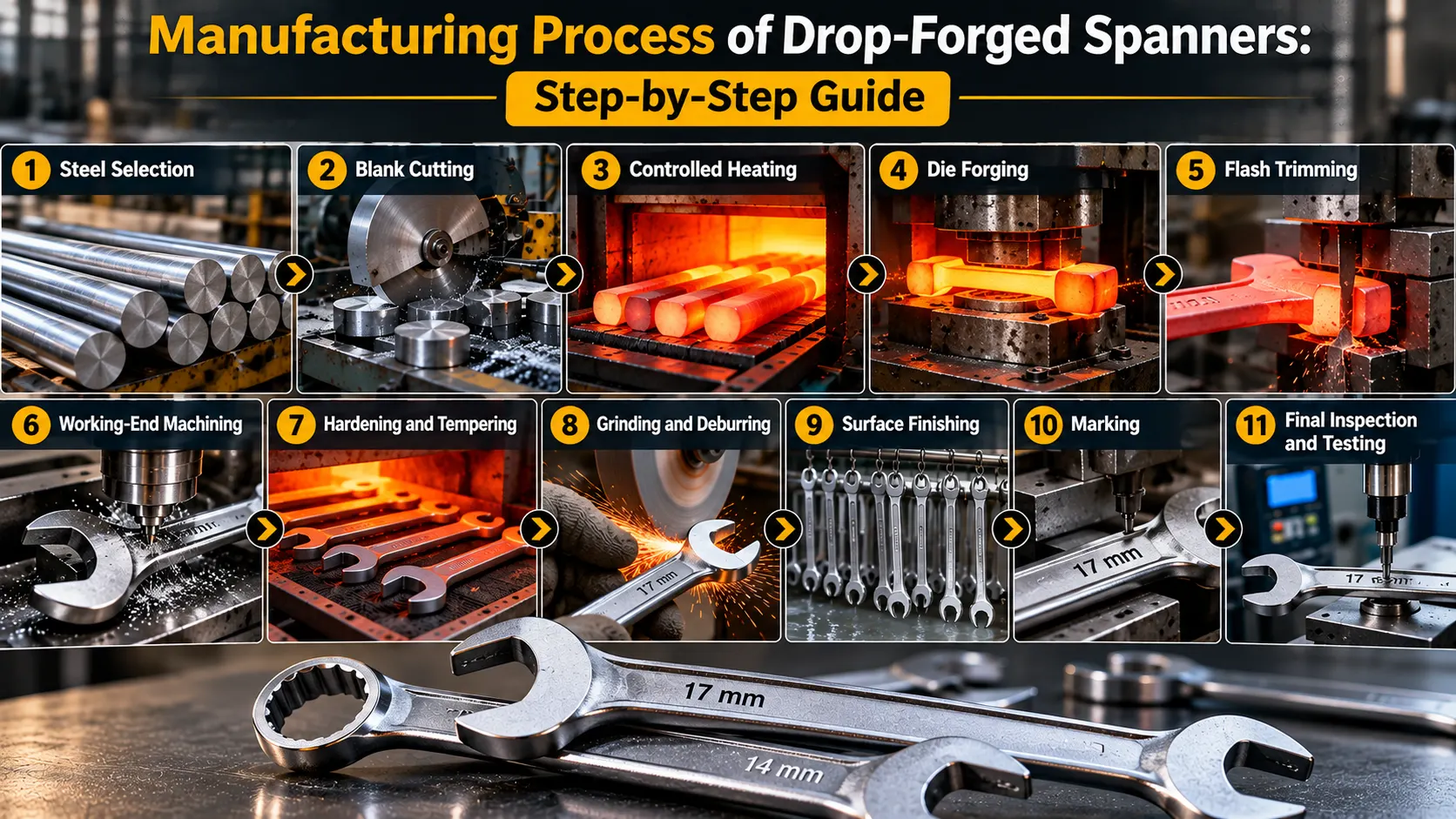
The manufacturing process of drop-forged spanners typically involves steel selection, blank cutting, controlled heating, die forging, flash trimming, machining, heat treatment, surface finishing, marking, and final inspection. During drop forging, heated steel is shaped between dies under high forging force to create the basic spanner geometry. Subsequent machining establishes functional dimensions, while heat treatment develops the required hardness and toughness.
For B2B buyers, understanding these stages helps evaluate a manufacturer‘s process control, dimensional consistency, material quality, and testing capabilities.
What Is a Drop-Forged Spanner?
A drop forged spanner is produced by forming heated steel between dies using repeated hammer blows or high forging force. The forging operation creates the basic shape of the tool, after which machining and finishing operations establish the precise working profile.
Unlike a spanner machined entirely from bar stock, drop forging forms most of the tool geometry through controlled plastic deformation. The exact production sequence varies according to the spanner design, steel grade, equipment, and applicable product specification.
Manufacturing Process of Drop-Forged Spanners
1. Steel Selection
The process starts with selecting a suitable carbon or alloy steel based on the spanner’s required mechanical properties and forging performance. Chrome-vanadium steel is commonly used for forged hand tools.
Incoming stock may be verified for:
- Steel grade and chemical composition
- Bar dimensions
- Surface condition
- Heat or batch traceability
The material choice establishes the foundation for the tool’s subsequent forging and heat-treatment performance.
2. Blank Cutting
Steel bar stock is cut into measured forging blanks. Each blank is sized to provide the material needed to form the spanner in the die.
Accurate blank weight is important, as insufficient material can cause incomplete die filling, while excessive material increases flash and trimming requirements.
3. Controlled Heating
The blanks are heated to the appropriate forging temperature for the selected steel grade.
This softens the material enough for controlled plastic flow during forging. Industrial producers may use furnaces or induction heating, with temperature monitoring used to maintain repeatable forging conditions.
4. Die Forging
The heated blank enters a shaped die and is subjected to repeated hammer blows or press force. The metal flows into the die impression, progressively forming the handle and working-end geometry.
Depending on the design, performing and final-impression stages may be used before the forged blank is released from the die.
5. Flash Trimming
Excess metal forced beyond the die cavity forms flash along the parting line. A trimming operation cuts away this material, leaving the forged blank ready for machining.
Accurate trimming prevents excess material from interfering with subsequent profile-forming operations.
6. Working-End Machining
The forged profile is refined to create the precise surfaces that engage with fasteners.
Depending on the design, this can involve:
- Punching openings
- Broaching ring profiles
- Machining open jaws
- Grinding functional surfaces
For a ring spanner, broaching establishes the internal drive profile; for an open-end design, machining establishes the jaw opening and geometry.
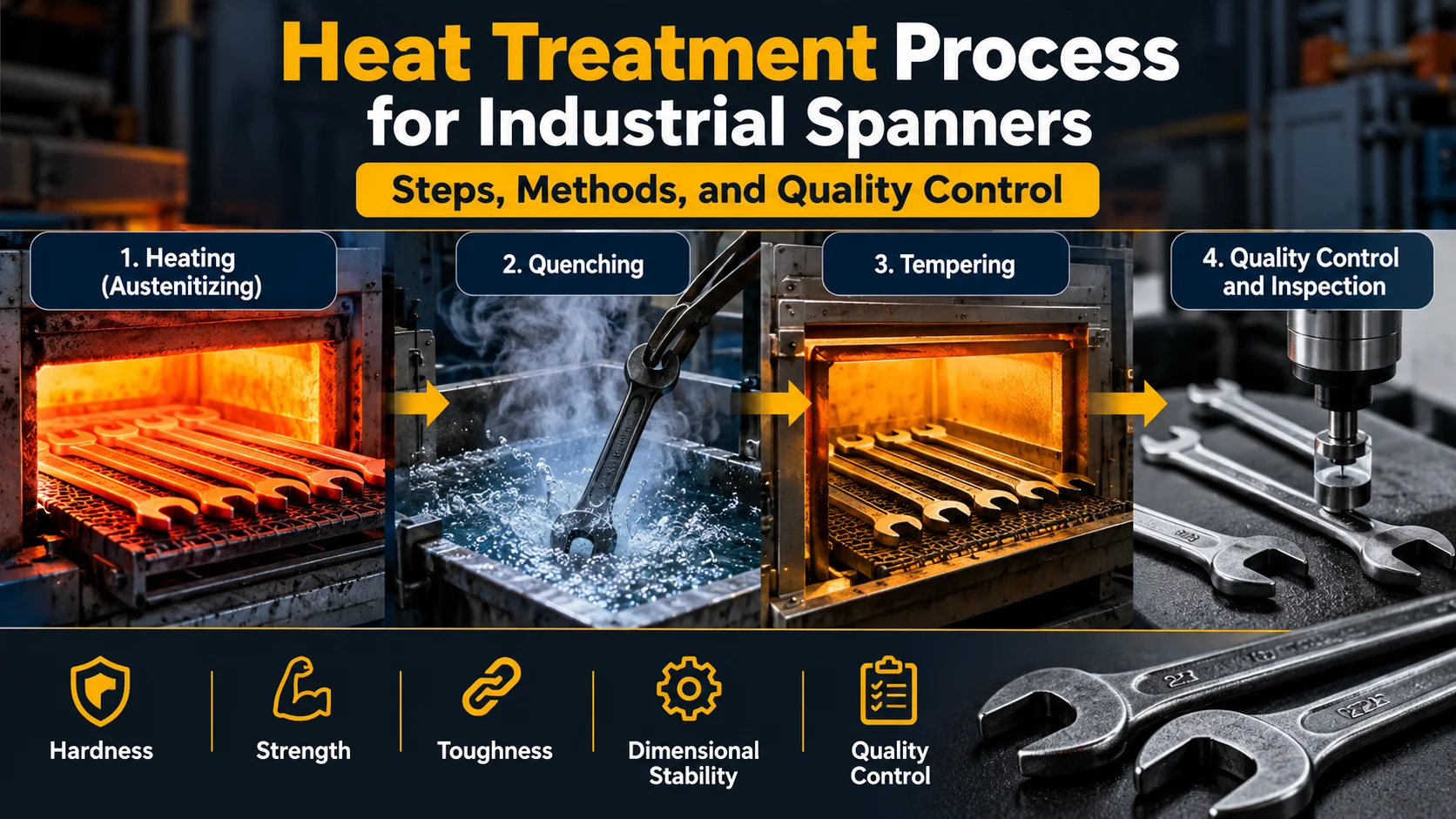
7. Hardening and Tempering
The forged spanner is heat treated to develop its required mechanical properties.
Hardening raises steel hardness, while tempering adjusts the resulting structure to achieve the required balance of hardness and toughness. The treatment cycle is selected according to the steel grade and product requirements.
Hardness testing can then verify the heat-treated condition.
8. Grinding and Deburring
Grinding removes remaining forging or machining irregularities and refines critical surfaces. Deburring eliminates sharp edges and residual material around the working areas.
Material removal is controlled carefully because excessive grinding can affect functional dimensions.
9. Surface Finishing
The spanner receives its specified surface treatment, which may include blasting, polishing, cleaning, nickel plating, chrome plating, or another protective coating.
The chosen finish serves the requirements of the product, including surface appearance and, where applicable, corrosion protection.
10. Marking
Before final inspection, the spanner is permanently identified as required. Typical markings include the nominal size, manufacturer or brand identification, and applicable product markings.
Batch or traceability information may also be added where required by the manufacturer’s quality system or customer specification.
11. Final Inspection and Testing
The finished spanner undergoes inspection to confirm that it meets the applicable drawing, standard, or purchase specification.
Quality checks may include:
- Working-end and overall dimensions
- Hardness
- Surface and workmanship inspection
- Cracks, seams, burrs, or other defects
- Torque or load testing where specified
- Marking and finish verification
For B2B sourcing, inspection criteria should be agreed upon against the applicable standard and customer specification, with test records or inspection documentation available where required.
Drop Forged Spanner Manufacturing Process Flow
Steel Selection → Blank Cutting → Controlled Heating → Die Forging → Flash Trimming → Machining/Broaching → Heat Treatment → Grinding & Deburring → Surface Finishing → Marking → Final Inspection
This is the simplified production flow. Individual factories may combine or add operations depending on the spanner design, material, forging equipment, and customer requirements.
What Happens Inside the Drop-Forging Stage?
The forging stage controls how the heated steel takes the shape of the tool.
- The blank is heated to the required forging temperature.
- The heated blank enters the die and is positioned for forming.
- Initial forming distributes the material through the die impression.
- Further forging establishes the profile of the spanner.
- Excess material forms flash around the die parting line.
- The forged component is removed for trimming and downstream operations.
This controlled deformation is what gives the process its characteristic forged shape. The forging operation does not, by itself, produce every final feature; machining, heat treatment, and finishing remain necessary.
What Determines Drop-Forged Spanner Quality?
For industrial buyers, quality is determined by the control of several connected manufacturing variables:
| Manufacturing factor | Why it matters |
| Steel grade | Determines the material’s suitability for forging and required mechanical properties |
| Blank weight | Influences die filling and flash formation |
| Heating control | Affects hot-metal flow and forging consistency |
| Die condition | Influences repeatability of the forged profile |
| Machining accuracy | Determines fit at the working ends |
| Heat treatment | Establishes the required hardness and toughness |
| Surface finishing | Controls surface condition and specified protection |
| Final inspection | Confirms conformity with drawings, standards, or customer requirements |
A consistent production process therefore matters as much as the forging operation itself.
Drop Forged Spanner Standards in India
In India, forged spanners are covered by product-specific Bureau of Indian Standards (BIS) requirements. The applicable standard depends on the spanner type. For example, IS 2028 covers forged open-jaw wrenches (spanners), while IS 2029 covers forged ring wrenches.
Depending on the product category, the applicable requirements can cover:
- Dimensions: Working profiles, sizes, and other specified dimensions
- Material: Steel grade and related material requirements
- Mechanical properties: Hardness and applicable performance requirements
- Workmanship: Surface condition, defects, and overall construction
- Finish: Requirements for the finished surface
- Marking: Size, manufacturer identification, and other specified markings
- Performance testing: Torque or other tests where required by the applicable standard
BIS standards are periodically revised, so manufacturers should verify the current edition and applicable requirements rather than relying on an older specification. BIS’s current testing framework lists 2026 editions for both open-jaw and ring wrenches.
For export orders, compliance may also involve:
- Customer drawings and technical specifications
- Agreed inspection and testing plans
- Destination-market regulations
- Applicable international or national standards
- Documentation and traceability requirements
For B2B sourcing, the practical approach is to identify the exact spanner type first, confirm the applicable current standard, and then align material selection, manufacturing controls, testing, and inspection with those requirements.
Conclusion
The manufacturing process of drop forged spanners is a controlled chain of operations rather than forging alone. Steel is prepared and heated, formed between dies, trimmed, machined, heat treated, finished, marked, and inspected before the completed tool reaches the customer.
For B2B buyers, examining these individual process controls provides a clearer basis for evaluating a supplier’s ability to produce dimensionally consistent, mechanically compliant, and specification-ready forged spanners.
FAQs
They are manufactured by cutting steel into blanks, heating the blanks, forming them between dies under high force, trimming flash, machining the working ends, heat treating, finishing, marking, and inspecting the completed tools.
The grade depends on the product specification. Chrome-vanadium and other alloy steels are commonly used for forged hand tools because their properties can be suited to the required combination of strength, hardness, and toughness.
Drop forging allows heated steel to be formed efficiently into the basic spanner geometry. Machining and finishing operations can then establish the required working dimensions and surface condition.
Heat treatment modifies the steel’s mechanical properties. Hardening increases hardness, while tempering adjusts the resulting properties to provide the required balance of hardness and toughness.
Testing depends on the applicable specification and can include dimensional inspection, hardness testing, visual/workmanship checks, and torque or load testing.