Single Open-End vs Double Open-End Spanners: Key Differences, Uses & Selection Guide
- Single Open-End vs Double Open-End Spanner: Quick Comparison
- What Is a Single Open-End Spanner?
- What Is a Double-Open-End Spanner?
- Single Open End vs Double Open End: Key Differences
- Which Is Better: Single or Double Open-End Spanner?
- DIN 894 vs DIN 895: What B2B Buyers Should Know
- Materials and Manufacturing Quality
- Buying Single and Double Open-End Spanners from India
- Conclusion
- FAQs
Single open-end and double open-end spanners are common hand tools used for tightening and loosening nuts and bolts in automotive, mechanical, assembly, and industrial maintenance applications. The main difference is the number of working ends: a single open-end spanner has one open jaw, while a double open-end spanner has two open jaws, usually covering two different sizes.
For B2B buyers, however, the choice involves more than the number of ends. Size range, access, head geometry, material, heat treatment, applicable standards, manufacturing quality, and supply capability should also be considered.
Single Open-End vs Double Open-End Spanner: Quick Comparison
| Factor | Single open-end spanner | Double Open-End Spanner |
| Working ends | One | Two |
| Size coverage | One specified size | Usually two different sizes |
| Tool inventory | More individual tools may be required | Two sizes can be combined in one tool |
| Access | Suitable for specific access requirements | Useful where either end can access the fastener |
| Application | Dedicated or specialized work | General maintenance and assembly |
| Procurement | Suitable for specific size requirements | Efficient for standard size ranges |
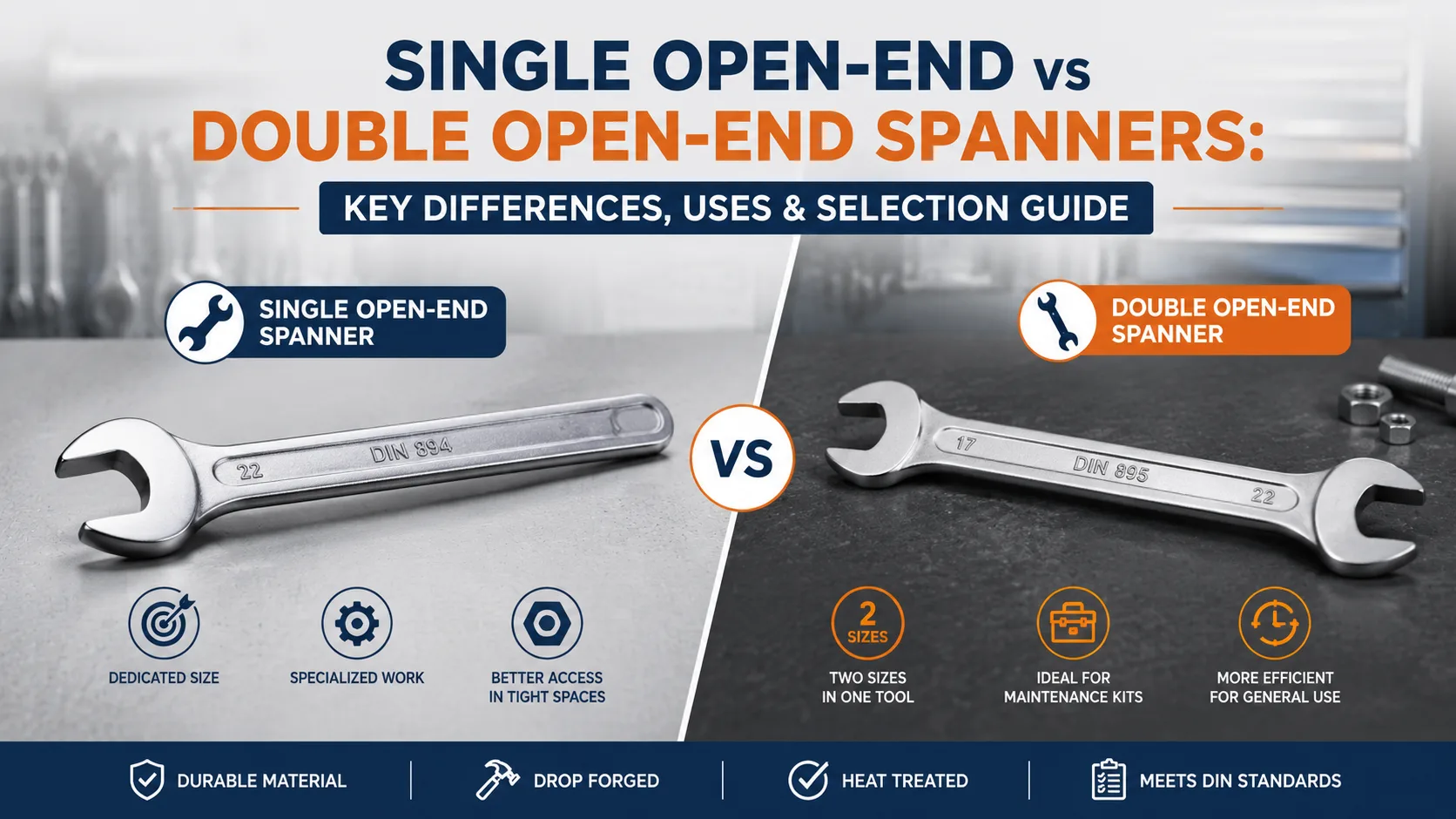
The main difference between a single open-end and double open-end spanner is the number of working jaws. A single open-end spanner has one open jaw for one specified size, while a double open-end spanner has two open jaws, generally covering two different sizes.
What Is a Single Open-End Spanner?
A single open-end spanner has one open-ended jaw designed for a specific nominal fastener size. Its dedicated configuration can be useful where one size is repeatedly required or where a particular head and handle arrangement is needed.
Single open-end spanners are used in mechanical maintenance, automotive repair, equipment servicing, industrial assembly and other applications involving accessible nuts and bolts.
Manufacturers in India offer single open-end spanners in different sizes, materials and finishes, including products specified to DIN 894.
Common Uses of Single Open-End Spanners
- Industrial machinery maintenance
- Automotive and mechanical repair
- Equipment servicing
- Assembly operations
- Applications requiring dedicated fastener sizes
- Specialized maintenance work
What Is a Double-Open-End Spanner?
A double open-end spanner has two open-ended jaws, generally designed for two different fastener sizes. One tool can therefore cover two sizes, which can be useful for maintenance teams, workshops and tool distributors managing multiple standard fastener sizes.
Indian manufacturers offer double open-end spanners in carbon steel and chrome vanadium steel, with options such as drop-forged construction, heat treatment and different surface finishes.
Common Uses of Double Open-End Spanners
- General mechanical maintenance
- Automotive workshops
- Industrial assembly
- Equipment repair
- Routine servicing
- Maintenance tool sets
Single Open End vs Double Open End: Key Differences
1. Number of Working Ends
A single open end spanner has one working jaw. A double open end spanner has two.
This is the fundamental design difference, but it does not by itself determine which tool will perform better for a particular application.
2. Size Coverage
A single open end spanner generally covers one nominal size, while a double open-end spanner typically combines two different sizes.
For example, a double open-end spanner marked 10 × 13 mm is designed to work with 10 mm and 13 mm fasteners. This can reduce the number of individual tools required for a standard maintenance range.
3. Access and Working Space
Access depends on more than whether a spanner has one or two ends. Buyers should consider jaw opening, head thickness, jaw angle, handle length and available clearance around the fastener.
Some standardized open-end designs use angled jaws to improve access and hand clearance; the exact geometry should be checked against the manufacturer’s technical drawing.
4. Tool Inventory
A double open-end spanner can provide two working sizes in one tool, making it attractive for general maintenance kits and workshops.
Single open-end spanners, on the other hand, can be preferable when each size needs to be stocked separately or when a dedicated configuration is specified.
5. Application Requirements
A single open-end spanner may be appropriate for a dedicated or specialized application. A double open-end spanner can be more practical when maintenance personnel regularly work with different fastener sizes.
Therefore, the application should determine the design—not simply the number of ends.
6. Head Geometry and Dimensions
For industrial procurement, compare more than nominal size. Check:
- Jaw opening
- Head thickness
- Jaw angle
- Overall length
- Handle dimensions
- Dimensional tolerances
These characteristics can vary by manufacturer and size. Product specifications from Indian manufacturers, for example, provide individual dimensions for length, thickness, and jaw/head measurements.
Which Is Better: Single or Double Open-End Spanner?
A double open-end spanner is generally more versatile when two fastener sizes are regularly required, while a single open-end spanner is better when a dedicated size or specific application requirement is more important. Neither design is universally better.
Choose a single open-end spanner when:
- One specific fastener size is used repeatedly.
- A dedicated tool is required for a particular application.
- Specific access or head geometry is important.
- Your technical specification calls for a single-ended design.
Choose a double open-end spanner when:
- Two sizes are regularly required.
- Tool inventory needs to be compact.
- The application involves routine maintenance.
- One tool covering two sizes improves operational efficiency.
DIN 894 vs DIN 895: What B2B Buyers Should Know
Standards should be specified clearly when purchasing industrial spanners.
DIN 894 is used for single open-end spanners, while DIN 895 is used for double open-end spanners. Indian manufacturers and exporters list their single open-end products to DIN 894 and double open-end products to DIN 895.
However, buyers should not rely only on a product title or catalog description. The RFQ should specify the required standard, dimensions, size range, tolerances and any additional customer requirements.
Materials and Manufacturing Quality
For B2B buyers, spanner design is only one part of product selection. Manufacturing quality can directly affect dimensional consistency, durability and suitability for repeated use.
Important factors include:
- Steel grade: Carbon steel and chrome vanadium steel are common options.
- Forging: Drop forging is widely used for industrial hand tools.
- Heat treatment: Hardening and tempering help achieve the specified hardness and toughness.
- Jaw accuracy: The open end should be accurately formed and finished for proper fastener engagement.
- Surface finish: Chrome, satin, phosphate, and other finishes may be specified depending on the product.
- Marking: Size, brand, and other identification should remain clear and consistent.
Indian manufacturers list forged, hardened, and tempered open-end spanners in both carbon steel and chrome vanadium steel, demonstrating the range of specifications available for B2B sourcing.
Buying Single and Double Open-End Spanners from India
When sourcing open-end spanners from India for wholesale, industrial, or export requirements, evaluate the manufacturer rather than comparing quotations on price alone.
Before placing a bulk order, verify:
- Spanner type: Single or double open end.
- Size system: Metric or imperial.
- Size range: Specify each required SKU.
- Material: Confirm the steel grade.
- Standard: Specify DIN or another applicable standard.
- Manufacturing: Check forging, machining, and heat-treatment capabilities.
- Dimensions: Confirm jaw opening, thickness, length, and tolerances.
- Finish: Specify the required surface treatment.
- Marking: Confirm logo, size, and private-label requirements.
- Quality control: Define inspection and testing requirements.
- MOQ: Confirm minimum quantity by SKU.
- Production capacity: Check whether the supplier can maintain consistent bulk supply.
- Packaging: Specify bulk, retail, or customized packaging.
- Export support: Confirm documentation and shipment requirements.
Requesting a production-representative sample before bulk production is particularly useful for verifying dimensions, finish, markings, and workmanship.
Conclusion
The choice between a single open end and double open end spanner depends on the application, fastener sizes, available access, and procurement requirements. A single open end provides a dedicated working end, while a double open end combines two sizes in one tool.
For B2B buyers sourcing spanners from India, evaluate material, forging, heat treatment, dimensional accuracy, applicable standards, quality control, production capacity, and consistency alongside price. A clear technical specification and production-representative sample can help ensure the selected spanner meets the intended application and bulk-order requirements.
FAQs
A single open end spanner has one open jaw and generally covers one fastener size. A double open end spanner has two open jaws, usually covering two different sizes, allowing one tool to serve two fastener sizes.
Not always. A double open end spanner can be more versatile for applications involving two sizes, while a single open end spanner can be better for dedicated sizes, specific access conditions, or specialized requirements.
It is used for tightening and loosening nuts and bolts in automotive, mechanical, industrial maintenance, assembly, and equipment servicing applications where a specific open-end size is required.
It is commonly used for automotive repair, industrial maintenance, mechanical assembly, and general servicing where two different fastener sizes can be handled with one tool.
Check the material, size accuracy, jaw dimensions, applicable standard, heat treatment, surface finish, markings, inspection procedures, MOQ, production capacity, packaging and export requirements.