What Is Drop Forging? Process, Types & Applications
- What Is Drop Forging?
- How Does the Drop Forging Process Work?
- What Are the Main Types of Drop Forging?
- What Materials Are Used in Drop Forging?
- What Are the Applications of Drop Forging?
- What Are the Advantages of Drop Forging?
- What Are the Limitations of Drop Forging?
- What Affects the Quality of Drop-Forged Components?
- How to Choose a Drop Forging Manufacturer
- Conclusion
- FAQs
Drop forging is a metal-forming process used to manufacture components by shaping metal between dies with repeated hammer blows. It is widely used in automotive manufacturing, hand tools, construction equipment, and industrial machinery to produce components with suitable strength, toughness, and consistent geometry.
Understanding the drop forging process, its applications, advantages, and limitations helps manufacturers and industrial buyers determine whether it is suitable for their production requirements.
What Is Drop Forging?
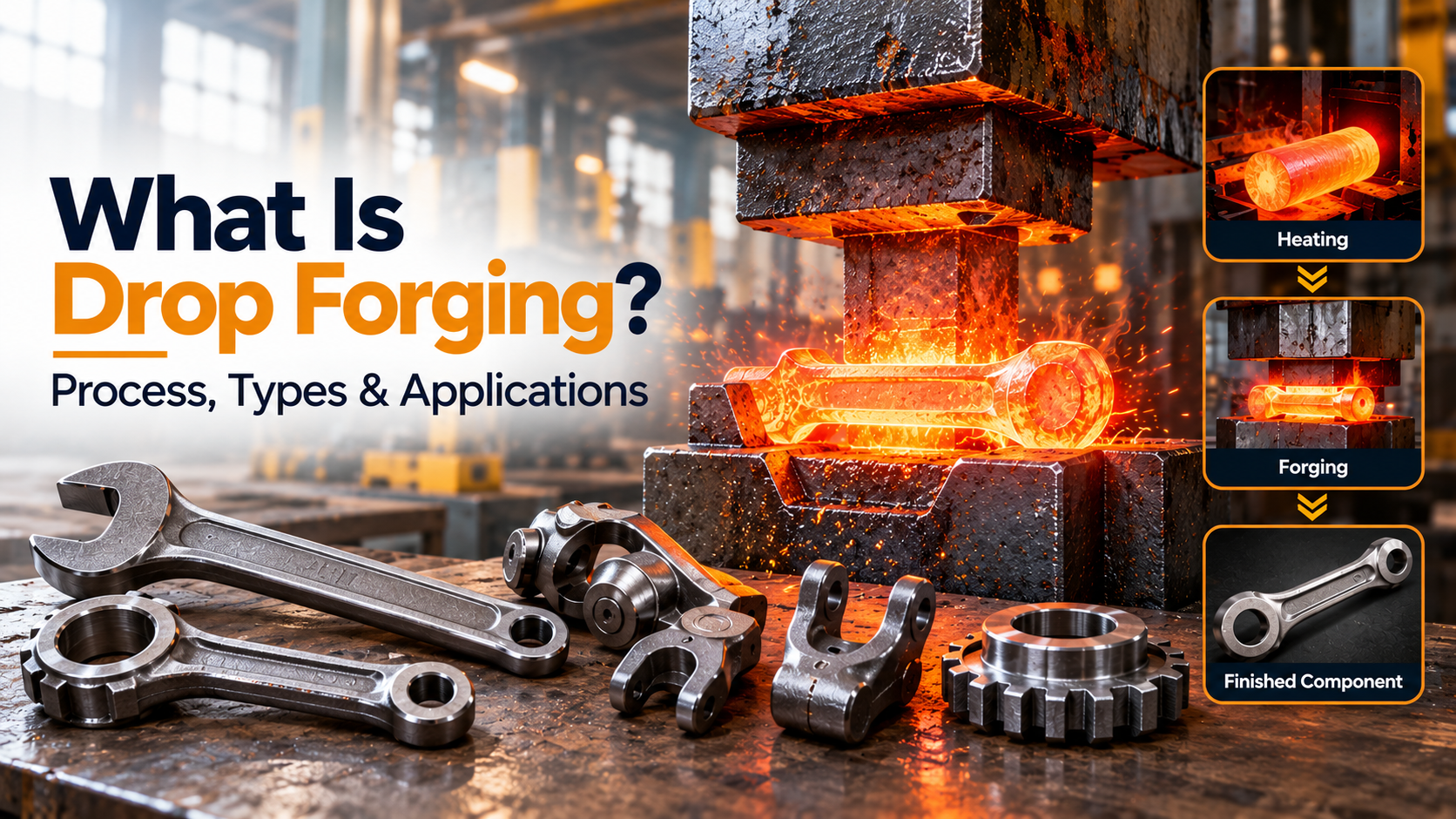
Drop forging is a metal-forming process in which a metal workpiece is shaped by repeated hammer blows between dies. The workpiece is usually heated to make it easier to deform and form into the required shape. The process is used to manufacture components such as spanners, automotive parts, and industrial machinery components.
In impression-die drop forging, the workpiece is placed between shaped die impressions that progressively form the metal. The deformation can create favorable grain flow, which may improve mechanical performance when the material and process are properly controlled.
How Does the Drop Forging Process Work?
The drop forging process generally involves six steps:
- Billet preparation: Metal stock is cut to the required size and weight based on the component design.
- Heating: The billet is heated to the appropriate forging temperature for the selected material.
- Pre-forming: Where required, preliminary die impressions distribute the metal before final shaping.
- Die forging: The billet is placed between the dies and struck repeatedly by a falling or powered hammer. The metal deforms and fills the die cavity.
- Flash trimming: In conventional impression-die forging, excess metal may escape between the dies, forming flash that is trimmed after forging.
- Finishing and inspection: The component may undergo descaling, heat treatment, machining, and dimensional or mechanical inspection according to its specifications.
The exact sequence depends on the component geometry, material, forging equipment, and quality requirements. Complex parts may require multiple die impressions to achieve the intended shape.
What Are the Main Types of Drop Forging?
Drop forging can be classified according to how the dies shape and contain the workpiece.
- Open-die drop forging: The workpiece is shaped between dies that do not fully enclose it. The metal is progressively deformed by repeated blows, making this method suitable for certain large workpieces, simpler shapes, and pre-forming operations.
- Impression-die drop forging: Shaped dies guide the metal into a defined geometry. Excess material can escape through the die parting line as flash. This method is commonly used for producing repeatable components in production runs.
- Flashless drop forging: The workpiece is formed in a cavity designed to prevent excess material from escaping. Accurate billet sizing and process control are essential to fill the cavity correctly.
The term drop forging primarily refers to hammer-based deformation, while impression-die forging describes the die arrangement. Press forging is a related process that uses sustained compressive force rather than repeated hammer impacts.
What Materials Are Used in Drop Forging?
Common materials used in drop forging include:
- Carbon steel: Used for general-purpose mechanical components and hand tools.
- Alloy steel: Selected for specific strength, toughness, wear resistance, or hardenability requirements.
- Stainless steel: Used when corrosion resistance and mechanical performance are important.
- Aluminium alloys: Suitable for applications requiring lower component weight and appropriate mechanical properties.
Material selection depends on forgeability, operating conditions, component design, and the required mechanical properties. Not every alloy is suitable for every forging method.
What Are the Applications of Drop Forging?
Drop forging is used across industries that require components with suitable mechanical strength, durability, and repeatable geometry.
1. Automotive manufacturing
Connecting rods, steering components, suspension parts, and selected drivetrain components may be forged to withstand repeated mechanical loads.
2. Hand tools
Spanners, wrenches, and pliers are common examples of drop-forged tools. Forging helps form their functional profiles while supporting the mechanical requirements of the finished product.
3. Construction and heavy equipment
Selected pins, links, hooks, levers, and other load-bearing components may be drop forged for use in construction machinery and material-handling equipment.
4. Agricultural machinery
Forged hitch components, shafts, and implement parts are used in equipment exposed to variable loads and demanding working conditions.
5. Industrial machinery
Shafts, couplings, gears, and other mechanical components may be manufactured through forging when their geometry, material, and production volume suit the process.
The choice of manufacturing method depends on component design, service loads, material specifications, and required quality levels.
What Are the Advantages of Drop Forging?
The main advantages of drop forging include:
- Favorable mechanical properties: Controlled deformation can produce beneficial grain flow and contribute to strength and toughness.
- Repeatable component geometry: Shaped dies help maintain consistency across suitable production runs.
- Efficient production at volume: Reusable tooling can support relatively high production rates once the process is established.
- Potential material savings: Near-net-shape components may require less machining than parts produced entirely from solid stock.
- Suitability for demanding applications: Properly designed forgings can perform well under impact, cyclic loading, and other challenging service conditions.
Actual performance depends on the material, forging conditions, heat treatment, component design, and quality controls.
What Are the Limitations of Drop Forging?
Despite its benefits, drop forging has several limitations:
- High initial tooling costs: Custom dies require investment in design, manufacturing, and maintenance.
- Design restrictions: Deep cavities, undercuts, and intricate geometries may be difficult or uneconomical to forge.
- Flash and surface scale: Conventional hot forging can produce excess material and oxidation, requiring additional processing.
- Secondary machining: Threads, holes, precision interfaces, and tight-tolerance surfaces may require machining after forging.
- Production-volume considerations: High tooling costs can make the process less economical for small batches or frequently changing designs.
Manufacturers should assess component complexity, expected production volume, finishing costs, and material requirements before selecting drop forging.
What Affects the Quality of Drop-Forged Components?
The quality of a forged component depends on material selection, process conditions, tooling, and post-forging operations.
- Material and billet quality: The starting material must meet the required chemical composition and quality specifications.
- Forging temperature: Incorrect temperatures can affect metal flow, surface quality, and the resulting properties.
- Die design and condition: Suitable die geometry and controlled die wear help achieve the required shape and material distribution.
- Heat treatment: Where specified, controlled heat treatment helps achieve the required hardness and mechanical properties.
- Inspection and testing: Dimensional checks, material traceability, and appropriate mechanical or other tests help verify compliance with component specifications.
Quality requirements should be established during design and confirmed through documented manufacturing and inspection procedures.
How to Choose a Drop Forging Manufacturer
Industrial buyers should assess a manufacturer’s capabilities against their component drawings and performance requirements. Important considerations include die-design expertise, material traceability, process control, heat-treatment facilities, dimensional inspection, and access to relevant mechanical testing.
Buyers should also verify production capacity, achievable tolerances, applicable certifications, and finishing capabilities. Sharing technical drawings, material grades, expected order volumes, critical dimensions, and operating conditions helps manufacturers evaluate feasibility and prepare an accurate quotation.
Conclusion
Drop forging is an established metal-forming process for manufacturing components with defined geometries and potentially favorable mechanical properties. It is used in hand tools, automotive manufacturing, construction equipment, agricultural machinery, and industrial applications.
For manufacturers and industrial buyers, choosing drop forging requires evaluating material properties, component design, production volume, tooling costs, and finishing requirements. A careful assessment of these factors helps determine whether drop forging is the right manufacturing method for a specific application.
FAQs
Drop forging is used to manufacture hand tools, automotive components, agricultural machinery parts, and selected industrial equipment components that require suitable mechanical properties.
Drop forging can produce favorable grain flow and mechanical properties compared with some cast components. However, performance depends on material, design, manufacturing conditions, heat treatment, and test results.
Carbon steel, alloy steel, stainless steel, and certain aluminium alloys are commonly forged, depending on their forgeability and the process requirements.
Yes. Impression-die drop forging can support high-volume production because reusable dies help produce consistent component shapes. Its cost-effectiveness depends on tooling investment, part complexity, and production quantity.