Modern Technologies Used in Hand Tool Production
- Core Manufacturing Stages in Hand Tool Production
- Material Preparation Technologies
- CNC Machining for Precision Components
- Forging Technologies for Structural Strength
- Laser and Waterjet Cutting Technologies
- Heat Treatment Technologies
- Surface Finishing Technologies
- Digital Quality Inspection Technologies
- CAD/CAM and Simulation Technologies
- Industry 4.0 in Hand Tool Manufacturing
- Global Manufacturing Technology Landscape
- Conclusion
- FAQs
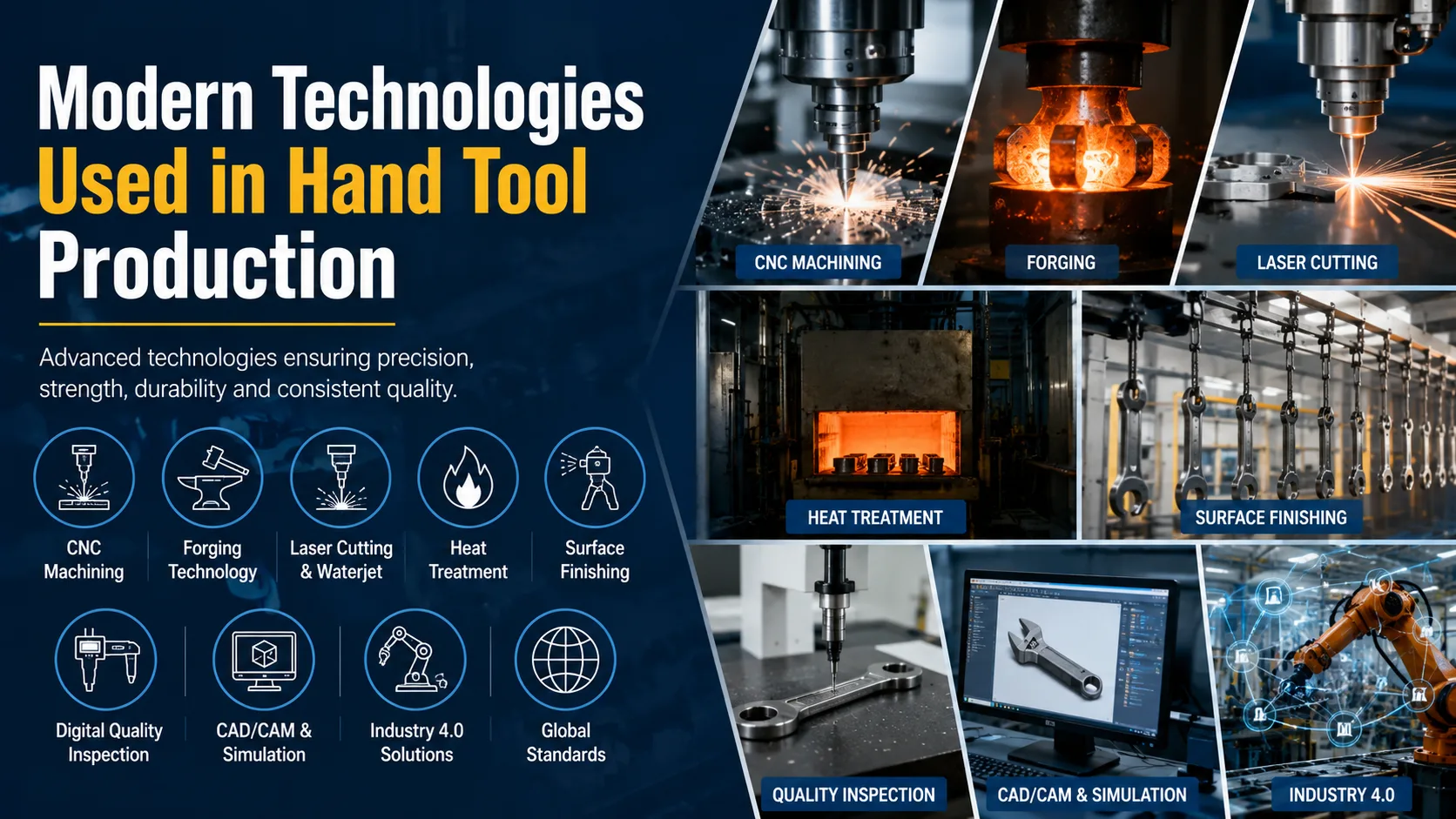
Modern hand tool production relies on advanced manufacturing technologies to ensure precision, durability, and consistency. Leading production hubs such as India, China, and Germany use these systems to meet global quality and export standards.
Core Manufacturing Stages in Hand Tool Production
Before understanding specific technologies, it is important to understand how hand tools are produced in a structured sequence. Each stage uses different technologies to control quality, precision, and performance.
- Raw material preparation and verification
- Shaping processes (forging, machining, cutting)
- Heat treatment for mechanical properties
- Surface finishing for protection and durability
- Quality inspection and validation
This stage-wise approach ensures that every technology serves a distinct role without overlap, resulting in consistent and export-grade tool production.
Material Preparation Technologies
Material preparation technologies ensure raw materials meet strict specifications before production begins.
Modern systems verify chemical composition and detect internal defects to prevent downstream failures.
- Chrome Vanadium (Cr-V) for high torque tools
- Chrome Molybdenum (Cr-Mo) for impact resistance
- Spectrometry for composition verification
- Ultrasonic testing for internal flaw detection
CNC Machining for Precision Components
CNC machining is a computer-controlled process used to shape metal components with high accuracy and repeatability.
It enables the precise manufacturing of complex geometries and tight tolerances required for critical hand-tool components.
- Multi-axis machining capabilities
- High-dimensional accuracy
- Consistent large-scale production
- Commonly used for spanners, sockets, and tool heads
Forging Technologies for Structural Strength
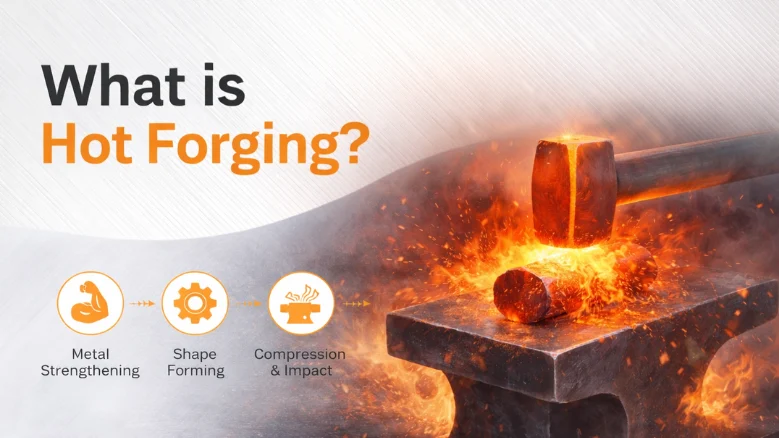
Forging technologies shape metal under high pressure to improve internal strength and structural integrity.
This process aligns the metal grain flow, producing tools capable of handling high mechanical stress.
- Closed-die and precision forging
- Temperature-controlled furnaces
- Improved grain structure
- Enhanced load-bearing strength
Laser and Waterjet Cutting Technologies
Laser and waterjet cutting are non-contact methods used for precise material cutting using heat or high-pressure water.
They enable accurate cutting based on material type without causing unnecessary distortion.
- Laser cutting for thin materials
- Waterjet for thick or heat-sensitive metals
- Minimal thermal impact
- High edge precision
Heat Treatment Technologies
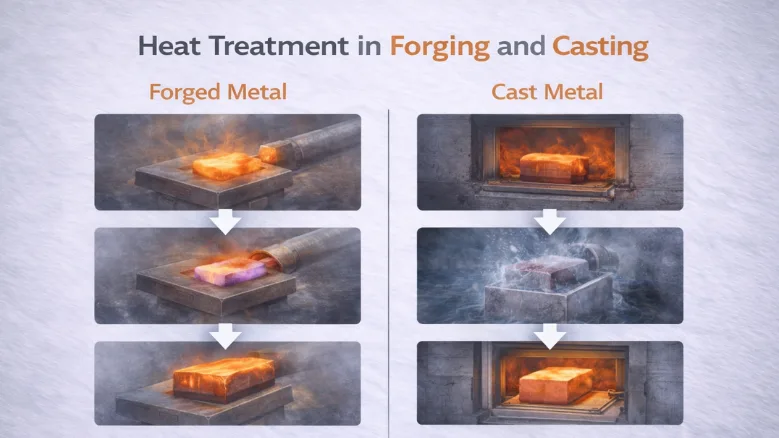
Heat treatment technologies involve controlled heating and cooling to alter the mechanical properties of metal.
These processes improve hardness, toughness, and resistance to wear.
- Induction hardening
- Vacuum heat treatment
- Controlled atmosphere furnaces
- Enhanced durability and performance
Surface Finishing Technologies
Surface finishing technologies apply protective and functional coatings to hand tools.
They improve corrosion resistance, reduce wear, and ensure a uniform surface finish for global markets.
- Electroplating (chrome, nickel)
- Powder coating systems
- Black oxide treatment
- Corrosion protection enhancement
Digital Quality Inspection Technologies
Digital quality inspection technologies use automated systems to measure and verify product accuracy.
They detect defects and ensure compliance with specifications during production.
- Coordinate Measuring Machines (CMM)
- Optical inspection systems
- Real-time defect detection
- Reduced rejection rates
CAD/CAM and Simulation Technologies
CAD/CAM technologies are used for designing and controlling manufacturing processes digitally.
They allow virtual validation and precise execution of manufacturing operations.
- 3D modeling and simulation
- Tool path optimization
- Reduced prototyping time
- Improved design accuracy
Industry 4.0 in Hand Tool Manufacturing
Industry 4.0 technologies integrate smart systems and data connectivity into manufacturing.
They enable real-time monitoring and predictive maintenance for better operational control.
- IoT-enabled machinery
- Predictive maintenance systems
- Real-time production tracking
- Data-driven decision making
Global Manufacturing Technology Landscape
The adoption of modern hand tool production technologies varies across global manufacturing hubs.
This variation influences production scale, precision capabilities, and cost efficiency for B2B buyers.
- India: Cost-efficient manufacturing with growing automation
- China: Large-scale, automation-driven production
- Germany: High-precision engineering and advanced processes
Strong focus on export-quality standards
Conclusion
Modern hand tool production combines specialized technologies across each manufacturing stage to ensure precision, durability, and consistency. For B2B buyers, understanding these technologies is essential for evaluating supplier capabilities and ensuring reliable product quality.
FAQs
Modern hand tool production uses CNC machining, forging, laser cutting, heat treatment, surface finishing, digital inspection systems, CAD/CAM design, and Industry 4.0 technologies to ensure precision and consistency.
CNC machining ensures high precision, repeatability, and consistent quality in hand tool components, making it essential for producing parts with tight tolerances and complex geometries.
Forging enhances strength by aligning the metal’s grain structure under high pressure, resulting in tools with better load-bearing capacity and resistance to mechanical stress.
Heat treatment improves hardness, toughness, and wear resistance by altering the internal structure of metal, ensuring tools perform reliably under demanding conditions.
Manufacturers use digital inspection technologies such as CMM machines and optical systems to measure accuracy, detect defects, and ensure compliance with global quality standards.