What Is Hot Drop Forging? Process & Applications
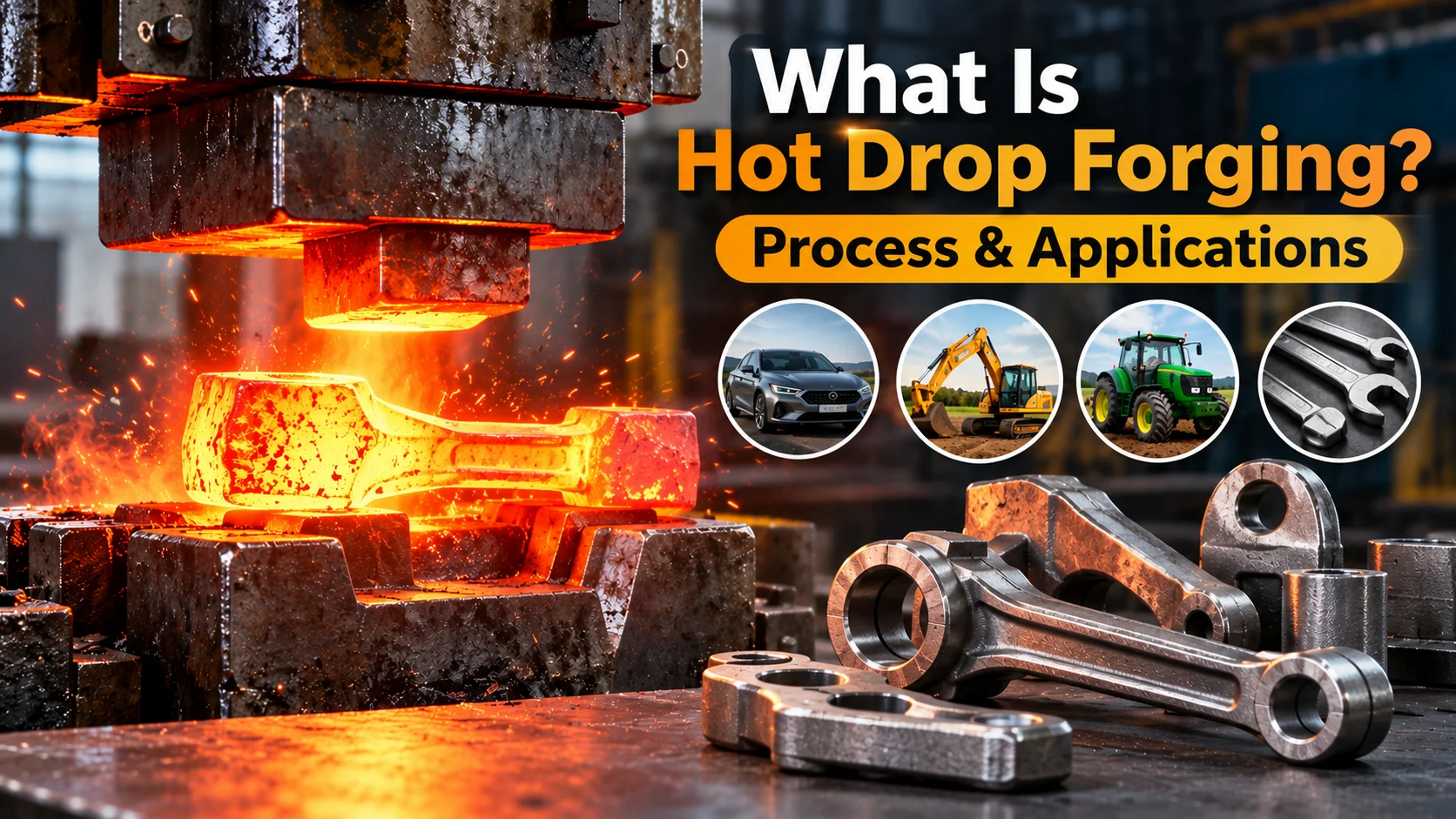
Hot drop forging is a metal-forming process in which heated metal is shaped using repeated hammer impacts and dies. It is used to manufacture durable metal components for automotive systems, construction equipment, agricultural machinery, industrial applications, and hand tools. The process combines heat, controlled impact, and die design to produce components with specific shapes and mechanical properties.
Unlike machining, which removes material to create a shape, hot drop forging plastically deforms heated metal into the required form. Its suitability depends on the material, component geometry, production volume, and performance requirements.
How Does the Hot Drop Forging Process Work?
The hot drop forging process involves six main steps: billet preparation, heating, die positioning, hammering and shaping, trimming and cooling, and finishing and inspection. Each stage helps determine the component’s dimensional accuracy, material properties, and final quality.
1. Billet Preparation
The process starts with selecting a suitable metal stock, such as carbon steel or alloy steel. The stock is cut into billets of the required size and weight, providing enough material to form the component while accounting for any excess metal.
2. Heating the Metal
The billet is heated to the appropriate forging temperature for the selected material. Heating increases its formability and reduces resistance to deformation, allowing it to take shape under impact. The temperature must be controlled to avoid defects associated with insufficient or excessive heating.
3. Positioning the Billet in the Die
The heated billet is positioned between the forging dies. The die arrangement depends on the component design and the type of drop forging being performed.
In impression-die forging, shaped cavities guide the metal into the intended profile. In open-die forging, the workpiece is deformed between dies that do not fully enclose it, allowing greater freedom of metal flow.
4. Hammering and Shaping
A forging hammer delivers repeated impacts to deform the heated billet. With each blow, the metal flows under compressive force and progressively takes the required shape.
In impression-die forging, excess material may escape between the die halves, forming a thin projection known as flash. Die design and controlled metal flow help determine how completely the cavity fills and how much excess material must be removed.
5. Trimming and Cooling
After forging, excess flash is removed where applicable. The component is then cooled under suitable conditions. Depending on the material and required mechanical properties, additional heat treatment may be necessary.
6. Finishing and Quality Inspection
The forged component is inspected for dimensional accuracy and visible defects. Secondary operations may include machining, surface finishing, heat treatment, and non-destructive testing, depending on the product specification.
Why does die design matter?
Die geometry influences metal flow, cavity filling, flash formation, and the amount of machining required. Proper process planning helps manufacturers achieve consistent components while managing material waste and production costs.
What Materials Are Used in Hot Drop Forging?
Material selection depends on the component’s strength requirements, operating conditions, weight, and intended application.
Common materials include:
- Carbon steel: Used for mechanical parts and hand tools requiring suitable strength and toughness.
- Alloy steel: Selected when specific combinations of strength, wear resistance, toughness, or hardenability are needed.
- Stainless steel: Used for components where corrosion resistance is important.
- Aluminium alloys: Suitable for applications where reducing component weight is a priority.
- Other forgeable alloys: Used for specialized components according to their material and processing requirements.
Each material requires appropriate forging temperatures and process controls. The final properties also depend on deformation conditions, cooling, and any subsequent heat treatment.
What Are the Applications of Hot Drop Forging?
Hot drop forging is used across industries that require shaped metal components with suitable mechanical properties and the ability to withstand operational loads.
1. Automotive Industry
Applications include connecting rods, steering components, suspension parts, and other suitable mechanical components. The choice of forging process depends on the part’s geometry, material, and production requirements.
2. Construction and Heavy Equipment
Construction machinery operates under demanding conditions involving impact, vibration, and repeated loading. Hot drop forging can produce suitable links, levers, and other mechanical components used in heavy equipment.
3. Agricultural Machinery
Tractors and agricultural machines use components that must withstand regular mechanical stress. Forging is suitable for selected parts where durability and resistance to service loads are important.
4. Industrial Machinery
Forged shafts, levers, gear blanks, and other mechanical components are used in industrial equipment. The process is particularly useful when a component’s design and required properties justify die-based metal forming.
5. Hand Tools
Spanners, wrenches, hammers, and similar tools are common applications of drop forging. The process forms the basic tool profile, while subsequent heat treatment and finishing help achieve the required hardness, toughness, and dimensional accuracy.
The suitability of hot drop forging for any application depends on the component design, material, performance requirements, and production volume.
What Are the Advantages of Hot Drop Forging?
The main advantages of hot drop forging include:
- Suitable mechanical properties: Controlled forging can refine the metal’s grain structure and produce directional grain flow that follows the component’s shape.
- Complex external profiles: Shaped dies can produce component geometries that may require extensive machining when made from solid stock.
- Lower deformation resistance: Heating makes many metals easier to shape than they are at room temperature.
- Repeatable production: Properly designed dies and controlled operating conditions support consistency across production runs.
- Potential material savings: Near-net-shape forging can reduce machining requirements, although flash and machining allowances may still generate waste.
These benefits are not automatic. Component performance depends on material quality, die design, process control, and any subsequent heat treatment.
What Are the Limitations of Hot Drop Forging?
Despite its advantages, hot drop forging has several limitations:
- High tooling costs: Custom dies require an initial investment, which may be difficult to justify for low-volume production.
- Oxidation and scale: Heating can produce surface scale that needs to be removed.
- Secondary machining: Critical dimensions, holes, and surface finishes may require additional operations.
- Die wear: Repeated impact can wear the dies, creating maintenance and replacement costs.
- Process-control requirements: Incorrect temperatures, die design, or forging conditions can cause defects and inconsistent results.
Manufacturers should assess these limitations alongside component performance, production volume, and overall manufacturing costs.
Hot Drop Forging vs. Press Forging
The main difference between hot drop forging and hot press forging is how the force is applied to shape the metal.
| Factor | Hot drop forging | Hot press forging |
| Force application | Repeated hammer impacts | Sustained compressive force |
| Deformation | Occurs progressively through impact blows | Occurs through controlled pressing |
| Typical equipment | Forging hammer and dies | Mechanical or hydraulic press and dies |
| Process selection | Depends on geometry, material, and production needs | Depends on geometry, material, and production needs |
Both methods can produce useful forged components. The appropriate method depends on component specifications, tooling investment, production rate, and manufacturing constraints.
Conclusion
Hot drop forging is a valuable manufacturing process for producing shaped metal components used in automotive systems, construction equipment, agricultural machinery, industrial applications, and hand tools. By combining controlled heating, hammer impact, and die-based shaping, manufacturers can produce components suited to demanding mechanical applications. Material selection, die design, process control, and quality inspection remain essential to achieving the required results.
FAQs
Hot forging is a broad metal-forming category in which metal is shaped at an elevated temperature. Hot drop forging is a specific method that uses repeated hammer impacts to deform the heated workpiece.
Yes. Carbon steel and alloy steel are commonly used in hot drop forging. The appropriate steel grade and processing conditions depend on the component’s intended application and required properties.
It enables manufacturers to form tool profiles using dies. Suitable material selection, controlled forging, heat treatment, and finishing help achieve the required dimensions, hardness, and toughness.
Forged parts can offer advantages in grain flow, toughness, and fatigue performance compared with some cast parts. However, the result depends on the material, component design, processing conditions, and properties being compared.