How JCBL Hand Tools Tests Spanners Before Bulk Supply
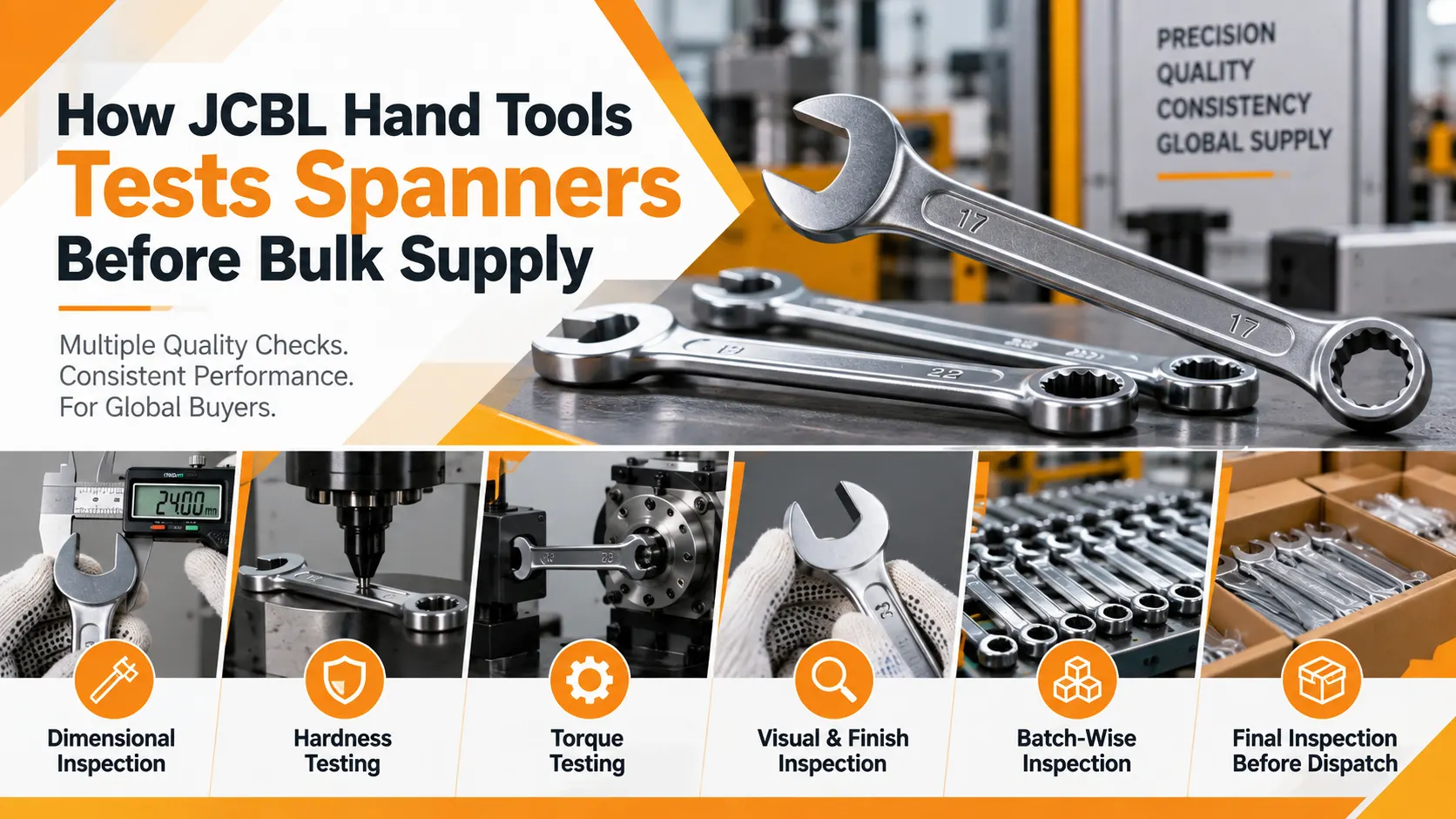
For bulk buyers, spanner quality cannot be judged by appearance alone. JCBL Hand Tools tests spanners through dimensional inspection, hardness testing, torque testing, visual checks, and batch-wise quality control before bulk supply. These checks help verify that finished spanners meet defined product specifications and maintain consistent quality across production lots.
For importers, distributors, wholesalers, and industrial buyers sourcing spanners from India, this testing process is important because quality must remain consistent across hundreds or thousands of tools, not just a single sample.
What Tests Are Performed on Spanners Before Bulk Supply?
Before bulk supply, spanners are checked for dimensional accuracy, hardness, torque strength, finish, batch consistency, and final quality.
1. Dimensional Inspection
What is checked: Spanner size, jaw opening, head geometry, thickness, overall dimensions, and critical contact areas.
Why it matters: Accurate dimensions ensure proper fastener engagement and consistent fit across the production batch.
JCBL includes dimensional inspection in its quality-control process for spanners and wrenches.
2. Hardness Testing
What is checked: The hardness of the finished spanner after manufacturing and heat treatment.
Why it matters: Appropriate hardness helps the tool resist wear and deformation while meeting specified mechanical requirements.
ISO 1711-1:2019 specifies minimum Rockwell hardness and torsional-strength requirements for covered hand-operated wrenches and sockets, including open-end wrench series.
JCBL includes hardness testing among its spanner quality checks.
3. Torque and Torsional-Strength Testing
What is checked: The spanner’s ability to withstand specified torque without unacceptable deformation or failure.
Why it matters: Torque testing verifies mechanical strength under load—an essential check for tools intended for demanding applications.
JCBL includes torque testing in its quality-control process for spanners.
4. Visual and Finish Inspection
What is checked: Surface defects, cracks or abnormalities, forging or machining irregularities, finish consistency, markings, and overall workmanship.
Why it matters: Visual inspection helps ensure that bulk orders meet the agreed product specification and presentation requirements.
5. Batch-Wise Spanner Inspection
Bulk supply requires consistent quality across the production lot, not just a single passing sample.
JCBL carries out batch-wise quality inspection covering key parameters such as:
- Dimensions
- Hardness
- Torque performance
- Finish and workmanship
This helps maintain consistency across large-volume orders for importers, distributors, wholesalers, OEMs, and private-label buyers.
For bulk supply, quality means consistent performance and specifications across the production batch, not simply one spanner passing inspection.
6. Final Inspection Before Dispatch
Before shipment, the finished batch is checked against the applicable product and customer requirements.
Final checks may include:
- Dimensional and visual verification
- Hardness and torque requirements
- Product markings
- Quantity
- Packaging and labeling
- Customer-specific specifications
JCBL’s published OEM-quality guidance describes final batch inspection before packaging and dispatch, including sampling, visual and dimensional checks, packaging and labeling verification, quantity checks, and documentation review.
Which Standards Apply to Spanner Testing?
The applicable standard depends on the spanner type, market, customer specification, and intended application.
For international requirements, ISO 1711-1:2019 is an important reference for hand-operated wrenches and sockets because it specifies minimum Rockwell hardness and torsional-strength values.
JCBL states that its spanners and wrenches are manufactured according to applicable DIN and ANSI standards and that its range is GS-certified for safety assurance.
For B2B procurement, buyers should therefore confirm the exact standard, specification, and testing requirements applicable to the particular spanner being ordered rather than assuming that one standard applies to every product.
How JCBL Hand Tools Controls Spanner Quality Before Supply
JCBL’s published quality information describes a testing approach built around multiple inspection points rather than a single final check.
The process can be summarized as:
Production → Dimensional Inspection → Hardness Testing → Torque Testing → Visual Inspection → Batch Quality Control → Final Inspection → Dispatch
JCBL also states that it manufactures spanners in India for bulk supply and supports distributors, wholesalers, importers, and industrial buyers, along with OEM and private-label requirements.
The advantage of this multi-stage approach is that different tests address different quality characteristics. Dimensional inspection checks fit and geometry; hardness testing verifies a key material property; torque testing evaluates mechanical performance; and batch inspection focuses on consistency across production.
What Should B2B Buyers Check When Choosing a Spanner Manufacturer?
Before placing a bulk order, procurement teams should ask:
- Does the manufacturer perform dimensional inspection?
- Is hardness testing part of the quality process?
- Is torque or torsional-strength testing conducted?
- Are inspections performed batch-wise?
- Which DIN, ANSI, ISO, or other applicable requirements are followed?
- Can the supplier maintain consistency across repeat orders?
- Can customer-specific specifications be accommodated?
- Does the manufacturer support OEM or private-label requirements?
These questions help buyers evaluate a supplier’s spanner quality-control system, rather than judging the product solely on price or appearance.
Conclusion
Spanner quality is not established by appearance alone. Dimensional inspection, hardness verification, torque testing, visual checks, and batch-level quality control each address a different aspect of finished-tool performance.
For businesses sourcing spanners from India, the quality of the supplier’s testing and inspection system is therefore an important part of procurement. A manufacturer capable of maintaining defined specifications and consistent performance across bulk production provides greater confidence for distributors, importers, OEMs, and industrial buyers.
JCBL Hand Tools manufactures spanners in India and provides bulk, OEM, and private-label supply for international markets, with quality controls covering dimensional inspection, hardness testing, torque testing, and batch-wise inspection.
FAQs
Spanners can be tested through dimensional inspection, hardness testing, torque or torsional-strength testing, visual inspection, and batch-level quality checks. The exact tests and acceptance criteria depend on the product specification, applicable standards, and customer requirements.
Torque testing evaluates how a spanner responds to an applied load. It helps verify torsional strength and whether the tool can withstand the specified torque without unacceptable deformation or failure.
Hardness testing helps verify an important mechanical property of the finished tool. It can indicate whether the material and heat-treatment process have achieved the required hardness for the intended application.
Depending on the product specification, dimensional inspection can cover the spanner opening, head geometry, thickness, overall dimensions, and other critical areas that affect proper engagement with fasteners.
ISO 1711-1:2019 specifies minimum Rockwell hardness and torsional strength values for covered hand-operated wrenches and sockets, including open-end wrench series.
Batch inspection helps manufacturers verify consistency across a production lot. This is especially important for importers, distributors, and industrial buyers purchasing large quantities under defined product specifications.
Related Readings:
- Why Choose JCBL Hand Tools for OEM and Bulk Spanner Sourcing?
- What Makes JCBL Hand Tools Different From Other Spanner Manufacturers?
- Why Global Buyers Source Spanners From JCBL Hand Tools?
- How JCBL Hand Tools Manufacture Spanners for Consistent Performance
- How JCBL Hand Tools Controls Quality Across Spanner Production