What Is Press Forging? Process, Types, Advantages & Applications
- What Is Press Forging?
- How Does the Press Forging Process Work?
- What Are the Different Types of Press Forging?
- What Are the Advantages of Press Forging?
- What Are the Industrial Applications of Press Forging?
- Press Forging vs Drop Forging: What Is the Difference?
- What Are the Limitations of Press Forging?
- How Do You Choose the Right Press Forging Process?
- Conclusion
- FAQs
Press forging is a metal-forming process that uses sustained compressive force to shape metal into specific components. Unlike drop forging, which relies on repeated impact blows, press forging applies controlled pressure through a mechanical, hydraulic, or screw press. The process can use open or closed dies and hot, warm, or cold working conditions to manufacture components for automotive, aerospace, and heavy engineering applications.
What Is Press Forging?
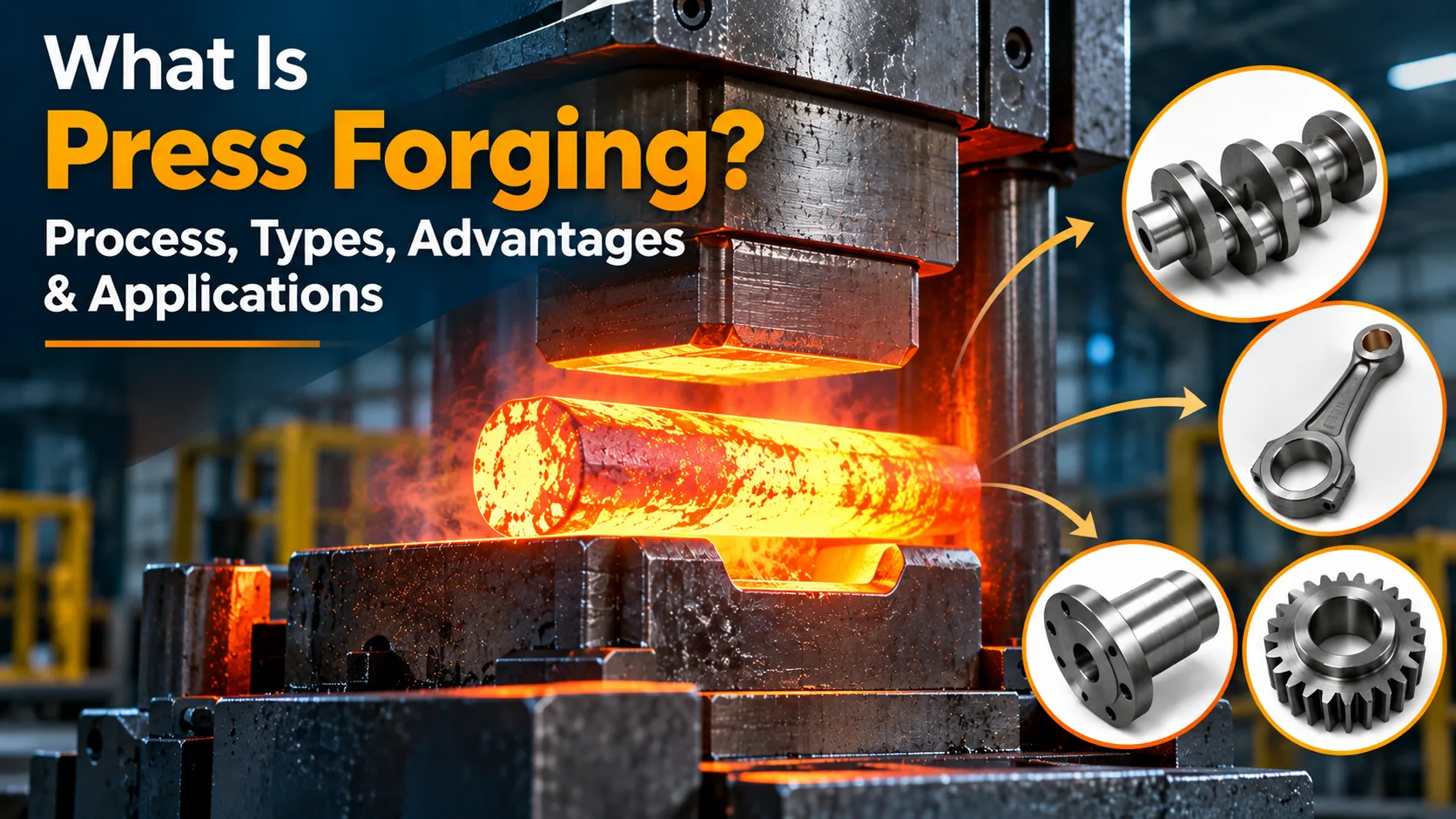
Press forging is a metal-forming process in which a mechanical or hydraulic press applies sustained compressive force to shape a metal workpiece using dies. Unlike conventional hammer or drop forging, which relies on repeated impact blows, press forging deforms the workpiece through a controlled pressing action.
The process can use open or closed dies and can be performed under hot, warm, or cold working conditions, depending on the material and component design. Press forging is used to manufacture components such as shafts, axles, and connecting rod blanks where controlled deformation, suitable mechanical properties, and repeatable production are important.
How Does the Press Forging Process Work?
The press forging process transforms a metal billet into a specified shape through five main stages.
1. Material selection and cutting
The manufacturer selects a suitable metal, such as carbon steel, alloy steel, stainless steel, or an aluminum alloy. The raw material is cut into billets or blanks sized for the component.
2. Heating the workpiece
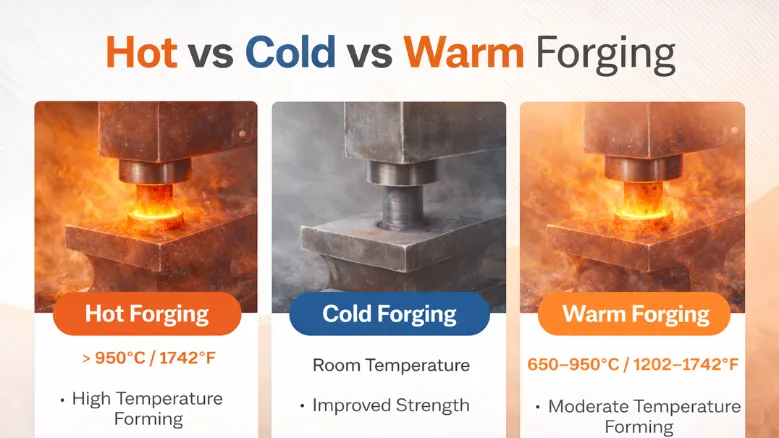
For hot press forging, the billet is heated to a suitable working temperature to improve its formability and reduce resistance to deformation. Cold forging is generally performed at or near room temperature, while warm forging uses intermediate temperatures.
3. Positioning the billet
The billet is placed between the dies and aligned with the intended forming geometry. Correct positioning helps control material flow and prevents defects caused by improper loading.
4. Applying pressure
The press drives one die toward the other, compressing the workpiece. The metal undergoes plastic deformation and takes the shape defined by the dies. Depending on the process, the operation may be completed in one pressing stage or several stages.
5. Finishing and inspection
The forged component may undergo trimming, heat treatment, machining, and dimensional inspection. Manufacturers select these operations according to the required tolerances, surface finish, and mechanical properties.
The quality of the final forging depends on material condition, die design, press capacity, temperature control, and process parameters.
What Are the Different Types of Press Forging?
Press forging can be classified by the equipment used, die configuration, and working temperature. These classifications describe separate aspects of the manufacturing process.
1. Types Based on Press Mechanism
- Hydraulic press forging: Uses hydraulic fluid pressure to move the ram and apply sustained force. It is suitable for operations requiring controlled deformation and substantial pressing force.
- Mechanical press forging: Uses a mechanical drive, such as a crank or eccentric mechanism, to move the ram. It is commonly used for repetitive production where stroke characteristics and cycle time matter.
- Screw press forging: Uses a screw-driven mechanism to deliver force and energy to the dies. Its suitability depends on the component, required forming energy, and production conditions.
2. Types Based on Die Configuration
- Open-die press forging: Compresses metal between dies that do not fully enclose the workpiece. The metal can spread laterally, making the process suitable for large or relatively simple components, including shafts and blocks.
- Closed-die press forging: Uses shaped die cavities to guide metal flow into a defined geometry. It is suitable for components with more detailed shapes and repeatable dimensional requirements. Excess material may form flash that must be removed.
3. Types Based on Working Temperature
- Hot press forging: Forms metal at an elevated temperature that improves its ability to deform. It is useful for substantial shape changes.
- Warm press forging: Forms metal at an intermediate temperature, balancing formability with dimensional and surface-quality requirements.
- Cold press forging: Forms metal at or near room temperature. It can produce good surface finishes and dimensional accuracy but generally requires higher forces for comparable deformation.
The appropriate combination depends on the metal grade, component geometry, production volume, tooling, and required properties.
What Are the Advantages of Press Forging?
Press forging offers several benefits when the equipment and process are matched to the component.
- Controlled deformation: Sustained loading allows manufacturers to manage the forming operation through press movement, force, and tooling design.
- Deformation through thick sections: Suitable presses can apply force that produces substantial deformation through the workpiece, depending on its dimensions and material.
- Repeatable component geometry: Consistent machine settings and properly maintained dies help control variation across production batches.
- Favourable mechanical properties: Forging can refine the metal’s microstructure and create directional grain flow, potentially improving strength and fatigue performance in the intended loading direction.
- Potential material savings: Appropriate billet sizing and die design can reduce excess material and subsequent machining.
- Flexible process configurations: Different press mechanisms, dies, and temperature conditions allow manufacturers to select a suitable method for a range of parts.
These benefits are not automatic. Final performance depends on the alloy, deformation conditions, grain flow, heat treatment, and quality controls.
What Are the Industrial Applications of Press Forging?
Press forging is used to manufacture metal components across industries where geometry and mechanical performance are important.
| Industry | Typical applications |
| Automotive | Axles, crankshaft blanks, connecting rods, and selected transmission components |
| Heavy engineering | Large shafts, gear blanks, and heavy-duty machine components |
| Oil and gas | Selected flanges, valve components, and other engineered forged parts |
| Aerospace | Qualified structural and mechanical components made under stringent process controls |
| Industrial machinery | Drive components, bearing-related parts, and load-bearing machine elements |
The manufacturing method varies by component size, alloy, operating conditions, and required specifications. Critical applications may also require material traceability, mechanical testing, nondestructive examination, and documented process qualification.
Press Forging vs Drop Forging: What Is the Difference?
Press forging and drop forging differ primarily in how force is applied to the workpiece.
| Factor | Press forging | Drop forging |
| Force application | Sustained compressive force | Repeated impact blows |
| Deformation control | Managed through press movement and loading parameters | Managed through hammer energy and blow sequence |
| Contact time | Generally longer | Generally shorter per impact |
| Process considerations | Press capacity, deformation rate, and die heating | Impact energy, blow sequence, and material flow |
| Selection factors | Component geometry, required deformation, and production economics | Component geometry, impact-based forming suitability, and production economics |
Both methods can produce high-quality forged components. The better choice depends on the part design, alloy, tooling, production volume, and required properties rather than on the process name alone.
What Are the Limitations of Press Forging?
The main limitations of press forging are:
- High initial investment: Industrial presses, supporting equipment, and tooling can require significant capital.
- Tooling and setup costs: Complex geometries may need specialized dies and multiple forming stages.
- Cycle-time constraints: Sustained deformation may take longer than impact-based operations in some applications.
- Process sensitivity: Poor temperature control, unsuitable lubrication, or incorrect die alignment can cause defects and inconsistent material flow.
- Design restrictions: The press capacity, die arrangement, and material formability limit which shapes can be produced economically.
Manufacturers should compare these costs and constraints with the component’s performance requirements and expected production volume.
How Do You Choose the Right Press Forging Process?
Selecting a suitable press forging method requires evaluating five factors:
- Component size and geometry: Large shafts may suit open-die forging, while components with detailed contours may require closed-die tooling.
- Material grade: The alloy determines forming temperature, deformation resistance, and suitable process conditions.
- Required tolerances: Dimensional accuracy and surface finish affect tooling design and the amount of subsequent machining.
- Production volume: High tooling costs may be easier to justify for larger production runs, while simpler tooling may suit smaller quantities.
- Quality requirements: Mechanical testing, heat treatment, inspection, and traceability must match the component’s intended service.
For example, a manufacturer producing a large steel shaft in relatively low quantities may evaluate open-die press forging because it avoids the need for a complex impression die. A high-volume component with detailed contours may be better suited to closed-die forging if the tooling investment is justified. The final decision requires assessment of the actual drawing, material, tolerances, and production economics.
Conclusion
Press forging shapes metal through sustained compressive force, offering manufacturers control over deformation and the potential to produce components with suitable mechanical properties and repeatable geometry. Choosing between hydraulic, mechanical, or screw presses and between open-die and closed-die configurations, depends on material, component design, tolerances, and production volume. A well-selected process balances part quality, tooling costs, and manufacturing efficiency.
FAQs
Press forging is the forming process, while hydraulic forging refers to press forging performed using a hydraulic press. Press forging can also use mechanical or screw-driven presses.
Press forging can be performed hot, warm, or cold. The appropriate temperature depends on the material, required deformation, dimensional requirements, and component design.
Common materials include carbon steel, alloy steel, stainless steel, and aluminium alloys. Suitability depends on the alloy’s formability, equipment capacity, and required component properties.
Common examples include shafts, axles, crankshaft blanks, connecting rods, gear blanks, and selected industrial machine components. The specific products depend on the die configuration and manufacturing requirements.