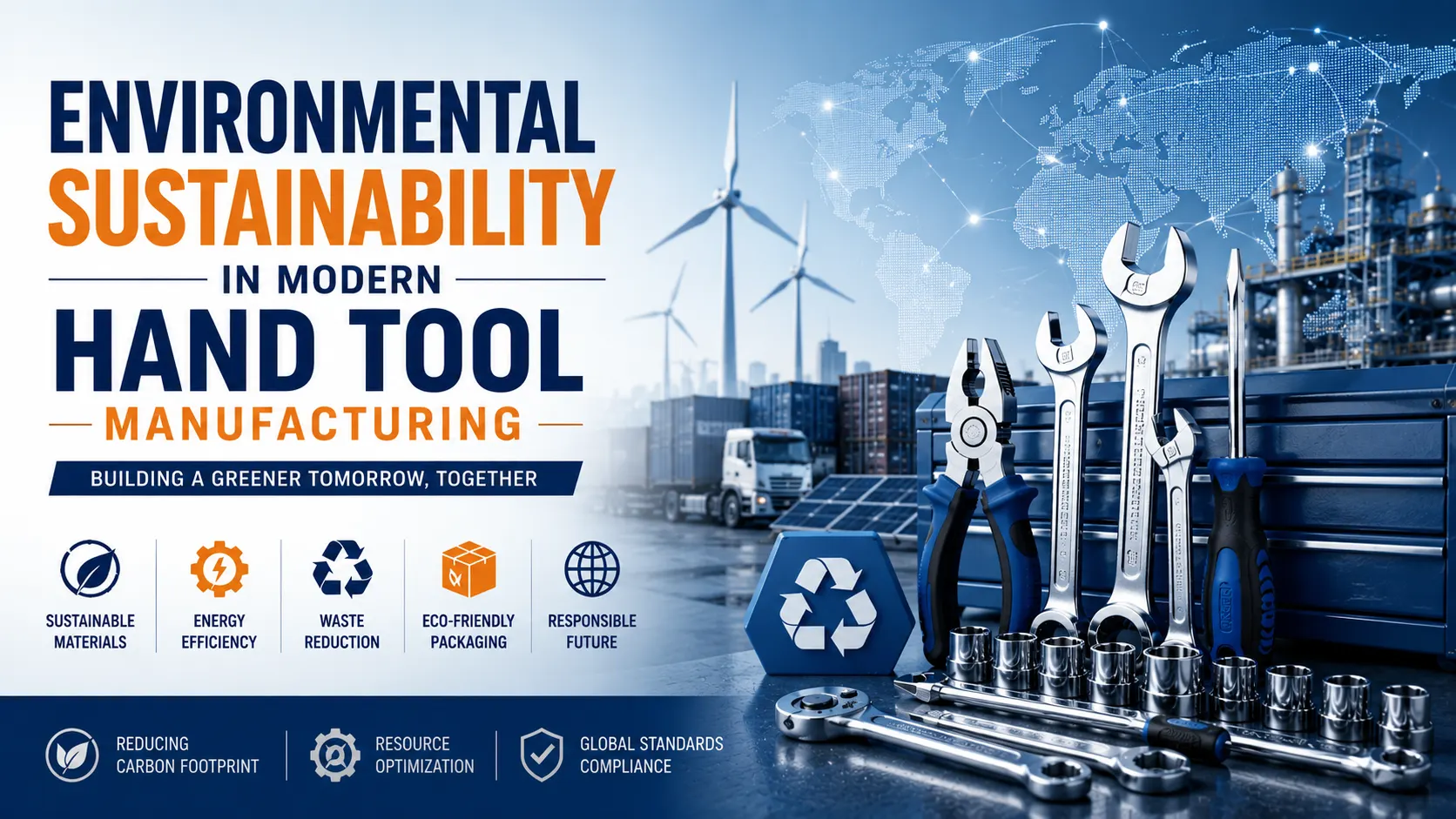
Environmental Sustainability in Modern Hand Tool Manufacturing
- Key Takeaways
- What is Environmental Sustainability in Hand Tool Manufacturing?
- Why Sustainability is Becoming Critical in the Hand Tools Industry
- Core Pillars of Sustainable Hand Tool Manufacturing
- Role of India in Sustainable Hand Tool Manufacturing
- Certifications and Standards That Define Sustainable Manufacturing
- Benefits of Sustainable Hand Tool Manufacturing for B2B Buyers
- Key Challenges in Implementing Sustainable Manufacturing
- Emerging Trends in Sustainable Hand Tool Manufacturing
- Checklist: How to Evaluate a Sustainable Hand Tool Supplier
- Conclusion
- FAQs
Environmental sustainability in hand tool manufacturing refers to designing, sourcing, producing, and distributing tools in ways that minimize environmental impact across their entire lifecycle. This includes responsible raw material use, energy-efficient production, waste reduction, and sustainable logistics, while maintaining durability, performance, and compliance with global standards.
Key Takeaways
- Environmental sustainability in hand tool manufacturing focuses on reducing carbon footprint, optimizing resources, and ensuring lifecycle efficiency.
- Modern manufacturers adopt practices like energy-efficient forging, recycled materials, and Circular Economy principles to minimize environmental impact.
- Compliance with standards such as ISO 14001 and alignment with ESG expectations are becoming essential for global B2B sourcing.
- Sustainable manufacturing delivers long-term benefits, including cost efficiency, regulatory compliance, and supply chain reliability.
- India is emerging as a competitive hub for sustainable hand tool manufacturing, offering a balance of cost, scalability, and evolving green practices.
What is Environmental Sustainability in Hand Tool Manufacturing?
Environmental sustainability in hand tool manufacturing is the strategic reduction of ecological impact through responsible sourcing, energy-efficient forging, and circular waste management. It focuses on maintaining tool durability while complying with global ESG (Environmental, Social, and Governance) and ISO 14001 standards.
Environmental sustainability in hand tool manufacturing is a lifecycle-driven approach that reduces ecological impact at every stage:
- Raw material sourcing (e.g., recycled or responsibly sourced steel)
- Manufacturing processes (energy use, emissions, water consumption)
- Packaging and distribution (materials, transport efficiency)
- Product lifecycle (durability, repairability, recyclability)
For B2B buyers, it is not just an environmental concern; it is a critical supply chain and compliance factor.
Why Sustainability is Becoming Critical in the Hand Tools Industry
Sustainability has evolved from a “nice-to-have” to a core procurement requirement. Key drivers include:
- Global ESG expectations: OEMs and distributors increasingly require environmentally responsible sourcing
- Export compliance: Markets in Europe and North America are tightening environmental regulations
- Total cost efficiency: Energy-efficient production and reduced waste lower long-term operational costs
- Risk management: Sustainable practices reduce exposure to regulatory and supply chain risks
As a result, buyers now evaluate suppliers not only on price and quality but also on environmental performance, transparency, and compliance readiness.
Traditional vs Sustainable Hand Tool Manufacturing
| Feature | Traditional Manufacturing | Sustainable Manufacturing |
| Primary Material | Virgin Steel | Recycled or Low-Impact Alloys |
| Energy Source | High-carbon Grid Power | Energy-optimized Forging / Renewables |
| Waste Strategy | Scrap Disposal | Circular Reuse & Lean Manufacturing |
| Surface Finish | Chemical-intensive Coatings | Eco-friendly / Low-emission Coatings |
Core Pillars of Sustainable Hand Tool Manufacturing
To achieve meaningful environmental sustainability, modern hand tool manufacturers focus on five core pillars that collectively reduce Carbon Footprint, improve resource efficiency, and support global compliance standards.
1. Responsible Raw Material Sourcing
Sustainability begins with material selection. Leading manufacturers prioritize:
- Recycled or low-impact steel inputs
- Supplier traceability and ethical sourcing
- Reduced dependence on virgin raw materials
This approach significantly lowers the embedded carbon footprint of each tool.
2. Energy-Efficient Production Systems
Manufacturing efficiency plays a major role in environmental impact:
- Optimized machining and forging processes
- Energy-efficient equipment and automation
- Monitoring and reduction of energy consumption per unit
Even incremental improvements here can significantly reduce emissions at scale.
3. Waste Reduction & Circular Manufacturing
Modern facilities increasingly adopt circular production principles:
- Reuse of metal scrap within production cycles
- Lean manufacturing to minimize excess material use
- Process optimization to reduce defects and rework
This not only cuts waste but also improves operational efficiency.
4. Low-Impact Surface Finishing & Coatings
Surface treatment processes can be environmentally intensive. Sustainable approaches include:
- Reduced use of hazardous chemicals
- Adoption of safer coating alternatives
- Controlled processes to minimize emissions and effluents
This is particularly important for compliance with international environmental regulations.
5. Sustainable Packaging & Logistics
Environmental impact extends beyond the factory:
- Use of recyclable or reduced packaging materials
- Optimized packaging design to reduce volume and weight
- Efficient logistics planning to lower transport emissions
For export-oriented businesses, this can significantly influence the overall carbon footprint.
Role of India in Sustainable Hand Tool Manufacturing
India has emerged as a key global hub for hand tool manufacturing, with increasing focus on sustainability:
- Competitive production costs combined with process optimization
- Growing adoption of energy-efficient manufacturing systems
- Strong export orientation aligned with global compliance standards
Manufacturers in regions across North India are leveraging skilled labor, scalable infrastructure, and improving environmental practices to meet international demand.
For global buyers, India offers a balance of cost efficiency, production capability, and evolving sustainability alignment.
Certifications and Standards That Define Sustainable Manufacturing
Environmental credibility in manufacturing is often validated through recognized certifications and compliance frameworks, such as:
- Environmental management systems (e.g., ISO-based frameworks)
- Quality and process control standards aligned with sustainability goals
- Compliance with international environmental and safety regulations
For B2B buyers, these certifications serve as verifiable indicators of responsible manufacturing practices.
Benefits of Sustainable Hand Tool Manufacturing for B2B Buyers
Choosing a sustainability-focused manufacturer provides measurable advantages:
- Lower lifecycle costs through efficient production and durable tools
- Regulatory compliance across global markets
- Improved supply chain reliability
- Enhanced brand reputation for environmentally responsible sourcing
- Reduced environmental and operational risk
Key Challenges in Implementing Sustainable Manufacturing
Despite its advantages, sustainability adoption comes with challenges:
- High initial investment in energy-efficient systems and technology
- Supplier ecosystem limitations in sourcing sustainable raw materials
- Process transformation complexity in existing manufacturing setups
- Balancing cost and sustainability goals
Emerging Trends in Sustainable Hand Tool Manufacturing
The industry is evolving rapidly, with several trends shaping its future:
- Green steel adoption to reduce carbon-intensive inputs
- Smart manufacturing systems for real-time energy and waste monitoring
- Carbon footprint tracking across production and logistics
- Design for durability and recyclability
Checklist: How to Evaluate a Sustainable Hand Tool Supplier
- Material Transparency: Can they provide the origin of their steel?
- Certifications: Do they hold ISO 14001 or equivalent environmental ratings?
- Process Efficiency: Do they use energy-monitoring systems for forging and machining?
- Packaging: Is the bulk packaging recyclable or plastic-free?
- Logistics: Do they offer optimized full container load (FCL) planning to reduce shipping emissions?
Conclusion
Environmental sustainability is becoming a defining factor in modern hand tool manufacturing. For B2B buyers, it is no longer just about cost and quality—but also about compliance, resilience, and long-term value.
Manufacturers that align with sustainable practices are better positioned to meet evolving global standards and buyer expectations. Companies like JCBL Hand Tools, operating within India’s growing industrial ecosystem, reflect this broader shift toward more responsible and future-ready manufacturing.
FAQs
A hand tool is environmentally sustainable when it is produced using responsible materials, energy-efficient processes, and minimal waste, while also being durable and recyclable at the end of its lifecycle.
No, not necessarily in the long term. While initial production costs may be slightly higher, sustainable tools offer a lower total cost of ownership through improved durability and reduced compliance risks.
Eco-friendly hand tools typically use recycled steel, responsibly sourced alloys, and low-impact coatings to reduce environmental impact.
Manufacturers reduce emissions by optimizing energy use, adopting efficient machinery, minimizing waste, and improving process control across production stages.
Sustainability ensures regulatory compliance, supply chain stability, and long-term cost efficiency while supporting corporate ESG goals.