Types of Forging Processes Explained (Complete Guide for Manufacturers & Exporters)
- What Are Forging Processes?
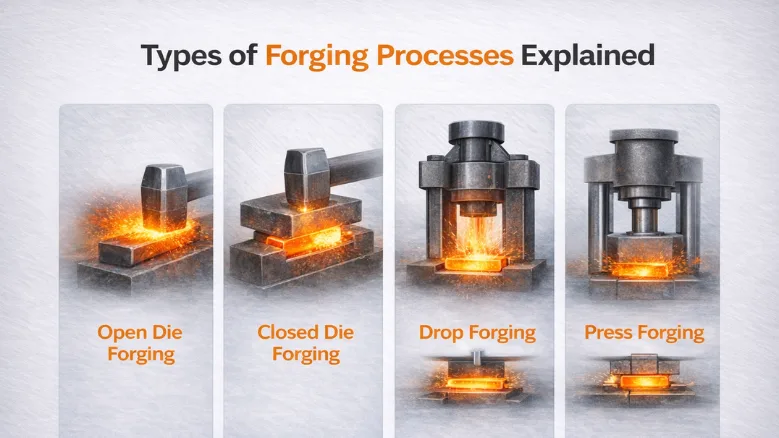
- Types of Forging Processes (Quick Comparison)
- Open Die Forging
- Closed Die Forging
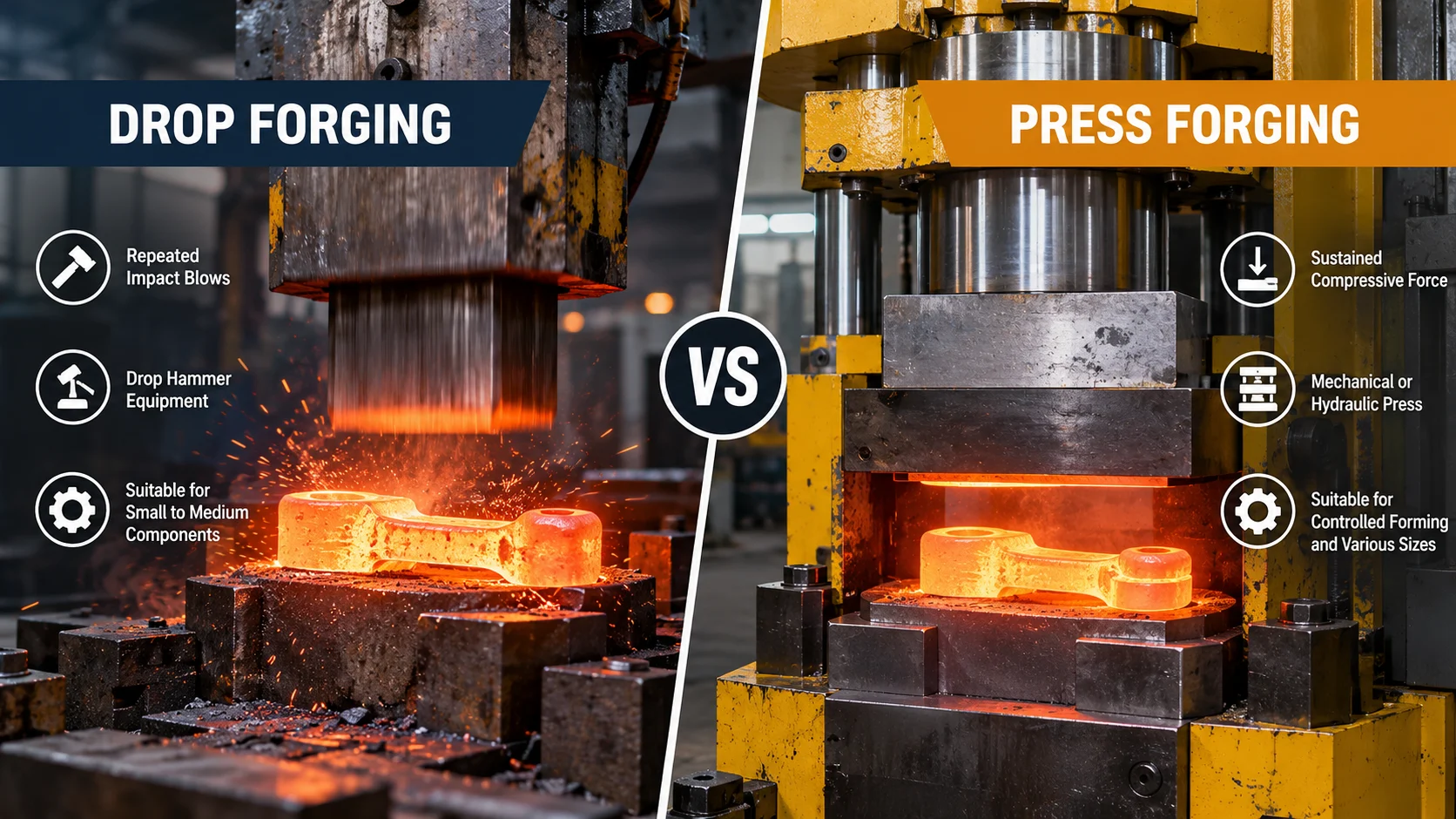
- Drop Forging
- Press Forging
- Which Forging Method Should You Choose?
- Quick Guide to Choose the Forging Process
- Which Industries Use Forging Processes?
- What Are the Industry Standards and Quality Considerations in Forging?
- Conclusion
- FAQs
Forging processes are advanced metal forming techniques that use compressive forces to reshape metal, improving its strength, grain structure, and fatigue resistance. The four main types of forging processes are open die forging, closed die forging, drop forging, and press forging, each designed for specific industrial applications, cost considerations, and production volumes.
What Are Forging Processes?
A forging process is a manufacturing method where metal is shaped using compressive force to improve strength, durability, and structural integrity. It is widely used to produce high-performance components for industrial applications.
Why Forging Is Important in Manufacturing
Forging is critical in modern manufacturing because it improves mechanical strength, reliability, and component lifespan compared to other metal forming methods.
- Aligns grain flow with the part geometry, which increases strength
- Eliminates internal voids that improve reliability
- Enhances fatigue resistance that helps to extend lifespan
This makes forging ideal for high-stress applications in automotive, agriculture, and heavy engineering.
Types of Forging Processes (Quick Comparison)
| Forging Type | Deformation Method | Accuracy | Tooling Cost | Mechanical Strength | Ideal Use Case |
| Open Die Forging | Free deformation | Low | Low | High | Large parts |
| Closed Die Forging | Controlled cavity | Very High | High | Very High | Precision parts |
| Drop Forging | Impact force | Medium | Medium | Very High | Tools & shafts |
| Press Forging | Gradual pressure | High | Medium | High | Complex parts |
Open Die Forging
Open die forging is a process where metal is compressed between flat or simple dies without being fully enclosed, allowing free material flow.
Process Insight
The metal undergoes repeated deformation cycles, during which:
- Grain structure elongates in the direction of force
- Internal porosity is reduced
- Mechanical properties improve significantly
Industrial Applications
- Railway axles
- Turbine shafts
- Large agricultural machinery components
Advantages
- Suitable for very large components (up to several tons)
- Excellent directional strength
- Flexible shaping process
Limitations
- Requires skilled operators
- Secondary machining needed for tight tolerances
Closed Die Forging
Closed die forging shapes metal within precision-engineered dies, producing near-net shape components with high dimensional accuracy.
How It Enhances Material Properties
- Creates uniform grain flow aligned with part geometry
- Minimizes material waste
- Improves repeatability in mass production
Applications
- Gear blanks
- Engine components
- Tractor and harvester parts
Cost vs Value Analysis
While tooling costs are high, the process:
- Reduces machining time
- Ensures consistent quality
- Lowers long-term production cost at scale
Ideal for OEMs and exporters focusing on high-volume production with strict tolerances.
To Understand the Difference Between Open-die forging and Closed-die forging Read: Closed-Die vs Open-Die Forging: Process & Key Differences
Drop Forging
Drop forging uses repeated hammer blows to shape heated metal within a die, producing components with exceptional strength and impact resistance.
Metallurgical Advantage
The repeated impact:
- Refines grain structure
- Increases toughness
- Improves resistance to shock and wear
Typical Applications
- Spanners and hand tools
- Connecting rods
- Heavy-duty fasteners
Why Industries Prefer Drop Forging
- High durability under cyclic loads
- Proven reliability in harsh environments
Press Forging
Press forging applies continuous, controlled pressure to deform metal, allowing deeper penetration and uniform shaping.
Technical Advantage Over Drop Forging
- Better control over deformation rate
- Reduced internal stress gradients
- More uniform mechanical properties
Applications
- Aerospace components
- Precision automotive parts
- Structural fittings
Key Benefit
Ideal for parts requiring dimensional consistency and internal integrity
Which Forging Method Should You Choose?
The best forging process depends on production volume, component complexity, performance requirements, and overall cost efficiency. For manufacturers and exporters, selecting the right method ensures consistent quality, competitive pricing, and compliance with global industry standards.
Based on Production Volume
For low-volume or custom manufacturing, open-die forging is the most practical choice due to its low tooling costs and flexibility. For high-volume production in markets like India, the US, and Europe, closed die and press forging are preferred for their repeatability, faster output, and consistent quality.
Based on Component Complexity
Open die forging works well for simple shapes and large components where precision is not critical. For complex geometries and tight tolerances required in automotive and export-grade parts, closed-die forging provides high accuracy and near-net-shape results.
Based on Performance Requirements
Drop forging is ideal for components that must withstand high impact and heavy loads, making it suitable for tools and heavy machinery parts. Press forging, on the other hand, is better for applications requiring uniform strength, dimensional consistency, and structural reliability.
Based on Cost Efficiency
For short production runs, open die forging helps minimize upfront investment and tooling expenses. For long-term and large-scale manufacturing, closed die forging reduces per-unit cost through better material utilization, less machining, and improved production efficiency.
Quick Guide to Choose the Forging Process
| Requirement | Forging Methods |
| Low volume | Open die forging |
| High volume | Closed die or press forging |
| Simple shapes | Open die forging |
| Complex parts | Closed die forging |
| High impact strength | Drop forging |
| High precision | Press forging |
For global suppliers and OEM manufacturers, choosing the right forging process directly impacts product durability, cost competitiveness, and success in international markets.
Which Industries Use Forging Processes?
Forging processes are used in automotive, agricultural machinery, construction, and aerospace industries to manufacture high-strength, durable, and performance-critical components that operate under extreme conditions.
Automotive Industry
Forging plays a vital role in manufacturing drivetrain and engine components such as crankshafts, connecting rods, and gears. These parts require high fatigue resistance and structural integrity to withstand continuous stress, making forging the preferred method for long-term reliability.
Agricultural Machinery
In the agricultural sector, forging is used to produce heavy-duty components like harvester parts, tractor linkages, and gear systems. These components must endure harsh operating conditions, including heavy loads, soil impact, and continuous usage, making forged parts ideal for durability and performance.
Construction & Infrastructure
Forged components are widely used in construction equipment and infrastructure projects where strength and load-bearing capacity are critical. Parts such as excavator components, lifting equipment, and structural fittings rely on forging for enhanced durability in high-stress environments.
Aerospace Industry
The aerospace industry depends on precision forging for manufacturing safety-critical components such as turbine discs, landing gear parts, and structural fittings. Forging ensures uniform grain structure and high strength-to-weight ratio, which are essential for performance, safety, and regulatory compliance.
What Are the Industry Standards and Quality Considerations in Forging?
Forging quality is ensured through controlled process parameters, material traceability, dimensional accuracy, and compliance with global standards such as ISO and ASTM. These factors help manufacturers meet export requirements, maintain consistency, and build trust with international buyers.
What Are the Key Quality Factors in Forging?
Forging quality depends on strict control of process parameters, material tracking, and inspection systems to ensure consistent performance and compliance.
- Controlled heating and cooling cycles ensure proper grain structure and prevent defects like cracks or distortion.
- Material traceability allows tracking of raw materials from source to finished product, ensuring compliance and accountability.
- Dimensional inspection verifies that components meet precise tolerances required for industrial applications.
Common Standards
- ISO quality management systems
- ASTM material standards
- Heat treatment certifications
Following these standards ensures consistent quality, buyer trust, and international trade compliance.
Conclusion
Forging processes are used to manufacture high-strength, durable components across industries such as automotive, agriculture, construction, and aerospace. The four main types, open die, closed die, drop forging, and press forging, are selected based on production needs, complexity, and performance requirements.
For manufacturers and exporters, choosing the right forging method is not just a technical decision; it directly impacts cost efficiency, product reliability, and global competitiveness.
FAQs
There are four main types of forging processes which include open die forging, closed die forging, drop forging, and press forging.
Drop forging is best for tools because it provides high strength, toughness, and resistance to impact and wear.
Drop forging is a process where heated metal is shaped using repeated hammer blows inside a die to achieve high strength and durability.
Closed die forging has high initial tooling costs but becomes cost-effective for large-scale production due to precision and reduced machining.
Closed die forging and drop forging offer the best durability due to improved grain structure and mechanical strength.
Related Readings
- What Is Forging?
- What Is Hot Forging?
- What Is Cold Forging?
- What Is Warm Forging?
- Hot vs Cold vs Warm Forging: Key Differences Explained
- Closed-Die vs Open-Die Forging: Process & Key Differences
- Grain Structure in Forged vs Cast Metal
- Heat Treatment in Forging and Casting
- Casting Defects vs Forging Defects
- Forging vs Casting Cost Comparison
- What Is Casting?