How JCBL Hand Tools Controls Quality Across Spanner Production
- Why Quality Control Matters in Spanner Manufacturing
- How JCBL Controls Quality Across Spanner Production
- JCBL Spanner Quality Control at a Glance
- How JCBL Maintains Consistency for Bulk Spanner Orders
- What Standards Are Relevant to JCBL Spanners?
- What Should B2B Buyers Check When Evaluating Spanner Quality?
- Why Process-Based Quality Matters to Global Buyers
- Conclusion
- FAQs
For an industrial spanner, quality is not determined by appearance alone. Material quality, forging consistency, heat treatment, dimensional accuracy, and torque performance all influence how reliably a spanner performs under load.
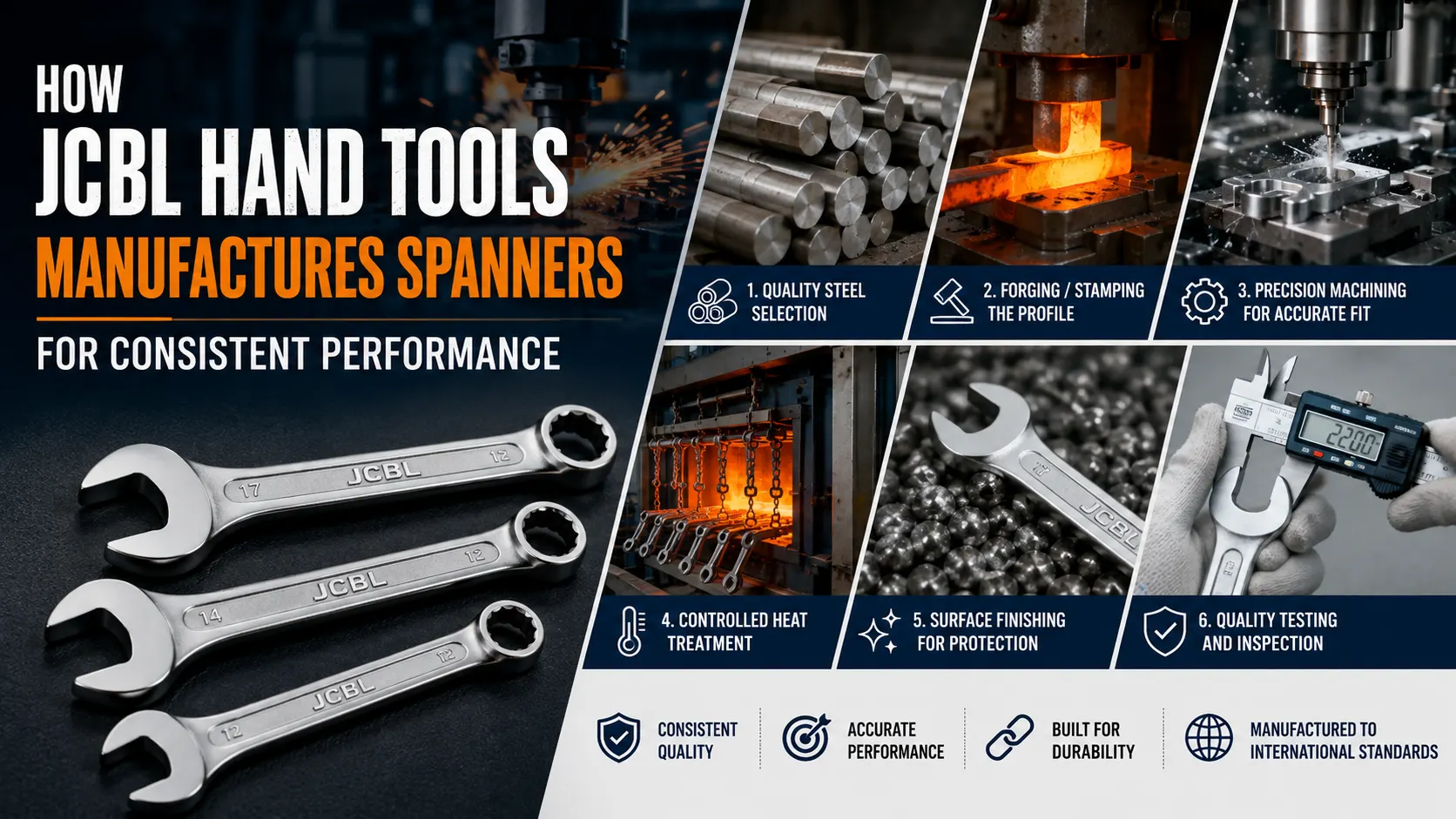
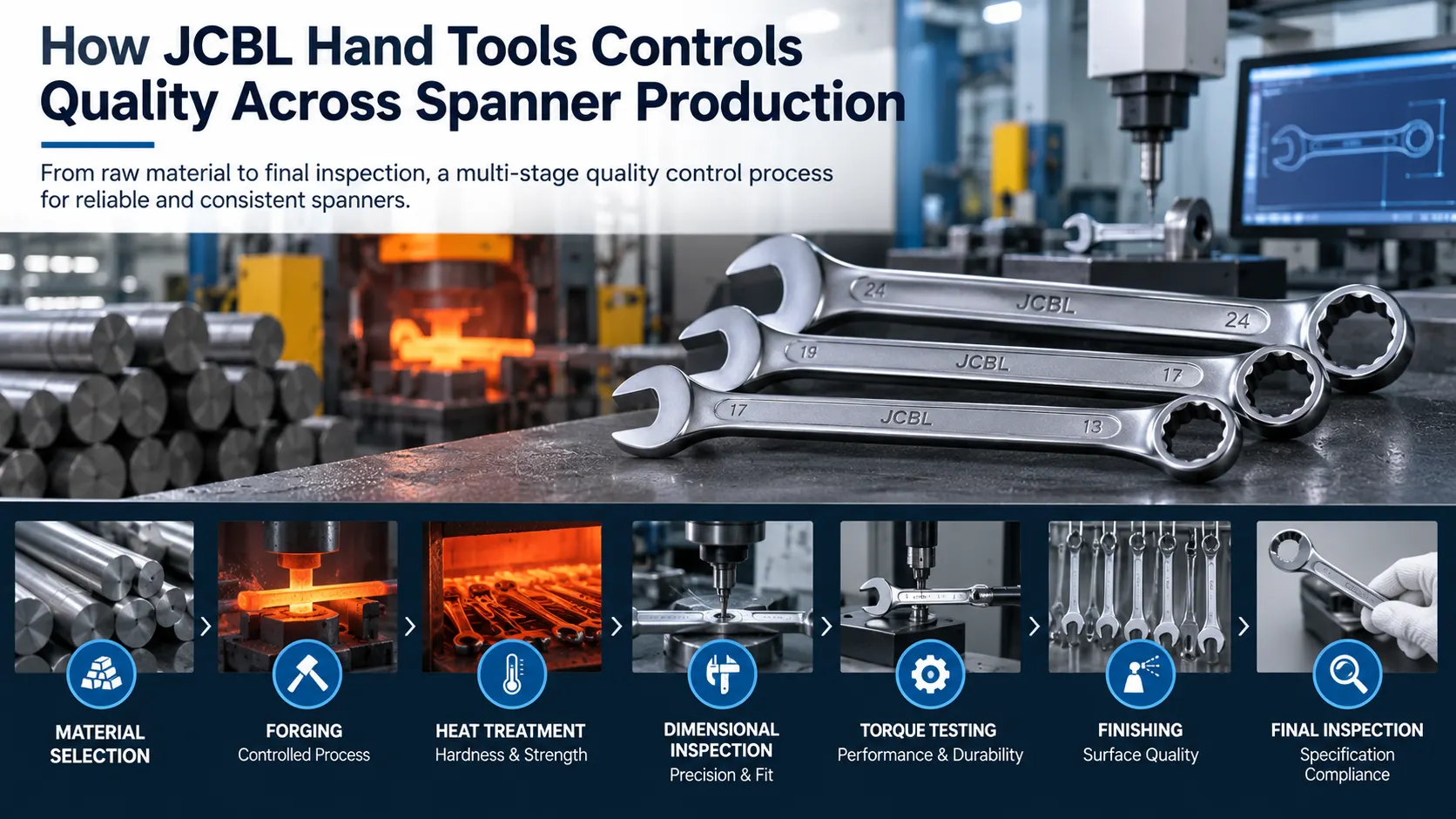
JCBL Hand Tools controls spanner quality through multiple production and inspection stages, from material selection and forging to heat treatment, machining, hardness and torque testing, finishing, and final inspection. This process-based approach helps maintain consistent specifications across individual tools, bulk orders, and repeat production.
For importers, distributors, OEMs, and industrial buyers sourcing from India, understanding these controls provides a practical way to evaluate a spanner manufacturer’s production capabilities.
Why Quality Control Matters in Spanner Manufacturing
A spanner transfers force directly to a fastener. Even small variations in dimensions or material properties can affect fit, strength, and performance.
For B2B buyers, inconsistent quality can result in:
- Poor fastener fit
- Premature tool wear
- Deformation under load
- Batch-to-batch variation
- Product returns
- Difficulty maintaining OEM or private-label specifications
That is why effective spanner quality control must be built into the production process rather than limited to a final visual inspection.
How JCBL Controls Quality Across Spanner Production
JCBL Hand Tools uses a multi-stage approach to quality control, with each stage addressing a different aspect of spanner performance.
1. Material & Forging Control
JCBL manufactures spanners using chrome vanadium (Cr-V) steel and carbon steel, depending on the product specification and application.
Controlled forging and precision tooling help maintain the required shape, geometry, and structural consistency. This is particularly important for bulk production, where the same specifications need to be reproduced across large quantities.
2. Heat Treatment & Hardness
Heat treatment establishes the mechanical properties needed for a durable spanner. The objective is to achieve an appropriate balance of hardness, strength, and toughness rather than simply maximizing hardness.
JCBL uses automated hardening and tempering processes, with hardness testing forming part of its quality-control system. This helps verify that the required material properties are being achieved consistently.
3. Precision & Dimensional Inspection
A spanner needs to fit its intended fastener correctly. JCBL therefore focuses on critical dimensions and working geometry, including features such as opening size, ring profile, head geometry, and thickness.
Dimensional inspection helps reduce variation and supports consistent fit across individual tools and repeat production batches.
4. Torque & Performance Testing
A spanner must withstand force in actual use—not simply meet visual or dimensional requirements.
Torque testing evaluates a spanner’s ability to withstand specified loading without unacceptable deformation or failure. It provides a functional quality check that complements dimensional and hardness testing.
JCBL identifies torque-testing equipment within its quality infrastructure and references applicable DIN and ANSI requirements across its hand-tool range. The exact requirements depend on the individual product specification.
5. Finish & Final Quality Inspection
Finishing is the final stage of the production process, but it is not the only quality check.
JCBL’s inspection process brings together visual, dimensional, performance and finish requirements before dispatch. This final verification helps ensure that the finished batch matches the agreed product specifications and presentation requirements.
JCBL Spanner Quality Control at a Glance
| Production stage | Primary quality focus |
| Material selection | Steel specification |
| Forging | Geometry and structural consistency |
| Heat treatment | Hardness, strength and toughness |
| Machining | Dimensions and fastener fit |
| Performance testing | Torque/load resistance |
| Finishing | Surface quality and appearance |
| Final inspection | Overall specification compliance |
In short, JCBL’s approach is process-driven: quality is checked at the stages where material properties, dimensions, performance and finish are established.
How JCBL Maintains Consistency for Bulk Spanner Orders
For a B2B buyer, producing one good sample is only part of the requirement. The bigger challenge is reproducing the same specification across thousands of tools and subsequent orders.
This is where process control becomes important.
JCBL’s manufacturing operations support requirements for OEM, wholesale and international buyers, where consistency in product specifications can be critical. Depending on the order, buyers may need defined requirements for:
- Material
- Dimensions
- Finish
- Marking and branding
- Packaging
- Applicable standards
- Product-specific testing
For importers and distributors sourcing from India, consistent production can help reduce variation between shipments and maintain predictable specifications across their inventory.
What Standards Are Relevant to JCBL Spanners?
Standards provide buyers with an objective reference when evaluating hand-tool specifications.
JCBL references DIN and ANSI requirements across its hand-tool range, with specific standards applying according to the individual product and its intended specification.
For example, applicable requirements may cover dimensions, design, mechanical performance, or testing.
B2B buyers should confirm the exact standard applicable to the specific spanner they are sourcing rather than assuming that one standard applies across an entire product range.
This distinction is particularly important for OEM and private-label sourcing, where the buyer may have its own technical specifications in addition to an industry standard.
What Should B2B Buyers Check When Evaluating Spanner Quality?
Price is only one part of evaluating an industrial spanner manufacturer. Procurement teams should also consider how the manufacturer controls quality.
A practical checklist includes the following:
- Material specification: Is the appropriate steel grade specified for the product?
- Forging and production control: Are the tool’s geometry and critical dimensions consistently reproduced?
- Heat treatment: Are hardness and mechanical properties verified?
- Dimensional accuracy: Are critical working dimensions inspected for consistent fastener fit?
- Performance testing: Is the finished spanner evaluated for torque or other applicable performance requirements?
- Standards compliance: Can the manufacturer provide the applicable DIN, ANSI or customer-specific requirements?
- Batch consistency: Can the same specification be maintained across repeat and large-volume orders?
- OEM capability: Can product specifications, branding, finishing and packaging requirements be reproduced consistently?
For buyers looking for a quality hand tools manufacturer in India, these factors provide a more meaningful basis for supplier evaluation than price alone.
Why Process-Based Quality Matters to Global Buyers
For international buyers, quality control is ultimately about repeatability.
A spanner manufacturer may produce an excellent individual tool, but B2B procurement requires confidence that the agreed specification can be reproduced across production batches.
A process-based quality system helps address this by controlling the factors that influence the finished product, including material, geometry, heat treatment, dimensions, performance, and finish.
For importers, distributors, OEM brands, and industrial suppliers, this can translate into more predictable sourcing and fewer quality variations across recurring orders.
Conclusion
Spanner quality is built throughout the production process, not added during final inspection. From material selection and controlled forging to heat treatment, dimensional inspection, hardness verification, torque testing, and final quality checks, each stage contributes to the consistency, strength, fit, and performance of the finished tool.
For businesses sourcing spanners from India, consistent process control is essential for reliable bulk procurement, repeat orders, and long-term product performance. JCBL Hand Tools follows a multi-stage quality-control approach designed to maintain consistent spanner production for domestic and international B2B requirements.
FAQs
JCBL controls spanner quality through multiple production and inspection stages, including material selection, forging, heat treatment, machining, dimensional inspection, hardness testing, torque testing, finishing, and final quality checks.
JCBL uses materials including chrome vanadium (Cr-V) steel and carbon steel, depending on the individual spanner specification and application.
Hardness testing helps verify the material properties achieved through heat treatment. It provides a measurable quality check for the consistency of the finished tool’s mechanical properties.
Torque testing evaluates how a spanner performs under applied load. It helps verify that the tool can withstand the specified torque without unacceptable deformation or failure.
JCBL references DIN and ANSI requirements across its hand-tool range. The applicable standard and requirements depend on the specific spanner and product specifications.
Consistency is supported through specification-based production and multiple quality-control stages covering material, geometry, heat treatment, dimensions, performance, and final inspection.
Related Readings:
- Why Choose JCBL Hand Tools for OEM and Bulk Spanner Sourcing?
- What Makes JCBL Hand Tools Different From Other Spanner Manufacturers?
- Why Global Buyers Source Spanners From JCBL Hand Tools?
- How JCBL Hand Tools Manufacture Spanners for Consistent Performance
- How JCBL Hand Tools Test Spanners Before Bulk Supply