How JCBL Hand Tools Manufactures Spanners for Consistent Performance
A spanner may look like a simple hand tool, but its performance depends on much more than its final shape. Material quality, forming method, dimensional accuracy, heat treatment, surface finishing, and testing all influence how consistently a spanner fits fasteners and handles torque.
For distributors, importers, OEMs, and industrial buyers, this manufacturing consistency is particularly important. Every batch needs to meet the agreed specifications, not just the first shipment.
At JCBL Hand Tools, spanners are manufactured in India using controlled production processes, quality inspection, and performance testing, with products manufactured according to applicable international standards.
What Makes a Spanner Perform Consistently?
A consistently performing spanner needs to maintain its intended dimensions, strength, and mechanical properties throughout production.
The main factors are the following:
- Material quality: Determines the tool’s strength and durability.
- Accurate forming: Establishes the required profile and geometry.
- Dimensional control: Helps ensure proper engagement with fasteners.
- Heat treatment: Develops the required hardness and mechanical properties.
- Surface finishing: Provides the specified finish and protection.
- Performance testing: Verifies critical characteristics before dispatch.
For professional hand tools, consistency comes from controlling these factors as a connected manufacturing process rather than relying on final visual inspection alone.
How Are Spanners Manufactured at JCBL Hand Tools?
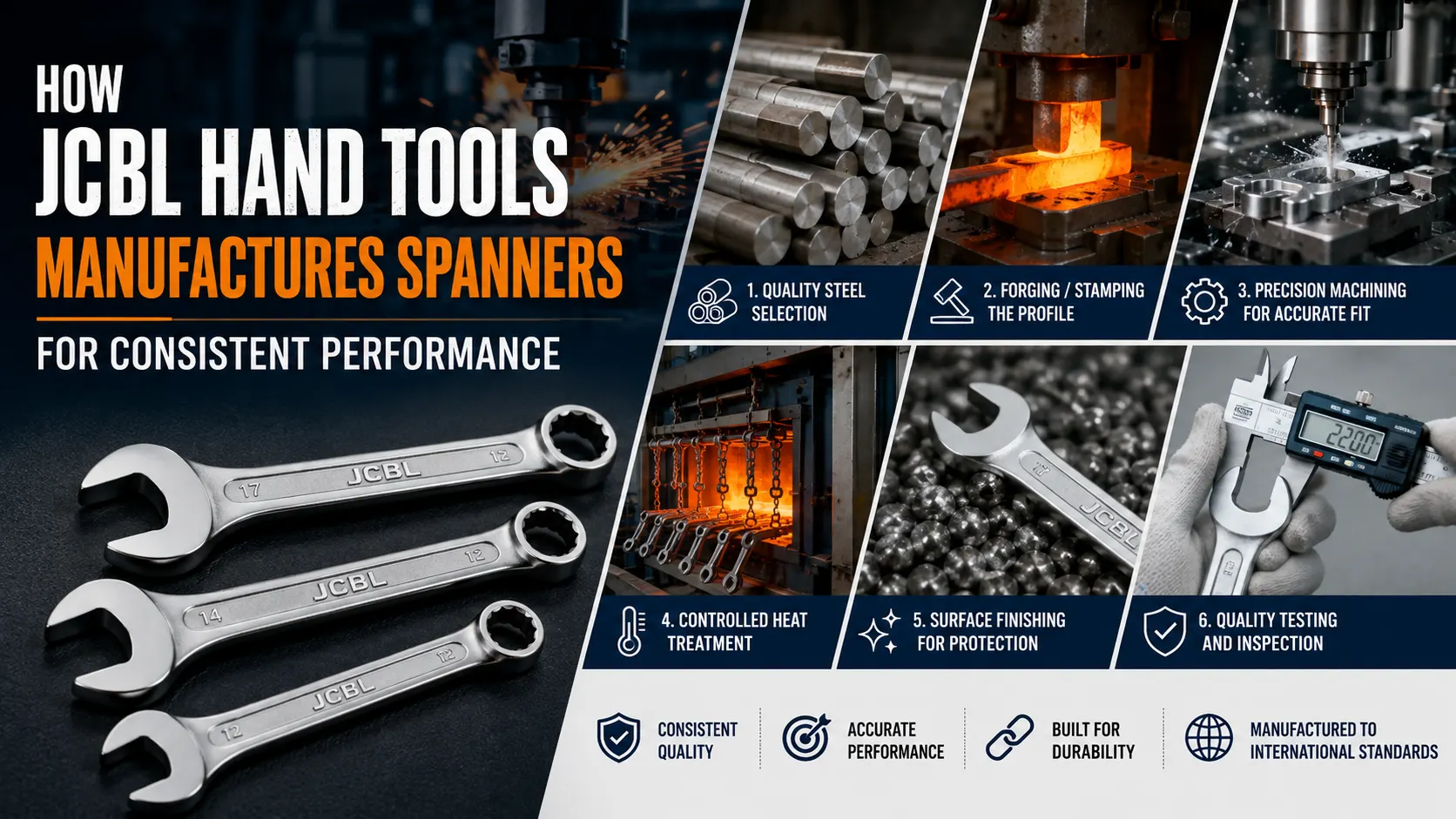
JCBL Hand Tools manufactures spanners through a controlled process that includes steel selection, forming, precision machining, heat treatment, surface finishing, and quality inspection. Each stage is designed to maintain dimensional accuracy, mechanical strength, durability, and consistency across production batches.
1. Selecting the Right Steel
The first step in spanner manufacturing is selecting steel that matches the tool’s design and performance requirements. JCBL manufactures spanners using chrome vanadium (Cr-V) steel and carbon steele, depending on the product specification.
Cr-V steel is commonly used for professional hand tools because of its suitability for applications involving repeated loading and torque. Carbon steel is also used for selected JCBL spanners.
The material choice provides the foundation for the subsequent forming, machining, and heat-treatment processes.
2. Forming the Spanner Profile
After material selection, the steel is formed into the required spanner shape using a manufacturing method suited to the product design. JCBL produces both drop-forged and cold-stamped spanners, with the process varying according to the specific tool.
For example, the JCBL-1010 CR-V combination spanner is cold stamped, followed by hardening and tempering.
The forming stage establishes critical characteristics such as:
- Overall tool profile
- Jaw or ring geometry
- Dimensions and cross-section
- Structural shape
Using the appropriate forming method helps maintain the geometry required for reliable fastener engagement.
3. Precision Machining for Accurate Fit
Forming establishes the basic spanner profile; precision machining refines critical areas to meet the required dimensions and tolerances. JCBL uses CNC machining, CNC-developed dies and fixtures, and dimensional inspection as part of its manufacturing capabilities.
Dimensional accuracy is essential because the working end of a spanner must engage the fastener correctly. Consistent geometry helps provide a predictable fit and reduces variation between individual tools.
For B2B buyers, this dimensional consistency becomes particularly important when sourcing spanners in large volumes, OEM programmes, or repeat orders.
4. Controlled Heat Treatment for Strength and Hardness
Heat treatment gives the steel the mechanical properties required for the finished spanner. JCBL uses controlled hardening and tempering processes and operates a fully automated hardening and tempering plant.
The purpose is to achieve the required balance of hardness and mechanical performance for the specific tool design.
Controlled heat treatment also improves process repeatability, helping maintain consistent properties across production batches rather than relying on uncontrolled treatment conditions.
5. Surface Finishing for Protection and Appearance
The final manufacturing stages include surface finishing to achieve the specified appearance, surface quality, and protection. Depending on the product, JCBL offers finishes such as mirror-polished, satin, matte, zinc, and black.
Surface finishing can:
- Refine the tool’s surface
- Improve its appearance
- Provide corrosion protection where applicable
- Deliver the finish specified for the product
For distributors, OEMs, and private-label buyers, consistent finishing also helps maintain a uniform appearance across an entire spanner range.
How Does JCBL Check Spanner Quality?
Manufacturing consistency requires inspection at more than one stage.
JCBL identifies dimensional inspection, hardness testing, and torque testing as part of its quality-control and performance-testing processes. The company also states that its products undergo batch-wise inspection to maintain uniformity across production.
Dimensional Inspection
Dimensional checks verify that critical measurements remain within the required product specification. This supports consistent fit and finish across production batches.
Hardness Testing
Hardness testing provides a measurable way to verify the material condition achieved through heat treatment. JCBL uses German-made hardness testing equipment as part of its manufacturing infrastructure.
Torque Testing
A spanner is ultimately a torque-transmitting tool, so torque testing is an important performance check. JCBL uses German-made torque testing machines to evaluate tool performance against applicable requirements.
Together, these checks help move quality control beyond appearance and toward measurable manufacturing characteristics.
Which Standards Apply to JCBL Spanners?
Standards provide defined technical benchmarks for the design and performance of hand tools.
JCBL states that its spanners and wrenches are manufactured according to internationally recognised DIN and ANSI standards, with GS-certified products in its range. Individual products can also specify their applicable standard.
For example, JCBL’s cold-stamped CR-V combination spanner JCBL-1010 is manufactured according to DIN 3113, while its double open-end spanner range includes products specified to DIN 3110 or other applicable standards depending on the model.
For buyers, checking the standard against the exact product specification is important rather than assuming that one standard applies to every spanner.
Why Manufacturing Consistency Matters to B2B Buyers
For an individual user, a variation between two tools may not always be obvious. For an importer or industrial distributor purchasing thousands of units, consistency becomes a commercial requirement.
A reliable manufacturing process can help buyers achieve:
- Consistent dimensions across bulk orders
- Predictable product performance
- Fewer quality-related discrepancies
- Uniform finishing across product ranges
- Better repeat-order consistency
- Easier OEM and private-label production
JCBL specifically offers bulk supply, OEM manufacturing, private labelling, customised branding, and export-ready packaging for international buyers.
Why Choose JCBL as a Spanner Manufacturer in India?
JCBL Hand Tools combines manufacturing infrastructure with more than 35 years of hand-tool manufacturing experience. Its capabilities include Cr-V and carbon steel spanners, controlled heat treatment, CNC-based manufacturing, dimensional inspection, hardness and torque testing, and multiple surface-finishing options.
For global distributors, importers and OEM buyers, JCBL also provides bulk and private-label manufacturing solutions. Its export footprint covers markets across the USA, Europe and CIS; Latin America; the Middle East; South Africa; and Australia.
The result is a manufacturing approach focused not simply on producing spanners but on maintaining repeatable specifications throughout production.
Conclusion
Consistent spanner performance begins long before the finished tool reaches a workshop. Material selection, forming, machining, heat treatment, finishing, and performance testing each contribute to the final result.
For B2B buyers sourcing spanners from India, evaluating these manufacturing controls can provide a better indication of supplier reliability than appearance or price alone. With established manufacturing infrastructure, standards-focused production, testing capabilities and OEM/export solutions, JCBL Hand Tools provides a manufacturing platform designed to support consistent spanner supply for domestic and international markets.
FAQs
Spanners are manufactured through a sequence that can include steel selection, forming, machining, heat treatment, finishing and quality inspection. The exact process varies according to the spanner’s material, design and manufacturing specification.
JCBL manufactures its spanners using chrome vanadium (Cr-V) steel and carbon steel, depending on the product. Specific material and construction details should be checked against the individual product specification.
Heat treatment develops the required mechanical properties of the steel. Controlled hardening and tempering help achieve the specified hardness and performance characteristics of the finished spanner.
JCBL uses controlled manufacturing processes supported by dimensional inspection, hardness testing, torque testing and batch-wise quality checks. Its manufacturing facilities also include CNC machinery and automated heat-treatment equipment.
JCBL states that its spanners and wrenches are manufactured according to applicable DIN and ANSI standards, while individual products may identify their specific standard, such as DIN 3113 or DIN 3110.
Yes. JCBL offers OEM and private-label solutions that can include customised branding, product marking, packaging and bulk supply for international buyers.
Related Readings:
- Why Choose JCBL Hand Tools for OEM and Bulk Spanner Sourcing?
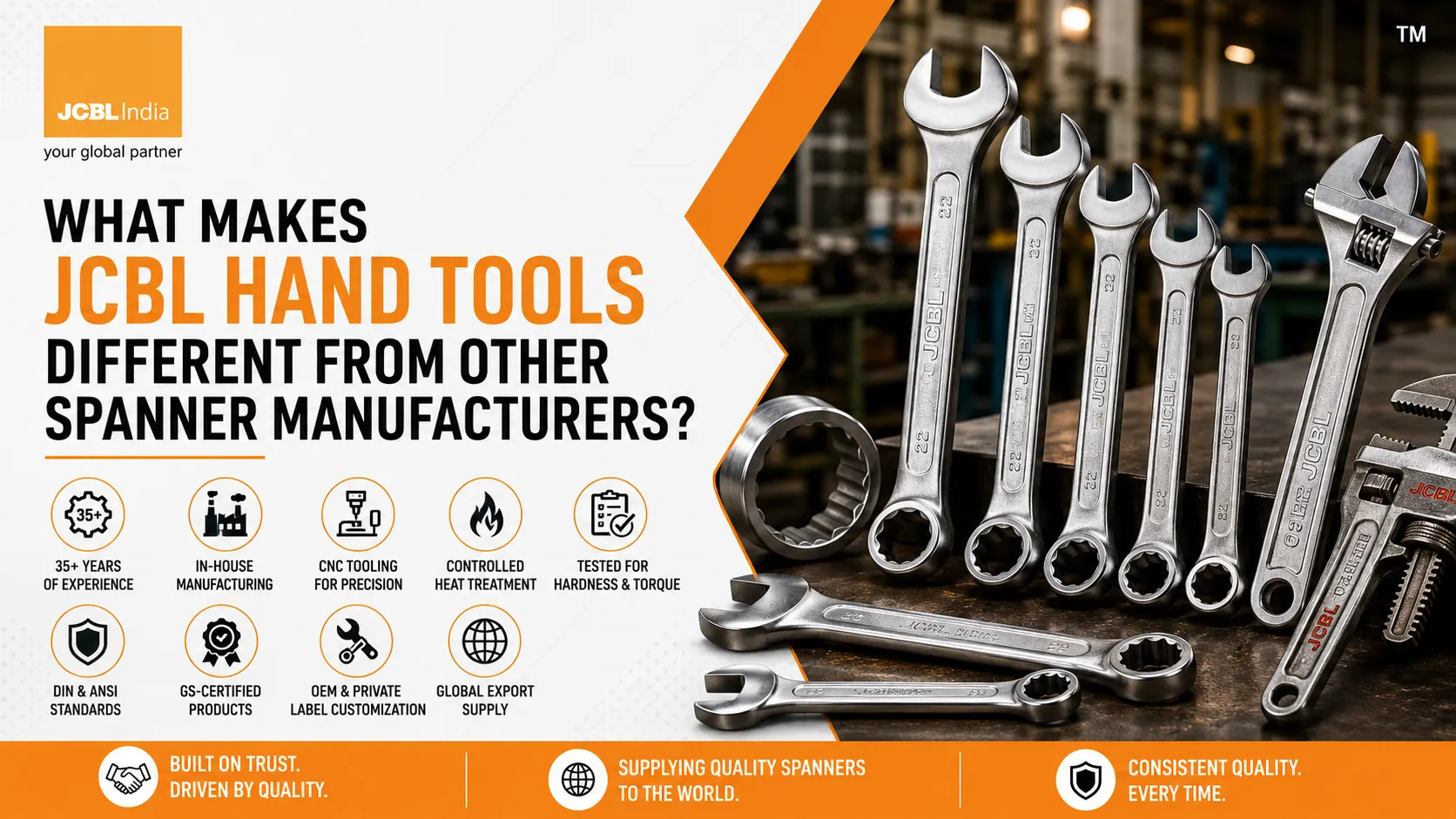
- What Makes JCBL Hand Tools Different From Other Spanner Manufacturers?
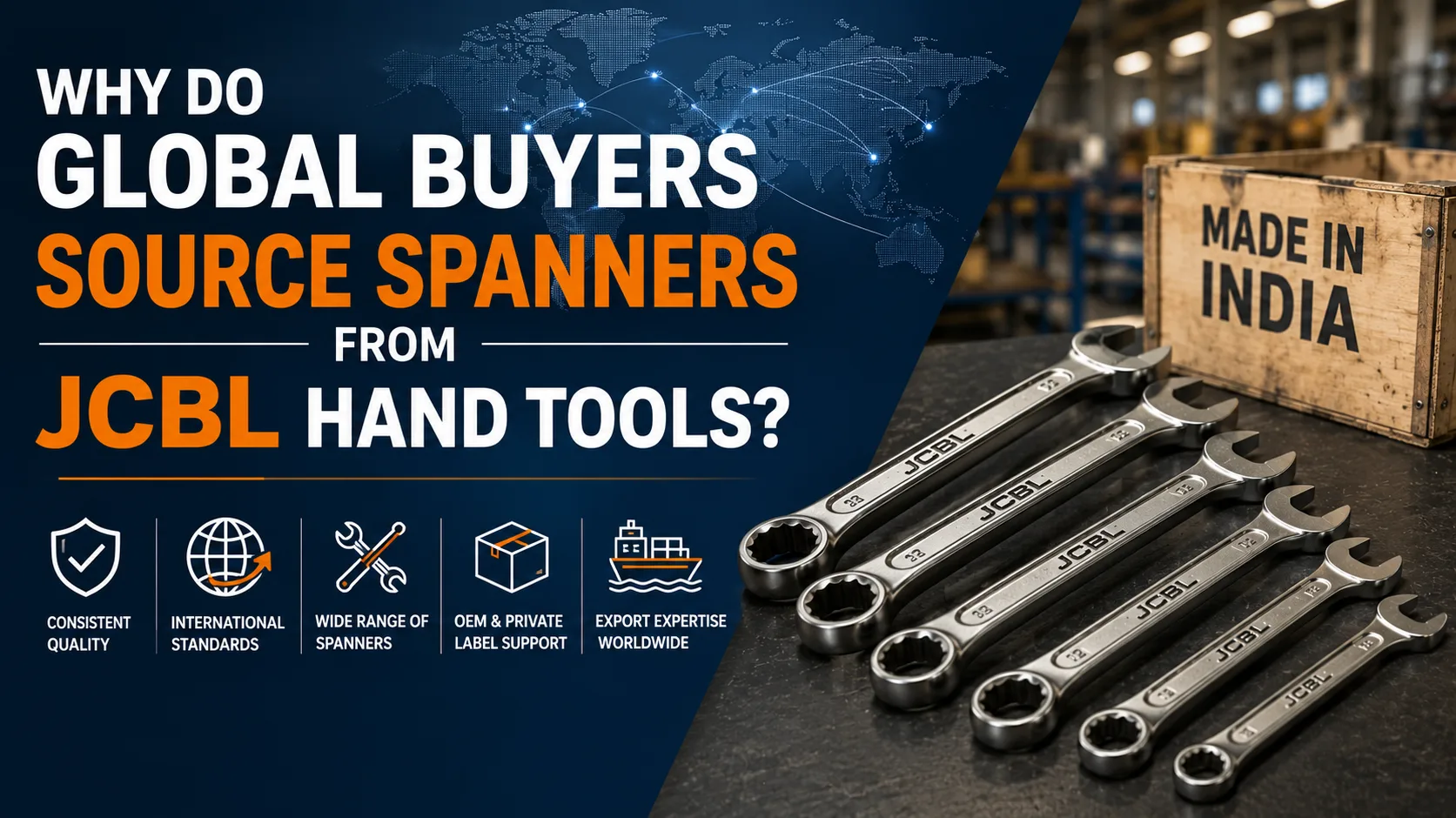
- Why Global Buyers Source Spanners From JCBL Hand Tools?
- How JCBL Hand Tools Controls Quality Across Spanner Production
- How JCBL Hand Tools Test Spanners Before Bulk Supply