What Are DIN and ANSI Standards for Hand Tools? A Complete Guide
- What Are Manufacturing Standards?
- What Are DIN Standards?
- What Are ANSI and ASME Standards?
- DIN vs. ANSI/ASME: Technical Comparison
- Industries That Commonly Use DIN and ANSI Tools
- How Manufacturers Test Standard-Compliant Hand Tools
- Why Standards Matter in Global Trade and Procurement
- How to Verify Compliance Before Sourcing Hand Tools
- Which Standard Should Your Business Prioritize?
- FAQs
- Conclusion
Hand tools are foundational assets across construction, automotive repair, precision manufacturing, and heavy industrial maintenance, where safety and reliability are paramount. To ensure consistent quality, baseline safety, and cross-brand compatibility, reputable manufacturers follow internationally recognized manufacturing standards.
Among the most widely adopted frameworks in the global hardware sector are DIN (European) and ANSI/ASME (American) standards. These documents outline rigorous guidelines for physical dimensions, mechanical testing, and material integrity, establishing an objective benchmark for performance.
What Are DIN and ANSI Standards?
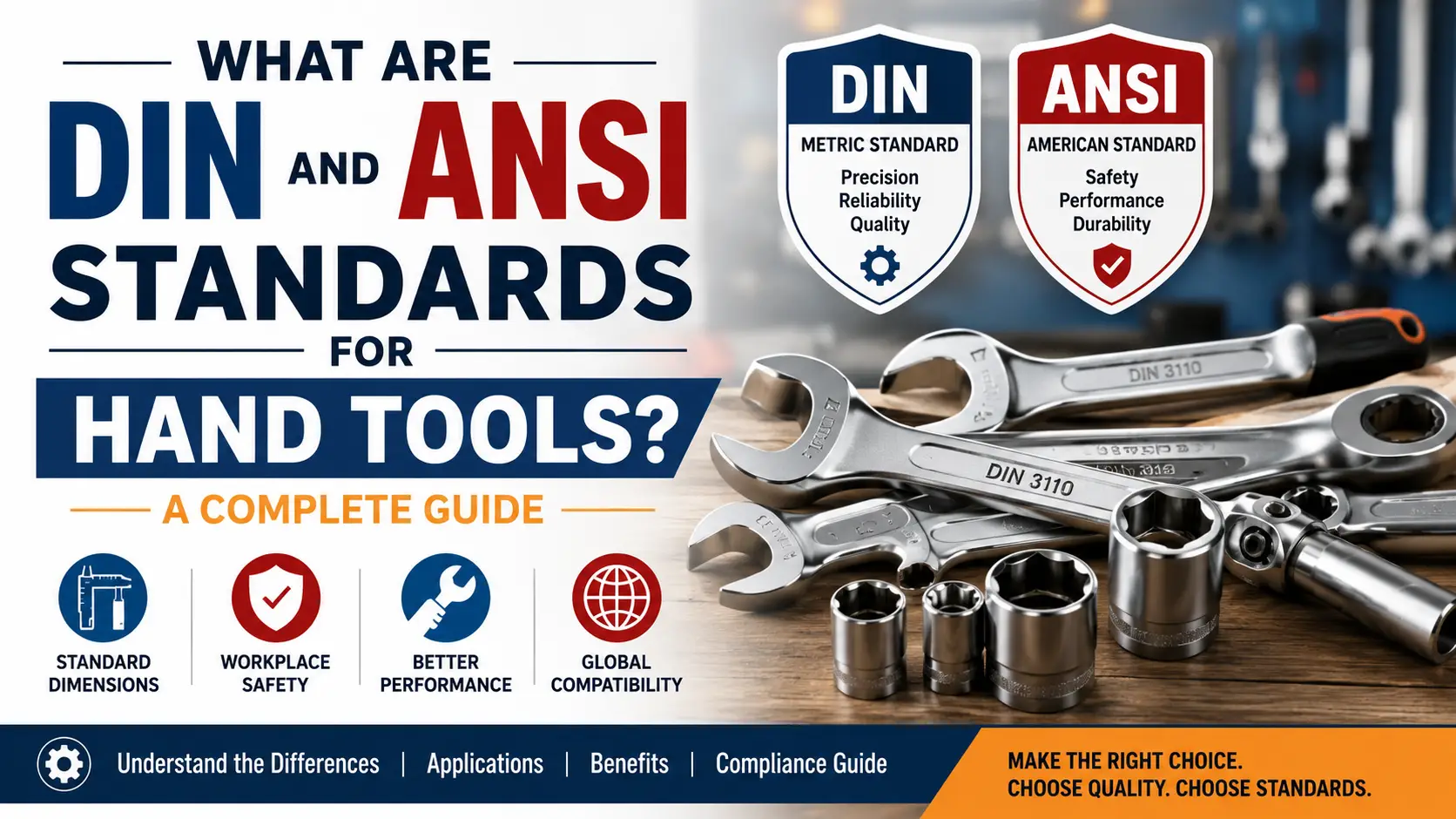
DIN and ANSI standards are internationally recognized technical specifications that define how hand tools should be designed, manufactured, tested, and measured. Developed by respective regional standards organizations, they help ensure consistent quality, workplace safety, dimensional compatibility, and reliable performance across different manufacturers and global export markets.
What Are Manufacturing Standards?
Manufacturing standards are formally documented technical specifications engineered by consensus-based standardization bodies. Rather than permitting varying dimensional frameworks across global production facilities, standards create a uniform technical baseline.
For professional-grade hand tools, these standardized parameters define:
- Dimensional Tolerances: Exact clearances for openings, drives, and lengths to ensure tool-to-fastener compatibility.
- Material Guidelines: Guidance on utilizing appropriate steel structures engineered to withstand mechanical loads.
- Mechanical Properties: Defined torque-load thresholds and performance metrics under static and dynamic stress.
- Surface & Safety Frameworks: Directives on industrial finishing, corrosion resistance, and mandatory permanent product markings for traceability.
What Are DIN Standards?
DIN stands for Deutsches Institut für Normung (the German Institute for Standardization).
History and Evolution of DIN
Founded in 1917 as the Normenausschuss der deutschen Industrie, DIN originally served to streamline German engineering during rapid industrialization. Over the decades, these specifications transitioned from national guidelines into widely adopted industrial standards used throughout Europe and recognized in many international manufacturing and export markets.
How DIN Standards Are Used
In the hand tool sector, tools manufactured to applicable DIN standards are designed to meet the dimensional, performance, and testing requirements specified by those standards. They provide industrial buyers with confidence that tools are manufactured according to established dimensional and performance requirements, helping ensure compatibility with standardized metric fasteners and industrial applications.
Common DIN Standards for Hand Tools
Industrial sourcing teams frequently verify compliance with specific DIN codes depending on the product taxonomy:
| DIN Standard | Common Hand Tool Application |
| DIN 3110 | [Open-End Spanners] (dimensions, jaw openings, and load criteria) |
| DIN 3113 | [Combination Spanners] (form, offset design, and testing) |
| DIN 838 | [Double Ring Spanners] / Double-ended deep offset ring spanners |
| DIN 3117 | [Adjustable Wrenches] / spanners |
| DIN 3124 | [Socket Tools] / Square drive sockets for manual operations |
What Are ANSI and ASME Standards?
ANSI stands for the American National Standards Institute. ANSI itself does not author the specific testing rules for hardware; instead, it accredits standards developed by technical societies.
The Role of ASME in Hand Tool Standards
For the vast majority of commercial and industrial hand tools deployed in North America, the relevant technical specifications are published in the ASME B107 Series (developed by the American Society of Mechanical Engineers). Therefore, when industrial supply chains reference “ANSI tools,” they are generally referring to tools designed in accordance with the ASME B107 Series.
Scope of the ASME B107 Series
Unlike the metric-dominant DIN framework, the ASME B107 series encompasses both fractional/imperial (inch-based) and metric hand tools. This dual-system coverage makes it the critical technical standard for aerospace, military, automotive, and heavy industrial applications across the United States, Canada, and Mexico.
DIN vs. ANSI/ASME: Technical Comparison
While both frameworks strive to deliver maximum product reliability, their regional focus creates distinct operational profiles.
| Structural Aspect | DIN Standards | ANSI / ASME Standards |
| Developed In | Germany | United States |
| Common Markets | Europe, Middle East, Asia | North America (USA, Canada, Mexico) |
| Measurement System | Primarily Metric (mm) | Metric (mm) & Imperial (inch) |
| Typical Applications | Industrial manufacturing, metric systems | Automotive, aerospace, heavy construction |
| Example Standards | DIN 3110, DIN 3113, DIN 838 | ASME B107 Series (e.g., B107.100) |
Industries That Commonly Use DIN and ANSI Tools
Tool adoption trends fluctuate fundamentally along vertical trade specializations, infrastructure standards, and geographical usage sectors.
| Target Industry | Dominant Standard Framework | Core Tool Configurations Deployed |
| Automotive Maintenance | DIN & ASME | Metric combination wrenches, impact sockets, precision pliers |
| Aerospace & Defense | ASME | High-precision imperial socket configurations, calibrated torque drivers |
| Industrial Manufacturing | DIN | Heavy metric spanners, engineering tools, internal hex keys |
| Commercial Construction | DIN & ASME | Structural adjustable spanners, heavy-duty striking wrenches, sockets |
| Oil & Gas Infrastructure | ASME | Striking wrenches, heavy-duty socket tools, structural alignment tools |
| Railways & Transit | DIN | Track wrenches, custom torque devices, heavy metric spanners |
| Heavy Machinery Assembly | DIN & ASME | High-torque industrial drive systems, custom [OEM Hand Tool Manufacturing] parts |
How Manufacturers Test Standard-Compliant Hand Tools
To legitimately stamp a standard code on a tool, production batches must undergo precise quality control protocols and engineering evaluations:
- Dimensional Inspection: Verifying jaw gaps, socket flanks, and wall thicknesses using high-precision gauges to confirm correct clearance.
- Material Verification: Depending on the manufacturer’s processes and customer requirements, material verification may include chemical composition analysis, hardness testing, and other quality control methods. Manufacturers commonly use alloys such as Chrome Vanadium (Cr-V), Chrome Molybdenum (Cr-Mo), or other steels appropriate for the intended application.
- Hardness Testing: Hand tools undergo precise heat-treatment processes to achieve the mechanical properties mandated for their specific product class and material composition.
- Torque Testing: Tools are secured into calibrated hydraulic test beds and subjected to torsional stress to confirm they can withstand forces far exceeding typical manual operation without premature structural failure.
- Corrosion Resistance: Where applicable, manufacturers may perform corrosion resistance testing to evaluate protective surface finishes such as chrome plating or black oxide coatings against corrosion and environmental exposure.
Why Standards Matter in Global Trade and Procurement
For bulk importers, international distributors, and B2B procurement managers, sourcing tools built to recognized standards is a strategic asset rather than just a compliance checkbox.
- Mitigating Procurement Risk: Sourcing products manufactured to uniform global standards minimizes variations across different production lots and suppliers.
- Simplifying OEM Specifications: Standardized specifications make it seamless for global OEMs to source private-label parts that directly align with engineering requirements.
- Easing Supplier Qualification: Many industrial buyers, OEMs, and procurement teams require documentation demonstrating compliance with applicable standards as part of their supplier qualification process.
- Promoting Proper Fastener Engagement: Adherence to standard clearings directly minimizes the risk of tool slippage, helps reduce fastener damage, and improves overall workplace safety metrics.
- Reducing Operational Downtime: Tools manufactured to recognized standards are designed to meet specified strength and performance requirements, helping reduce the likelihood of sudden failure when used correctly, mitigating unexpected maintenance interruptions and costly operational delays.
How to Verify Compliance Before Sourcing Hand Tools
When purchasing tools in bulk for commercial distribution or plant operations, procurement teams should implement an audit process to verify compliance assertions. Do not rely solely on the standard code stamped onto the metal body.
- Request Product Specification Sheets: A comprehensive engineering data sheet must detail the exact technical specifications, dimensional parameters, structural design variances, and target steel grades used in the manufacturing run.
- Evaluate Official Manufacturer Documentation: Legitimate tool producers will provide verifiable documentation validating quality system processes (such as ISO 9001 registration).
- Cross-Reference Technical Catalogues: Review the supplier’s structural drawing books to ensure the clearance ranges, length variances, and dynamic tolerances exactly balance with your application needs.
- Audit Factory Test Reports: High-performance production facilities issue internal metallurgy and destructive torque test reports upon request. These internal lab readouts serve as real performance data metrics for batch validations.
- Examine Product Markings and Traceability: Verified tools display clear, permanent steel roll marks or laser etchings showing the standard number, sizing codes, brand name, and country of origin for complete asset tracking.
- Verify the OEM Compliance Declaration: Request an official, signed declaration statement explicitly detailing compliance with the specific sub-clauses of the target standard (e.g., ASME B107.100 or DIN 3113).
Which Standard Should Your Business Prioritize?
Selecting between DIN and ANSI/ASME protocols is determined by your target end-user demographic, existing equipment profiles, and regional market norms.
Prioritize DIN Specifications If:
- Your primary distribution channels serve European, UK, or metric-centric industrial operations.
- The procurement plan supports infrastructure, assembly lines, or machinery configured entirely around metric dimensions.
- You are bidding on specialized public sector or OEM supply contracts in metric regions.
Prioritize ANSI/ASME Specifications If:
- Your commercial customer base operates inside the United States or North American supply chains.
- The target marketplace depends heavily on fractional/imperial (SAE) socket tools and wrench sizes.
- You are fulfilling tooling contracts for North American automotive service networks, aviation sectors, or military support channels.
Procurement Insight: Some global manufacturers design product ranges to meet different regional requirements depending on customer specifications and export markets, offering flexible inventories for cross-border distributors.
FAQs
Neither standard is inherently superior. Both DIN and ANSI/ASME represent elite tiers of industrial manufacturing quality. The choice depends entirely on your market destination, engineering requirements, and whether the application relies on metric or imperial fastening systems.
Hand tools themselves (like spanners or pliers) operate independently. However, their driving interfaces—such as sockets and wrenches—cannot be mixed interchangeably on fasteners unless the size perfectly crosses over (e.g., 19mm and 3/4 inch are close but not identical). Using a metric DIN tool on an imperial ANSI fastener risks rounding the corners of the nut.
OEM buyers specify DIN or ASME standards to help ensure consistent product performance, dimensional accuracy, and compatibility across suppliers. This simplifies procurement, supports quality assurance, and reduces the risk of variation in critical applications.
Conclusion
DIN and ANSI/ASME standards provide a common technical language that helps manufacturers produce reliable hand tools and enables buyers to compare products with confidence. Rather than evaluating hand tools based on arbitrary branding metrics, these frameworks present objective technical specifications that verify a tool’s capabilities under load.
Whether you’re sourcing tools for industrial maintenance, OEM production, or international distribution, understanding these standards can help you make informed purchasing decisions and select products that meet your performance and market requirements. By anchoring your procurement process in recognized engineering frameworks, your business safeguards both operational safety and long-term supply chain efficiency.
Partner with an Industry Expert
Looking for hand tools manufactured to international quality standards? Explore JCBL Hand Tools‘ range of spanners, wrenches, sockets, and OEM manufacturing solutions designed to meet diverse industry and export market requirements. Contact our team to discuss your sourcing needs.